Attio
7/22/2026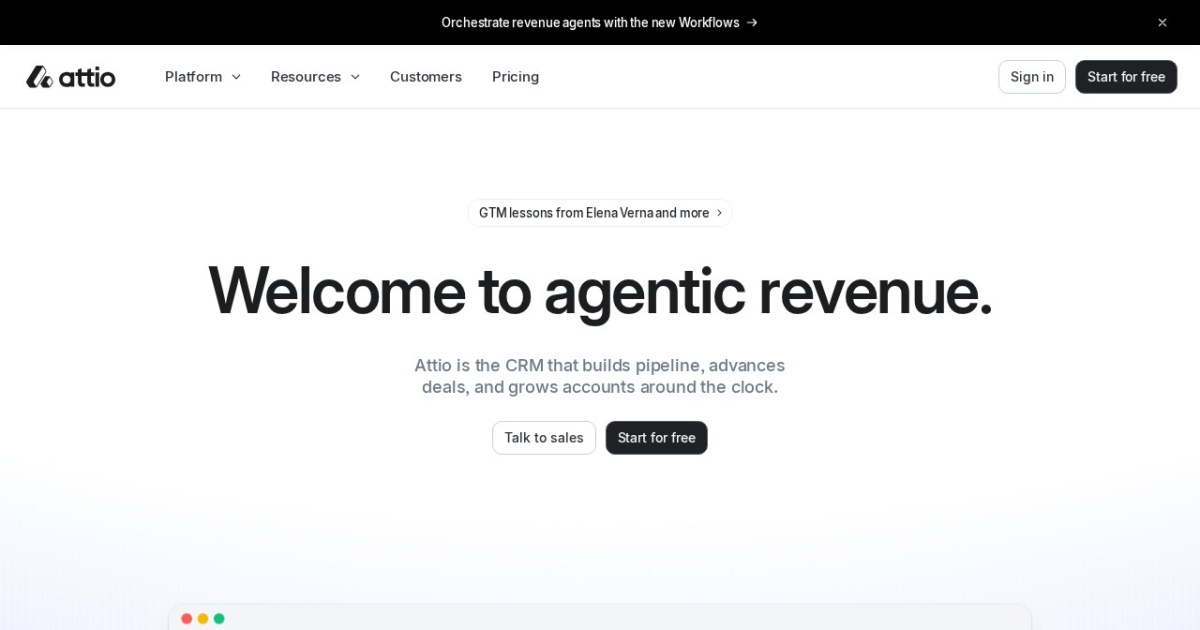
You can clone the homepage in an afternoon; you cannot clone the seven-year, $141M relational-database CRM engine humming underneath it.
The landing page is a weekend build; the AI-native relational CRM data model, integrations ecosystem, and $141M of funded engineering behind it are not.
Not worth cloning as a full product — this is a funded, multi-year CRM platform (backendScore 10, promptsFull effectively infinite) competing in a market Salesforce/HubSpot dominate; a solo prompt-built clone would only ever be a landing-page facade with no real CRM engine behind it. Cloning just the marketing site is trivial but has zero standalone business value.
CRM is a massive, mature market dominated by Salesforce and HubSpot, but Attio has carved a fast-growing niche as a flexible, AI-native CRM for startups/VCs/agencies — reports describe it as the fastest-growing CRM vendor and fourth by adoption, ahead of a declining Pipedrive.
$500–5,000+ (scales with users; DB hosting, AI/LLM inference costs, enrichment API costs, email/calling infra)
Attio itself runs on Attio offers a Free plan, Plus at $29/user/month billed annually, Pro at $69/user/month billed annually, and Enterprise with custom pricing per-seat SaaS pricing; a clone could copy this model but would need real differentiation (data, integrations, AI quality) to win paying seats against entrenched incumbents.
Salesforce, HubSpot, Pipedrive, Affinity, folk, Clay, Airtable, Copper, Zoho CRM
Per-seat SaaS: Attio's paid plans are $29/seat/month (Plus) and $69/seat/month (Pro) billed annually, or $36 and $86 respectively billed monthly, plus custom Enterprise pricing and usage-based AI/enrichment credits.
Backed by $141M in funding from investors like Redpoint Ventures, Balderton Capital and Point Nine; growing fast in CRM adoption rankings per third-party trackers, though still a small fraction of the overall CRM market (~0.02% share reported by one estimator).
- Highly regulated adjacent space (payment/customer data, GDPR for EU users)
- Crowded incumbents (Salesforce/HubSpot) with massive distribution and switching-cost moats
- Trademark/brand — 'Attio' name and product identity
- Any real clone needs its own data-enrichment/partner integrations, which are commercial agreements, not code
Next.js (App Router) + Postgres/Supabase for the relational object model + Auth.js/Clerk for auth + Temporal or a custom job queue for automations/sequences + OpenAI/Anthropic API for the AI layer + Twilio for call intelligence + Stripe for billing
Vercel's Next.js SaaS Starter or the Supabase Next.js template, plus a headless data-table library (e.g. TanStack Table) as the record-grid foundation
- 1.Rebuild the marketing site first: hero, platform sub-pages (/workflows, /ask, /ai, /data), pricing, logo wall — pure Next.js + Tailwind, no backend needed
- 2.Design a flexible entity/attribute schema (objects, records, custom attributes) in Postgres to mimic Attio's data model
- 3.Build core CRUD CRM: contacts/companies/deals as dynamic objects with custom fields, list/board/table views
- 4.Add auth + multi-tenant workspaces + roles/permissions
- 5.Layer in an automation/workflow engine (trigger-condition-action) using a queue (BullMQ/Temporal)
- 6.Integrate an LLM for the 'Ask' natural-language query feature and for AI-enrichment of records
- 7.Add call intelligence (Twilio/Aircall webhook + transcription + LLM summarization) and outbound sequences (email API + scheduling)
- 8.Wire up Stripe billing with seat-based tiers mirroring Free/Plus/Pro/Enterprise
▸Technical evidencefacade · hidden · 1 signals · DR 75ShowHide
A prompt can nail the marketing shell: Next.js hero sections, animated product screenshots/illustrations for "Workflows", "Ask", "AI", pricing tables, and the logo/testimonial carousels.
Behind the site is a full multi-tenant relational CRM database engine with custom objects/attributes, real-time collaborative record editing, an AI layer ("Ask Attio", enrichment, call intelligence transcription), workflow/automation and sequence engines, native calling integration, third-party data enrichment pipelines, plus support (Intercom/Pylon-style), analytics, CMS, and CRM-marketing backends of its own — none of which are visible in the HTML.
You could build it — but that moat means you can't win. Find a better bet.
Analyze a different idea →