Sentry.io
7/25/2026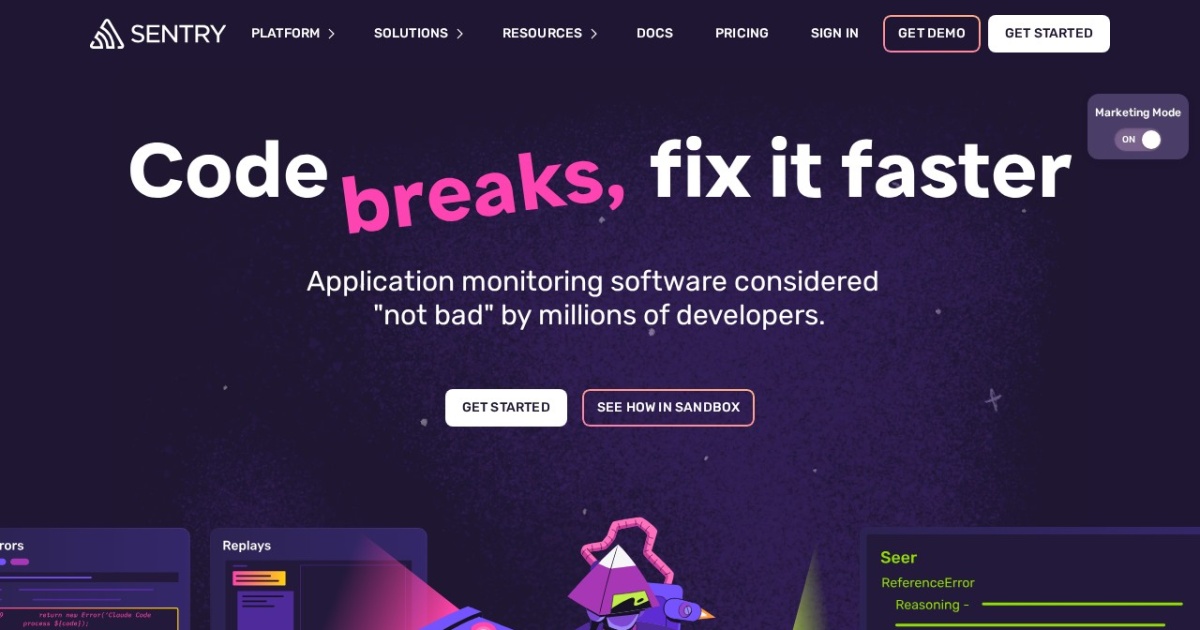
You can clone the homepage in an afternoon; you cannot clone a decade-old, 4-million-developer error-monitoring platform that ingests billions of events a day.
The homepage is a weekend build; the 802,000+ active domains, 4M developers, $128M revenue, and near-80% category market share are not.
Not worth cloning as a real competitor — the market is dominated by an incumbent with near-monopoly share, deep integrations, and an open-source moat that already gives away the core product; a marketing-page clone has zero standalone value without the ingestion backend, which is a multi-year, capital-intensive build.
Massive and growing: error/APM monitoring is a category Sentry effectively created and now dominates, reporting roughly $128M in annual revenue, 130,000+ organizations, and 4 million developers on its platform, with an estimated 77.7% share of the error monitoring market, nearly 5x its closest competitor New Relic.
$0–20 for a static landing clone; realistically $50k+/mo at even modest scale to run an actual ingestion/storage pipeline (Kafka/ClickHouse/Snuba-style infra, storage, alerting workers) if attempting the real product
A landing-page clone earns nothing on its own — there's no product behind it. Sentry itself monetizes via pricing structured around three primary dimensions: plan tier (Developer, Team, or Business), event volume, and team size, using a consumption-based model where costs scale with events generated, a pricing/business model that took years of infra work to support profitably.
Bugsnag, Rollbar, TrackJS, Datadog, New Relic, LogRocket, Raygun, PostHog, Dynatrace
Freemium consumption-based SaaS: Sentry pricing: Developer free (5K events), Team $26/mo (50K events), Business $80/mo (100K events), plus custom Enterprise pricing and pay-as-you-go overage fees per event.
Very large and still expanding — Sentry grew from a handful of early detections in 2013 to over 802,000 active domains by mid-2025, though growth peaked at 754,757 active domains in April 2025 before pulling back to 649,036 by July.
- Trademark/brand infringement if cloning Sentry branding
- Core product is already open source (getsentry/sentry) — competing commercially means competing with the vendor's own free self-hosted offering
- Any real error-ingestion clone requires handling customer application data/PII, raising data-privacy/compliance exposure (GDPR/CCPA)
Astro (static marketing site) + Tailwind for the landing page; if attempting the real product: Next.js dashboard + ClickHouse/Kafka for event ingestion + Postgres for org/user data + Auth0/Clerk for auth + Stripe for metered billing + Vercel/GCP for hosting
Astro Starter Kit (for the landing page) or open-source getsentry/self-hosted repo (for the actual product, since Sentry itself is open source)
- 1.Fork Astro starter, rebuild hero/nav/pricing/feature-grid sections from the crawled HTML
- 2.Wire signup form to a stub API route and plug in Plausible or PostHog for analytics
- 3.For a real MVP: stand up an ingestion endpoint (SDK -> HTTP -> queue -> ClickHouse) to capture errors, mirroring Sentry's own open-source 'Relay' ingestion service
- 4.Build a minimal issues dashboard (list, group, resolve errors) backed by Postgres/ClickHouse
- 5.Add Stripe metered billing keyed to event volume to mimic Sentry's consumption pricing
- 6.Integrate Slack/GitHub webhooks for alerting to match table-stakes features
- 7.Deploy, then realize you're rebuilding an open-source project (github.com/getsentry/sentry) that already exists — fork that instead of starting from scratch
▸Technical evidencefacade · hidden · 7 signals · DR 90ShowHide
A prompt can replicate the Astro-based marketing homepage: hero copy, feature grids, pricing cards, testimonial logos, and a signup CTA form wired to a fake endpoint.
Behind the marketing shell sits a planet-scale event-ingestion and processing pipeline (error/crash capture, distributed tracing, session replay, profiling), a multi-tenant data store handling billions of events/day, SDKs for 30+ languages, alerting/integration engine (Slack, PagerDuty, GitHub, Jira), billing/metering system, and an open-source self-hosted variant — none of which is visible in the crawled HTML/JS.
You could build it — but that moat means you can't win. Find a better bet.
Analyze a different idea →