Substack
7/15/2026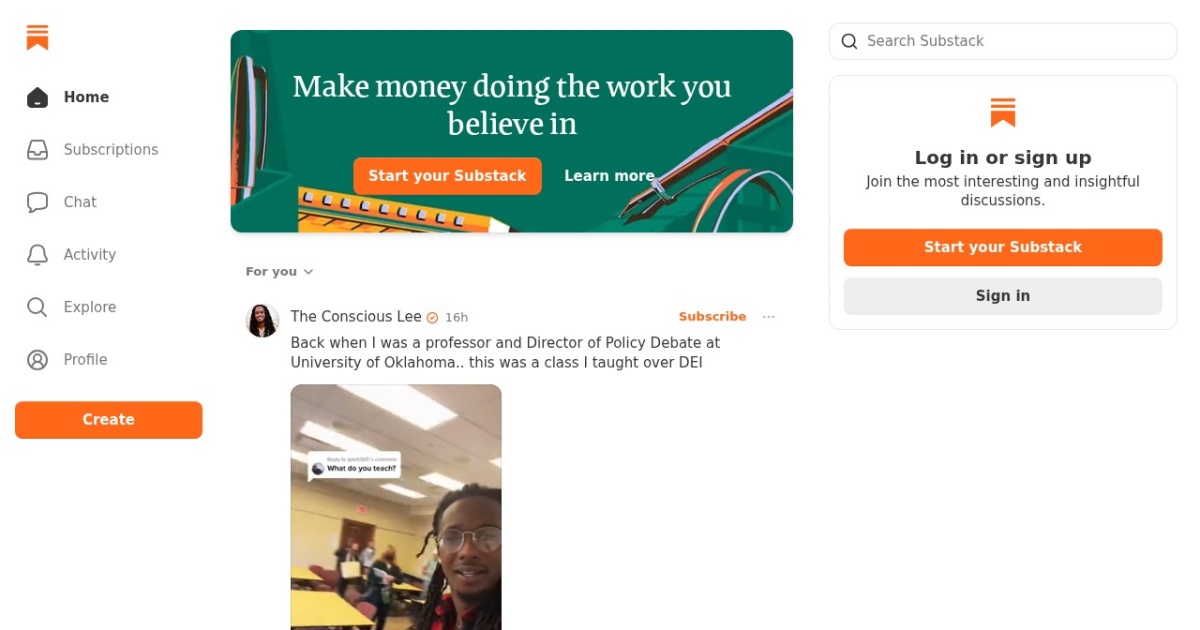
You can prompt your way to a pretty Substack-shaped homepage in an afternoon, but you'd need a small engineering org and years to rebuild the email, payments, and creator-payout machinery actually running underneath it.
You can clone the homepage in a weekend, but not the 5M paying subscribers, 100K monetizing writers, and the email deliverability reputation built over 8 years.
Not worth attempting a full clone — the visible site is trivial to prompt, but the actual business (payments, deliverability, discovery network, app) requires years of engineering and a chicken-and-egg audience Substack already owns; better to build a narrow niche newsletter tool than compete head-on.
Newsletter/creator-subscription publishing is large and growing fast — Substack itself is valued at $1.1B after a $100M Series C, with over 5 million paid subscriptions and $450M in gross writer revenue in 2025.
$5–50k+ (email delivery infra, video/audio hosting/transcoding, Stripe fees, CDN, observability, support tooling) — scales sharply with subscriber/email volume
Real revenue only comes from taking a cut (Substack uses 10%) of paid subscriptions passing through the platform, which requires reaching real creator/reader scale — a clone with zero users generates $0 and must out-compete an incumbent with a huge distribution/discovery moat and lower switching incentive for writers already earning there.
Beehiiv","Ghost","Medium","Patreon","ConvertKit","ManyChat
Freemium platform — free to publish, Substack takes a 10% cut of all paid subscription revenue flowing through the platform; optional add-ons like in-app purchases (Apple IAP) and emerging sponsorship/brand-deal facilitation.
~120M+ monthly visits to substack.com and growing (per Semrush, June 2026), with the broader ecosystem (custom domains) estimated near 169M monthly visitors; 5M+ paid subscriptions, up from 2M in 2023.
- Regulated payments/money transmission (handling payouts to hundreds of thousands of creators), content moderation/liability exposure, trademark on "Substack" brand/name, competitive incumbents with huge lock-in (writer email lists), Apple IAP policy compliance
Next.js (marketing + reader pages) + Node/Postgres backend + Stripe Connect (payments/payouts) + Postmark/SendGrid (transactional+bulk email) + S3/Mux (video/audio hosting) + Auth.js or Clerk (auth) + Vercel/AWS hosting
Vercel's Next.js SaaS starter or a Ghost/Postal open-source newsletter starter as a payments+email backbone
- 1.Fork a Next.js marketing template for the homepage/explore/about pages and match Substack's typography/layout with a prompt
- 2.Stand up Postgres schema for publications, posts, subscribers, and tiers; wire Clerk/Auth.js for creator + reader auth
- 3.Integrate Stripe Connect so each writer can onboard and receive payouts minus a platform take-rate
- 4.Build a rich-text/markdown post editor and a transactional email pipeline (Postmark/SendGrid) with unsubscribe/bounce handling
- 5.Add a recommendation/discovery feed (collaborative filtering or simple tag-based matching) to replace Substack's Explore/Notes engine
- 6.Layer in Mux or Cloudflare Stream for podcast/video hosting, plus Sentry/Datadog for observability
- 7.Ship a bare React Native or PWA reader app once the web core is stable
▸Technical evidencefacade · hidden · 1 signalsShowHide
A prompt can quickly clone the marketing homepage, /explore grid, /about page and basic responsive layout with stock fonts/imagery — it's mostly server-rendered React with standard marketing copy and image cards.
Behind the facade sits a full publishing platform: a CMS/editor, mass email delivery at scale (deliverability, bounce handling, DKIM/SPF), Stripe Connect-style payment splitting and payouts to hundreds of thousands of writers, subscriber/CRM databases, a recommendation/discovery engine, native iOS/Android apps with in-app purchases, podcast/video hosting and transcoding, comment/Notes social graph, and enterprise-grade observability (Sentry, Datadog RUM, Cloudflare) plus support tooling (Intercom/Zendesk).
You could build it — but that moat means you can't win. Find a better bet.
Analyze a different idea →