Notion
7/11/2026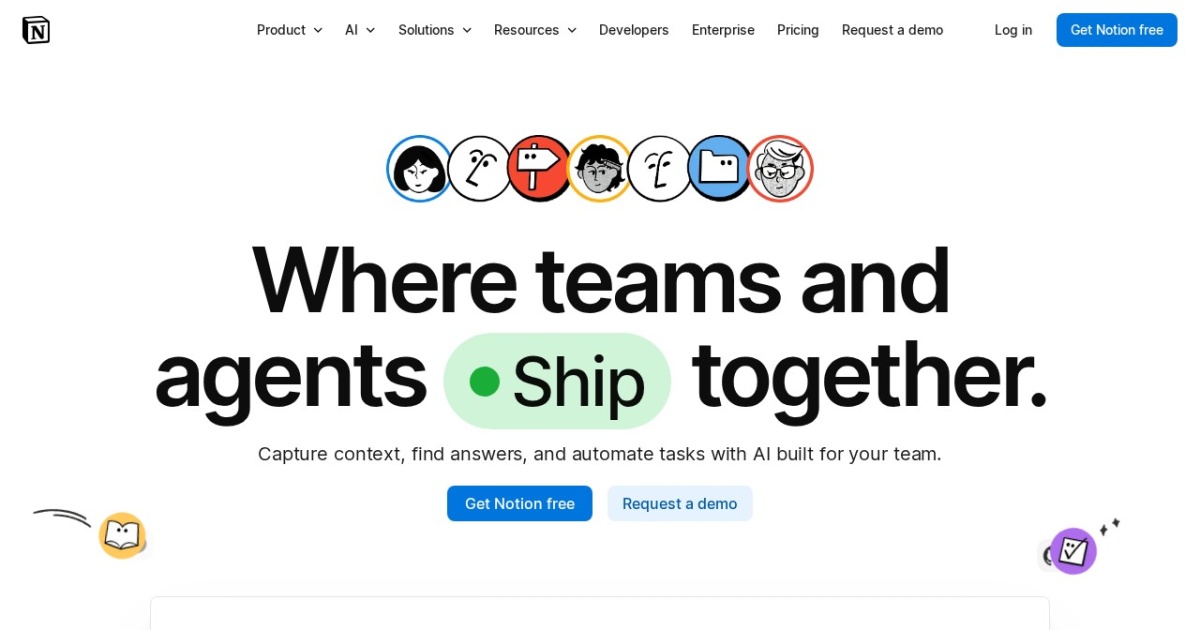
You can clone the billboard in an afternoon; the actual $11B product behind it is a decade of distributed-systems engineering a prompt will never touch.
You can clone the landing page in a weekend, but not 100M users, 4M paying customers, a 12-year data moat, and a real-time sync engine battle-tested at global scale.
Cloning the landing page is trivial and worthless on its own; cloning the actual product is a multi-year, multi-million-dollar engineering effort competing against an entrenched incumbent, so this is only "worth it" if you're targeting a narrow underserved niche (privacy-first, offline-first, vertical workspace) rather than a head-on Notion clone.
Productivity/workspace software is a massive, still-growing market (Notion itself sits inside a >$50B category dominated by Microsoft/Google) and Notion is reportedly near a $10-11B+ valuation with ~$600M ARR and 100M+ users, showing huge continued demand for "all-in-one workspace" tools.
$20–150 for a clone of just the marketing site (Vercel + CMS + CDN); a real Notion-like product with sync engine, DB, and AI would run $2k–20k+/mo at even modest scale (compute, storage, vector/AI inference, CDN).
The marketing site alone makes no money; a real clone would need to monetize via freemium subscriptions like Notion/Coda/ClickUp, but competing against an entrenched $11B incumbent with 100M users and massive brand recognition makes unit economics brutal without a differentiated wedge (e.g., vertical-specific workspace, local-first/offline, or privacy-first positioning like Anytype/AFFiNE).
ClickUp, Coda, Airtable, Confluence, Slite, AFFiNE, Anytype, AppFlowy, Craft, Monday.com
Next.js (App Router) + Supabase/Postgres (auth, DB, realtime via logical replication) + Yjs/Liveblocks for CRDT-based collaborative editing + Stripe for billing + Vercel hosting + Algolia/Meilisearch for search + Contentful for the marketing CMS
Vercel's 'Platforms Starter Kit' or 'Next.js SaaS Starter' for the shell, plus 'Liveblocks Notion-clone example' or 'BlockSuite/AFFiNE' open-source repo for the actual block-editor + realtime sync engine
- 1.Fork a Next.js marketing template and rebuild the /product, /product/calendar, /product/mail pages with static content + Framer Motion for the interactive product-tour animations
- 2.Stand up Supabase (Postgres + Auth) for user accounts, workspaces, and page/block schema (parent-child tree + JSON properties for the database views)
- 3.Integrate Yjs or Liveblocks with a websocket relay for real-time multiplayer block editing, presence, and cursors — this is the hardest, highest-value chunk
- 4.Add a permissions layer (row-level security policies per workspace/page) and a share-link system with public page rendering
- 5.Wire Stripe for tiered billing (Free/Plus/Business/Enterprise) and build an admin/enterprise console stub (SSO/SCIM can be mocked initially)
- 6.Bolt on an AI layer (OpenAI/Anthropic API) for AI-assisted writing and a RAG-based 'enterprise search' feature over indexed workspace content
- 7.Deploy on Vercel, add Sentry for observability and a headless CMS (Contentful) for the marketing pages to match the detected backend signals
▸Technical evidencefacade · hidden · 1 signalsShowHide
A prompt can spin up the Next.js marketing site — hero copy, product-tour pages (/product, /product/calendar, /product/mail, /product/ai), pricing tables, and localized routing/SEO metadata — in an afternoon of iteration.
Behind the marketing shell sits Notion's actual product: a real-time collaborative block-based document engine with operational-transform/CRDT sync, a custom database engine supporting relations/rollups/views, granular permissions and sharing, a public API, third-party integrations (Slack, Google, Jira), an AI/agent layer, enterprise SSO/SCIM/audit logs, and a CMS/CRM/observability stack behind the site itself (Contentful-style asset hosting, Sentry, marketing CMS).
You could build it — but that moat means you can't win. Find a better bet.
Analyze a different idea →