Netlify
7/31/2026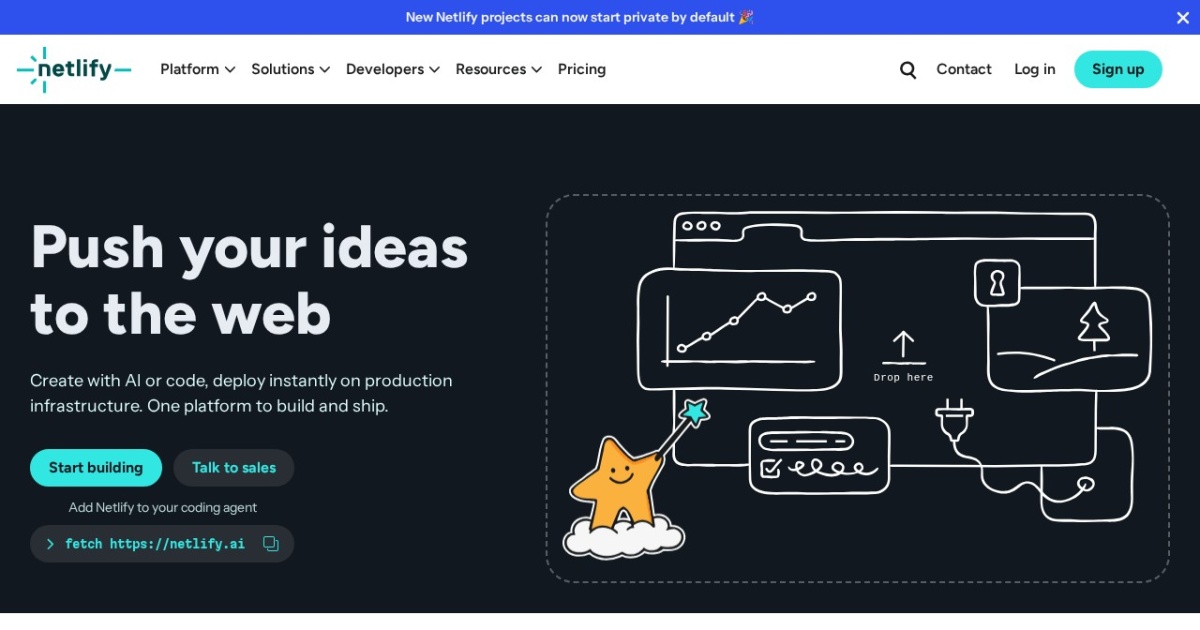
You can clone the homepage in an afternoon; you cannot clone the global build-and-deploy cloud running underneath it in a lifetime of prompting.
The landing page is a weekend clone; the multi-region build/edge infrastructure, 121k+ company customer base, and 12-year developer-trust brand are not.
Not worth cloning as a business — the visible site is trivial to fake but the real product is a globally distributed cloud platform that took a well-funded team over a decade to build; at best this is a portfolio/landing-page exercise, not a viable competitor.
Cloud/JAMstack hosting is a large, mature, fiercely competitive market. Netlify itself reportedly generated roughly $150M in revenue with a ~$2B valuation, but faces intense competition and single-digit CDN market share against giants.
$5,000+ (even a bare-bones global CDN + build farm + functions runtime clone requires substantial multi-region infra, not a $20/mo Vercel/Supabase stack)
A cloned landing page alone earns nothing; monetizing would require actually building the deploy/CDN/functions backend, competing against entrenched platforms with better economics and years of infra investment — a losing proposition for a solo cloner.
Vercel, Cloudflare Pages, AWS Amplify, Render, Railway, Heroku, DigitalOcean App Platform, GitHub Pages
Freemium SaaS: free tier plus credit-based usage pricing — Personal ~$9/mo, Pro ~$20/mo flat (unlimited seats as of April 2026), custom Enterprise contracts with volume/bandwidth commitments.
Large and established — used by 121,000+ companies for CDN alone per market-share trackers; traffic/usage roughly flat-to-growing amid intensifying competition from Vercel and Cloudflare.
- Trademark/brand infringement if cloning name/logo
- Competing in a capital-intensive infra market against well-funded incumbents
- Any real functions/build backend would require substantial compliance (data residency, security certifications) to be enterprise-credible
Astro (matching their real stack) + Vercel/Netlify hosting for the clone itself + HubSpot forms embed + Tailwind/CSS variables for design tokens
Astro official 'basics' starter or the 'Astro Marketing Site' template
- 1.Scaffold Astro project with view-transitions and component-based page sections mirroring hero/platform/pricing pages
- 2.Rebuild design tokens (CSS custom properties for spacing/color) and reusable PageSection component seen in the crawled CSS
- 3.Embed HubSpot form script (js.hsforms.net) for the signup capture, pointing to a dummy thank-you route
- 4.Add OneTrust or a simple cookie-consent banner for parity
- 5.Wire Google Tag Manager + GA4 snippets for analytics parity
- 6.Stop there — do NOT attempt the deploy pipeline/CDN/functions backend; that requires real infra (e.g., Kubernetes build workers, S3/CDN edge, DNS orchestration) far beyond prompt-based building
▸Technical evidencefacade · hidden · 7 signals · DR 91ShowHide
A prompt can nail the Astro-based marketing site: hero, pricing tiles, feature grids, blog listing, and HubSpot signup form — it's clean component-driven HTML/CSS with no unusual visual complexity.
Behind the marketing shell sits a global CDN/edge network, git-triggered build pipeline, serverless/edge function runtime, a real-time deploy log and observability stack, DNS/SSL management, billing/credit metering, and an AI gateway — years of distributed-systems infrastructure no prompt can generate.
You could build it — but that moat means you can't win. Find a better bet.
Analyze a different idea →