Render.com
7/30/2026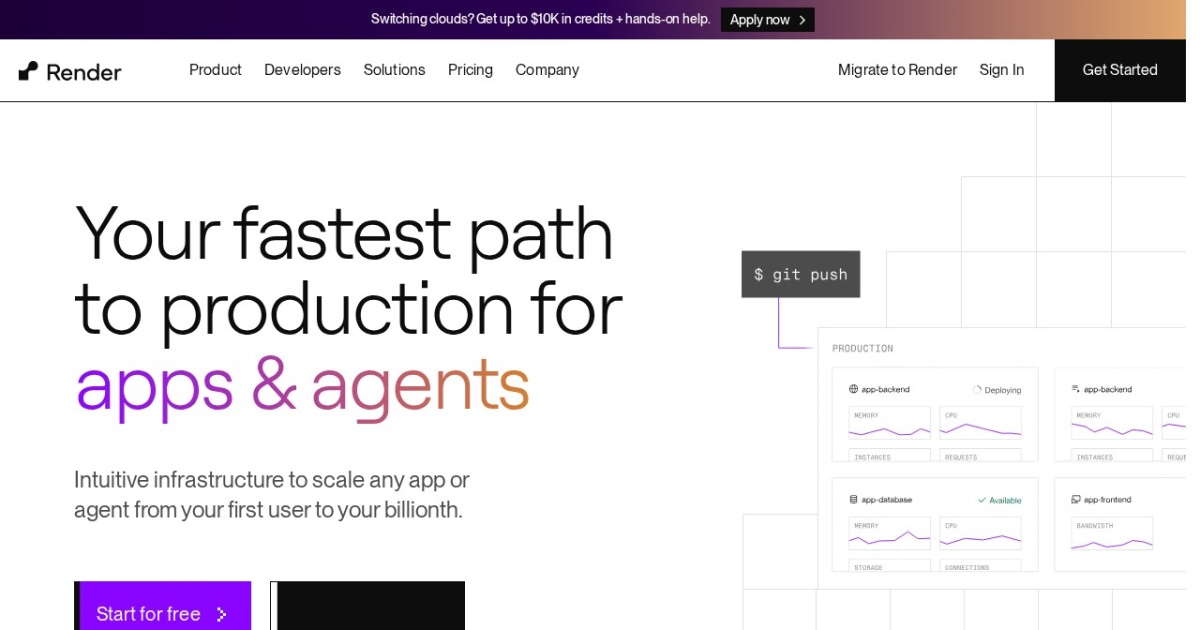
You can clone the landing page in a weekend, but Render itself is a $1.5B cloud provider — the "backend" here is a literal data-center-scale operating platform, not a database schema.
The marketing page is a weekend clone; the actual moat is $258M in funding, a live global compute fleet serving 800,000+ developers, and OpenAI/Codex as a deployment partner.
Not worth cloning as a business — the visible site is trivial to replicate but is just a shopfront for a genuine, capital-intensive cloud infrastructure company; a clone with no underlying compute fleet is a static prop, not a competitor. Cloning the landing page only makes sense as a portfolio/design exercise.
Cloud PaaS is a large, fast-growing market accelerated by AI-generated code needing somewhere to run.
$20–100 to host a lookalike marketing site (Vercel/Netlify + Sanity); effectively unbounded (millions) to run an actual competing cloud compute platform
A cloned landing page earns nothing on its own; a real competing PaaS business would need usage-based compute/bandwidth billing at massive infrastructure cost — only viable with serious capital and years of engineering, exactly what Render itself required.
Heroku, Vercel, Netlify, Railway, Fly.io, DigitalOcean App Platform, AWS Elastic Beanstalk, Google Cloud Run
Usage + subscription hybrid: flat workspace subscription plus metered compute (per-service instance pricing from $7/mo) and metered bandwidth, plus enterprise/custom plans.
Large and growing — 800,000+ developers on the platform, just raised $100M at a $1.5B valuation amid AI-coding-driven demand surge.
- Trademark/brand infringement if cloned under similar name
- No realistic way to replicate actual compute infrastructure without massive capital
- Public API cloning could violate ToS if scraping docs.render.com/api content
Next.js (App Router) + Tailwind + Sanity.io (CMS) + Vercel hosting; skip backend entirely since it can't be meaningfully replicated
Vercel's official Next.js + Sanity starter template
- 1.Scaffold Next.js app with App Router and Tailwind, mirroring route structure (/platform, /workflows, /migration-credits)
- 2.Set up Sanity Studio schema for blog posts, case studies, and marketing blocks; wire GROQ queries into pages
- 3.Rebuild hero, pricing tables, and feature grids as reusable React components matching the visual design tokens
- 4.Add a stubbed docs section (MDX or static pages) with a client-side fuzzy search instead of the real docs-search API
- 5.Integrate lightweight analytics (Plausible or PostHog) in place of the first-party /pan proxy
- 6.Deploy to Vercel/Netlify with custom domain + TLS; skip building any actual compute/container orchestration backend
▸Technical evidencefacade · hidden · 7 signals · DR 84ShowHide
A prompt tool can quickly rebuild the polished Next.js marketing site — hero copy, pricing tables, docs nav, CMS-driven blog/case-study pages via Sanity — since it's standard React/Tailwind component work.
Behind the marketing shell sits an actual multi-tenant cloud provider: container orchestration, VM/bare-metal fleet management, global networking/CDN, managed Postgres/Redis clusters, zero-downtime deploy pipelines, billing/metering infrastructure, IAM, and compliance (SOC2/ISO27001) — years of infra engineering, not a web app.
You could build it — but that moat means you can't win. Find a better bet.
Analyze a different idea →