ClickUp
7/12/2026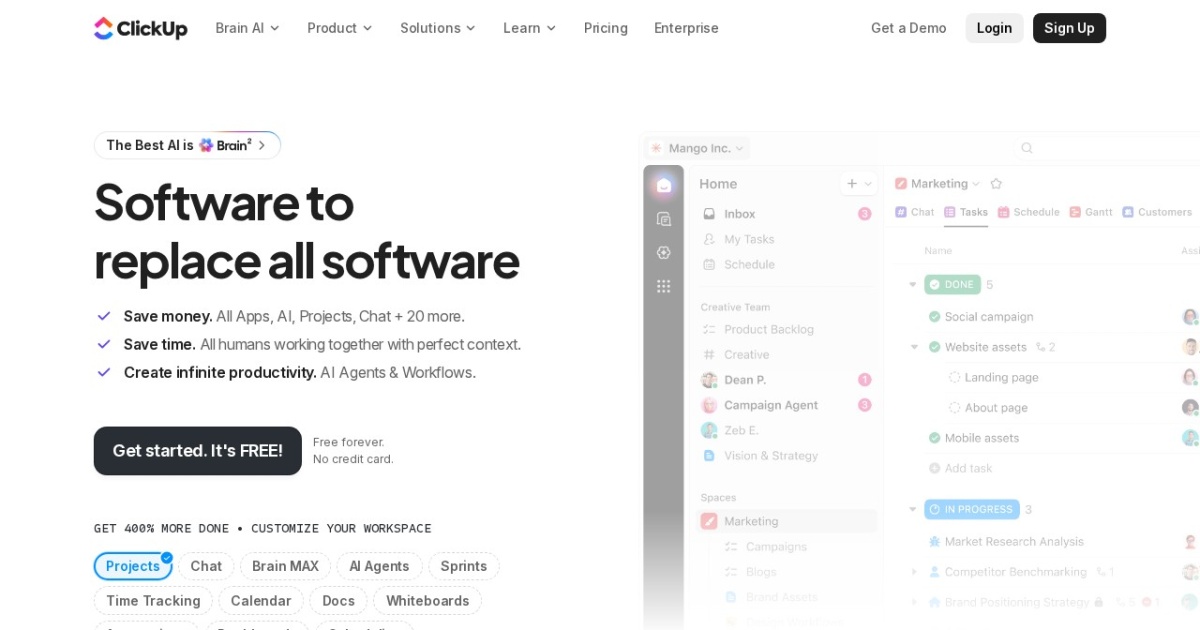
You can clone the landing page in a weekend; you cannot clone a $300M ARR, 1,000-employee real-time work-OS that took nearly a decade and $535M to build.
The landing page is a weekend clone; the 1,000-employee engineering org, $535M in capital, and 250M tasks/month of real-time collaborative data are not.
Not worth cloning as a business — the landing page is trivial to prompt, but the actual product (task DB, real-time sync, permissions, billing, AI agents) is a multi-year, multi-hundred-million-dollar engineering effort competing in a "red ocean" against Asana, Monday.com, and Notion; only worth it as a portfolio/demo piece, not a viable venture.
Massive and growing — work management/PM software market projected to reach $9.81 billion by 2028 growing at roughly 10.67% CAGR, with ClickUp itself generating $300M ARR against a peak $4B valuation.
$500–5,000+ for a barebones clone at small scale (Postgres/Mongo DB, realtime infra like Pusher/Ably, hosting, LLM API costs for any AI features) — scales fast with usage
A cloned landing page alone makes no money; a real competitor would need the full per-seat SaaS product plus a years-long enterprise sales/support motion — the market is real but brutally capital-intensive and already dominated by well-funded incumbents.
Asana, Monday.com, Notion, Trello, Smartsheet, Wrike, Jira/Atlassian, Basecamp
Freemium per-seat SaaS: a free tier to drive adoption, followed by an Unlimited plan at $7/user/month annually, a Business plan at $12/user/month, and custom Enterprise pricing, plus a paid AI add-on layered on top (ClickUp Brain at $9/user/month and Everything AI at $28/user/month) metered via usage-based credits.
Large and still growing — hundreds of millions in ARR with a claimed 250 million tasks managed per month and enterprise/mid-market expansion continuing into 2026.
- Trademark/brand name conflict if cloned as-is
- Crowded, capital-intensive incumbent market (Asana, Monday.com, Notion, Atlassian)
- Enterprise security/compliance requirements (SOC2, ISO, HIPAA, SSO/SCIM) needed to compete at scale
- Any scraping of CMS-driven marketing content for reuse could raise IP/copyright concerns
Next.js (marketing site) + Supabase/Postgres (DB + auth) + Pusher/Ably (realtime) + Stripe (billing/seats) + OpenAI/Anthropic API (AI assistant) + Vercel (hosting)
Vercel Next.js SaaS Starter or Supabase Next.js + Stripe template for the shell; a Kanban/task-board open-source project (e.g. Plane.so or Focalboard) as the backend core to fork instead of building task-management from scratch
- 1.Fork a static Next.js marketing template and rebuild the hero, pricing table, and feature pages using the crawled copy/structure
- 2.Wire OneTrust-style consent banner and Segment/GTM analytics scripts for parity with tracking behavior
- 3.Stand up Supabase Postgres schema for workspaces, spaces, folders, lists, tasks, custom fields, and permissions (multi-tenant RLS)
- 4.Add Stripe Billing with per-seat metering across Free/Unlimited/Business/Enterprise tiers and a credit-based add-on for AI usage
- 5.Integrate a realtime layer (Pusher/Ably or Postgres logical replication) for live task/doc updates across clients
- 6.Bolt on an LLM-backed 'Brain' assistant via OpenAI/Anthropic function calling scoped to workspace data, metered by credits
- 7.Build core views (List/Board/Gantt/Calendar) as React components rendering the same underlying task data model
▸Technical evidencefacade · hidden · 10 signalsShowHide
A prompt can rebuild the Next.js marketing site: hero sections, pricing tables, feature pages, and cookie/consent banners with CMS-driven content and animated illustrations.
Behind the marketing shell sits a full multi-tenant SaaS: real-time collaborative task/doc/whiteboard engine, permissions and workspace hierarchy, billing and seat metering, AI agent orchestration (ClickUp Brain across multiple LLM providers with credit metering), mobile apps, integrations marketplace, and enterprise security (SSO/SCIM/HIPAA) — a system built by a 1,000+ person company over 8+ years.
You could build it — but that moat means you can't win. Find a better bet.
Analyze a different idea →