Calendly
7/13/2026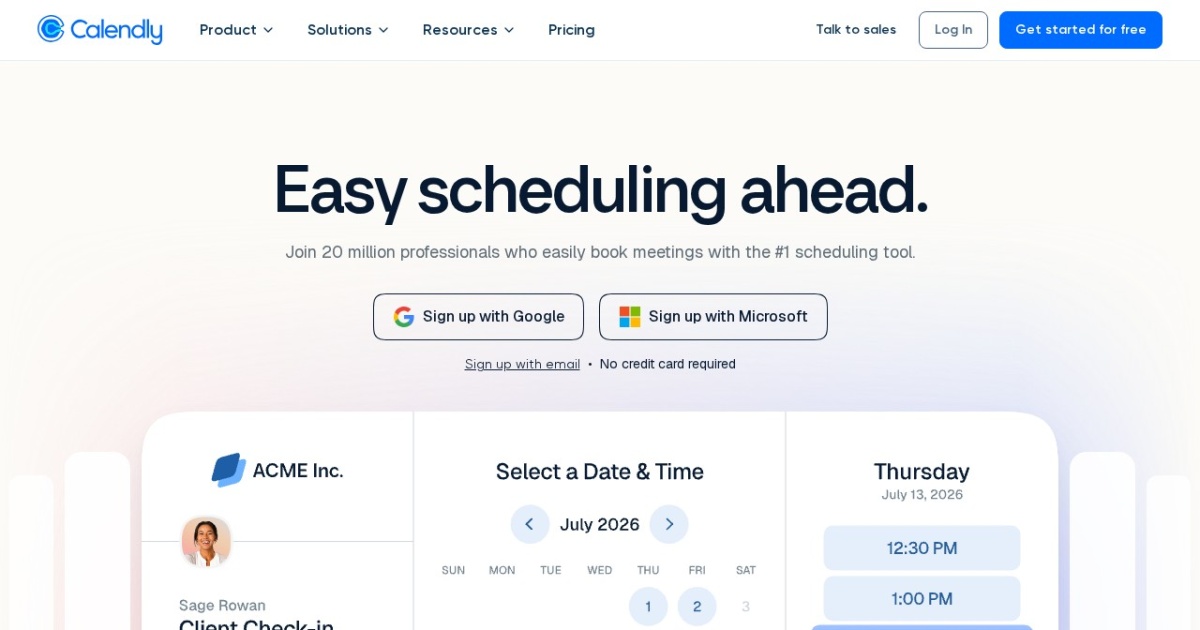
You can clone the homepage in a weekend; you cannot clone the calendar-sync engine, integrations marketplace, or the decade of enterprise trust Calendly sits on.
The landing page is a weekend clone; the 10M-user viral booking-link network, Fortune-500 penetration, and $350M war chest are not.
Not worth cloning as a business — the marketing site is trivial to replicate but valueless without the scheduling engine, and that engine is a multi-year, VC-scale build competing against an entrenched incumbent with a viral network effect; if you want to play in this space, fork the open-source Cal.com instead of rebuilding Calendly's backend from scratch.
Huge and mature: scheduling automation is a crowded multi-hundred-million-dollar category with dozens of players; Calendly alone drives roughly $270M+ ARR at a past $3B valuation with 10M+ users.
$50-300 for a landing-only clone (Vercel + Contentful + basic SaaS tools); $10k+/mo at real scale once calendar-sync infra, support, and compliance are added
A cloned landing page earns nothing on its own; monetizing scheduling requires rebuilding the entire calendar-sync/booking engine and competing in a market already dominated by Calendly's brand and network — most clones would have to niche down (e.g., open-source Cal.com already does this) rather than compete head-on.
Acuity Scheduling, Cal.com, YouCanBookMe, Chili Piper, HubSpot Meetings, Microsoft Bookings, Doodle, Setmore, TidyCal
Freemium PLG: free tier with unlimited 1:1 bookings, paid per-seat tiers (~$10-16/user/mo Standard/Teams), Enterprise plans with SSO/SCIM/compliance sold via bottoms-up expansion into large orgs.
Very large and still growing — 10M+ active users globally, 40%+ market share in employee-scheduling category, used inside 86% of Fortune 500 companies.
Next.js (App Router) + Contentful (CMS) + Vercel hosting; for a real product: Cal.com's open-source stack (Next.js + Prisma + Postgres) + NextAuth + Stripe + Google/Microsoft Graph calendar APIs
Cal.com open-source repo (github.com/calcom/cal.com) for the actual scheduling engine, or Vercel's Next.js marketing template for the landing page alone
- 1.Fork Cal.com if the goal is a working scheduler; fork a Next.js marketing template if only the landing page matters
- 2.Wire Contentful (or any headless CMS) for blog/resources/feature-page content so marketing can edit without deploys
- 3.Rebuild the visible pages (home, features, solutions, resources, pricing) matching Calendly's component/design system with Tailwind + a custom font
- 4.Integrate Google Calendar / Microsoft Graph / CalDAV APIs for real calendar sync and double-booking prevention if building the product, not just the site
- 5.Add Stripe for paid tiers and NextAuth/Auth.js + SAML (WorkOS or similar) for enterprise SSO if targeting business customers
- 6.Layer in Intercom for support, Segment/GTM for analytics, and a webhook/API layer to match integration-marketplace parity
- 7.Load-test timezone and recurring-availability logic — this is where most scheduling clones break in production
▸Technical evidencefacade · hidden · 8 signals · DR 95ShowHide
A prompt can nail the polished Next.js marketing site — hero sections, integration logo grids, feature pages, CMS-driven blog/resources, pricing tables and font/animation polish (Contentful-backed content, GTM/Intercom/Maze widgets).
Behind /scheduling sits a decade-old scheduling engine: multi-provider calendar sync and double-booking prevention (Google/Outlook/Office365/iCloud), timezone resolution, round-robin/routing logic, workflows/automation, a 100+ app integrations marketplace, Stripe/PayPal payments, SSO/SCIM enterprise auth, SOC2/ISO/GDPR compliance infrastructure, mobile apps, and a public API/webhook platform serving 10M+ users.
You could build it — but that moat means you can't win. Find a better bet.
Analyze a different idea →