Plausible Analytics
7/24/2026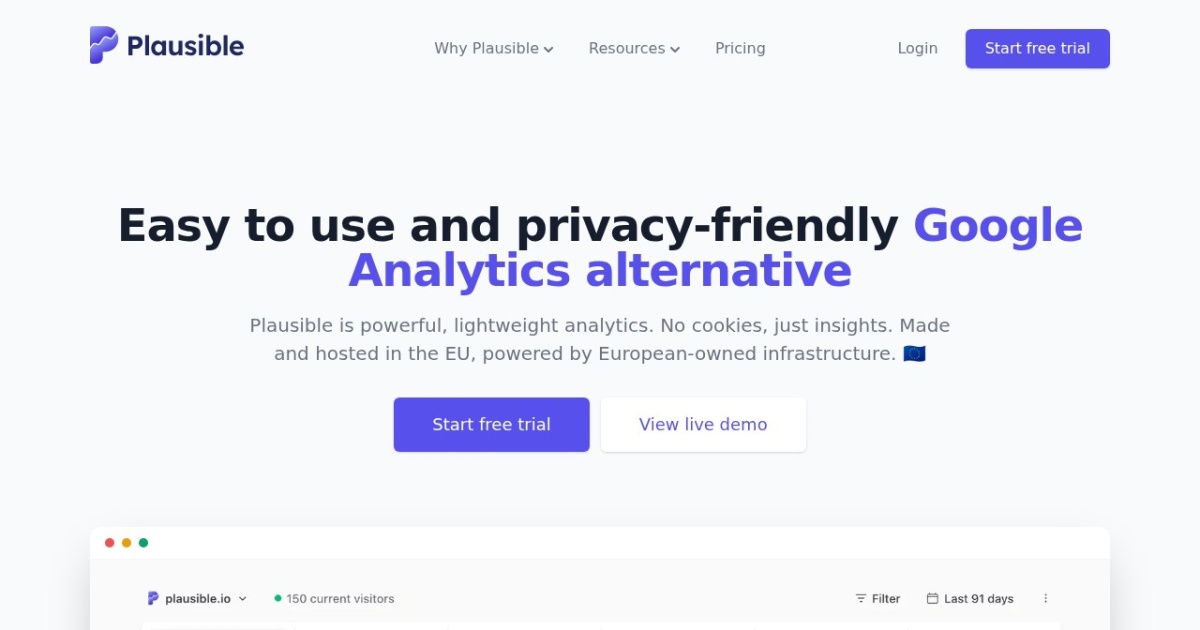
You can clone the brochure in an afternoon, but you'd be cloning a Docker-compose-deployable ClickHouse+Elixir analytics engine that took years to harden — that's not a prompt, that's a startup.
The landing page is a weekend Jekyll clone; the moat is 27.9k GitHub stars, an AGPL open-source community, and 19,000 paying subscribers including Hugging Face and MongoDB who trust the brand and data-residency story.
The landing page alone is trivial and not worth cloning in isolation; the actual valuable product (the analytics engine) is a multi-month-plus infra build competing in a saturated niche against a well-funded, trusted open-source incumbent — not a good prompt-and-ship opportunity.
Privacy-focused/cookieless analytics is a real and growing niche as GDPR/cookie-law pressure pushes sites off Google Analytics; the space is crowded with Fathom, Simple Analytics, PostHog, Matomo, Umami and others competing on price and self-hosting.
$200–2,000+ (ClickHouse cluster, Postgres, ingestion servers, CDN, scales sharply with tracked pageview volume)
Real revenue model exists (usage-based SaaS subscriptions), but margins depend on efficient ClickHouse ops at scale; a clone would need real infrastructure spend before earning a cent, and would compete against an entrenched open-source incumbent with a large community moat.
Fathom Analytics, Simple Analytics, Matomo, PostHog, Umami, Cloudflare Web Analytics, GoatCounter, Pirsch]
Usage-based SaaS subscriptions priced by monthly pageviews (Growth $9/mo, Business $19/mo at 10k pageviews, scaling with traffic) plus a free self-hosted open-source Community Edition that funds the business only indirectly via cloud conversions.
Large established audience — 19,000+ paying subscribers and 27.9k GitHub stars, positioning it as one of the top privacy-analytics brands; traffic/usage trending up with GA4 migration wave.
- AGPLv3 open-source license means a direct code clone is legal but must honor copyleft/attribution, Competing against an entrenched incumbent brand with a large existing user base, GDPR/data-residency claims require genuine EU infrastructure to be credible]
Next.js/Jekyll for marketing site + Elixir/Phoenix (or Node) backend + ClickHouse for event storage + Postgres for accounts/billing + Stripe/Paddle for payments + Docker Compose for self-host option, hosted on Fly.io/Hetzner (EU)
Fork the actual open-source plausible/analytics GitHub repo rather than rebuilding from scratch — it's AGPL-licensed and production-ready
- 1.Clone plausible/analytics repo and stand up Docker Compose (Postgres + ClickHouse + Phoenix app) locally
- 2.Rebuild the marketing site separately as a static Jekyll/Next.js site with the same landing/use-case pages
- 3.Wire up Paddle (or Stripe) for subscription billing and a currency-detection API endpoint
- 4.Implement the lightweight tracking script + ingestion endpoint that batches events into ClickHouse
- 5.Build the dashboard UI (traffic sources, pages, devices, real-time visitors) on top of ClickHouse queries
- 6.Add team/site management, API access, and data import/export for parity with Business tier
- 7.Deploy on EU infrastructure to replicate the GDPR/data-residency selling point
▸Technical evidencefacade · hidden · 1 signals · DR 89ShowHide
A prompt can quickly clone the static Jekyll marketing site — hero, feature grid, comparison/use-case pages (SaaS, ecommerce, agencies), and a fake pricing table with a Paddle-style currency widget.
Behind the marketing site sits a full production analytics platform: an Elixir/Phoenix ingestion + dashboard app, ClickHouse for high-volume event storage, Postgres for accounts/sites, a lightweight tracking script served to millions of sites, real-time dashboards, Paddle billing/subscriptions, team/site management, data import/export, and self-hosted Docker Community Edition — none of which is visible in the crawled HTML.
You could build it — but that moat means you can't win. Find a better bet.
Analyze a different idea →