Slack
7/12/2026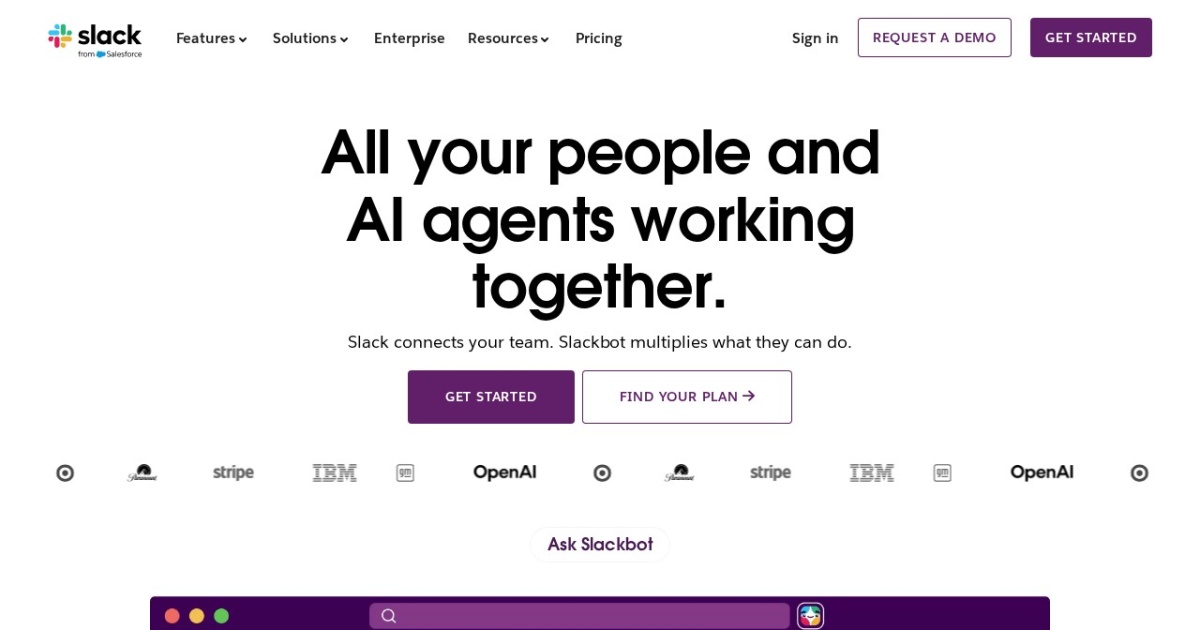
You can clone Slack's homepage in an afternoon; you cannot clone fifteen years and billions of dollars of real-time messaging infrastructure serving hundreds of thousands of paying orgs.
The landing page is a weekend clone; the 950,000-organization network, enterprise trust, and Salesforce-scale infrastructure behind it are not.
Not worth it as a business — the landing page is trivial to prompt but valueless without the product, and the product itself is a decade-plus, multi-billion-dollar engineering effort now owned by Salesforce; only sensible use of cloning here is a design/portfolio exercise, not a competing venture.
Team collaboration/messaging is a massive, mature market (tens of billions in annual spend) with Slack alone projected near $3B in revenue in fiscal 2026, though growth has plateaued as Microsoft Teams' bundled distribution has pulled ahead in share.
$0-20 to host a static clone of the marketing site; a real competing chat product would cost thousands/month minimum (WebSocket infra, storage, search, compliance) once it has any real users
A cloned landing page alone earns nothing; monetizing would require building the entire real-time chat product and competing against an entrenched, deeply-integrated incumbent with enterprise trust and 2,600+ app integrations, which is not commercially realistic to bootstrap.
Microsoft Teams, Google Chat, Discord, Mattermost, Rocket.Chat, Troop Messenger, Chanty, Zoom Team Chat
Freemium SaaS: free tier with 90-day message history cap, then paid per-seat tiers — Pro (~$7.25/user/mo), Business+ (~$15/user/mo), Enterprise+/Enterprise Grid (custom pricing), plus Slack AI as a premium add-on.
Tens of millions of monthly active users/visits at the product level (Slack reports up to ~79M DAUs per some estimates), flat-to-slowly-growing as Microsoft Teams outpaces it via bundling.
- Trademark/brand protection (Slack name, logo)
- Enterprise customer contracts and compliance certifications not replicable
- Massive capital and engineering moat, not a legal risk but a practical barrier
- Any real clone competing on 'Slack' branding would face IP/trademark issues
Next.js + Tailwind for the static marketing site; if attempting any real backend, Supabase/Postgres + Socket.io or Pusher for realtime + Clerk/Auth0 for auth + Stripe for billing
Vercel's Next.js marketing template or a Tailwind UI landing kit
- 1.Scaffold Next.js site and replicate hero, feature grid, and pricing sections from the crawled HTML/CSS structure
- 2.Add OneTrust-style cookie consent banner and GTM snippet for parity
- 3.Build a pricing page with plan-comparison tables (Free/Pro/Business+/Enterprise+) as static content
- 4.If going beyond the landing page, stand up a minimal chat MVP: Postgres schema for workspaces/channels/messages, Socket.io for realtime delivery, Clerk for auth
- 5.Integrate Stripe for seat-based subscription billing to mimic monetization
- 6.Skip enterprise features (SSO/SCIM, DLP, Discovery API, AI) — these represent years of scope no prompt sequence covers
▸Technical evidencefacade · hidden · 6 signals · DR 92ShowHide
A prompt can clone the slack.com marketing homepage — hero copy, feature sections, pricing cards, consent banner, and responsive layout — in a few passes, since it's fundamentally a static-ish marketing bundle sitting behind CDN JS.
Behind the marketing shell sits the actual Slack product: real-time messaging infrastructure (websockets/RTM), multi-tenant workspace architecture, SSO/SCIM enterprise auth, search indexing across billions of messages, file storage, a 2,600+ app integration platform/marketplace, workflow builder, huddles (audio/video), Slack AI, billing, and compliance/eDiscovery tooling — none of which is visible in the crawled HTML.
You could build it — but that moat means you can't win. Find a better bet.
Analyze a different idea →