Amplitude
7/23/2026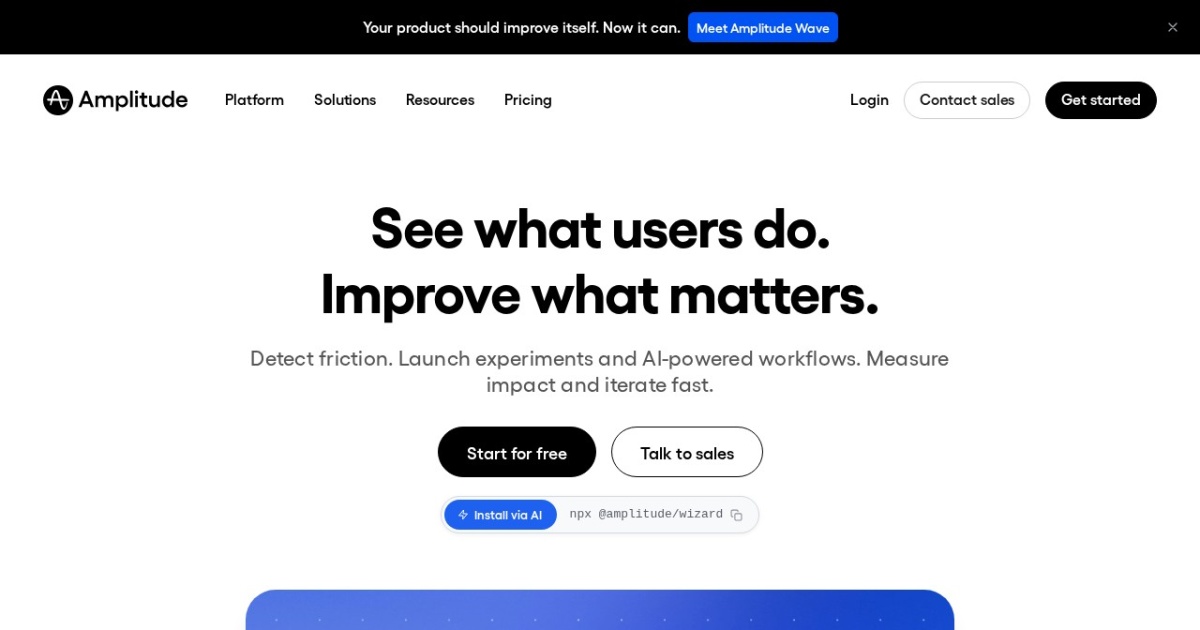
The landing page is a Tuesday-afternoon Next.js clone; the actual product behind it is a decade-old, venture-scale data platform that took a public company hundreds of engineers to build.
You can clone the landing page in an afternoon, but not the 12-year-old, billions-of-events-per-day analytics engine, the public-company balance sheet, or the 4,700+ enterprise customers paying $340M+ ARR.
Not worth cloning as a business — the landing page is trivial to replicate but worthless without the analytics backend, and that backend is a multi-year, deeply competitive, capital-intensive undertaking against a public company with $340M+ ARR and entrenched enterprise customers; only worth it as a UI/portfolio exercise, not a product.
Massive and growing — product/digital analytics is a multi-billion dollar category; Amplitude itself generated $343.2M revenue in 2025, up 15% YoY, with 4,797+ paying customers, competing against Google Analytics, Mixpanel, Heap, PostHog, and Adobe Analytics.
$5,000+ (event ingestion at scale, ClickHouse/columnar DB clusters, session-replay storage, ML inference for "AI" features)
A cloned landing page generates zero revenue on its own — profitability only exists once you build the actual ingestion/query/experimentation engine, which is a multi-year, capital-intensive SaaS build competing in a market already dominated by well-funded incumbents (Amplitude is public; Mixpanel, PostHog are well-capitalized private players).
Mixpanel, Heap, PostHog, Google Analytics 4, Adobe Analytics, Hotjar, FullStory, Pendo
Enterprise SaaS subscriptions (subscription revenue is 98% of total revenue) tiered by data volume/features, with self-serve free/starter tiers funneling into $100K+ ARR enterprise contracts (698 customers over $100K ARR, 56 over $1M ARR per FY2025 results).
Large and steady — enterprise SaaS site drawing significant B2B organic/paid traffic; parent company is a public NASDAQ-listed firm (AMPL) with $366M ARR, so site traffic supports a substantial sales pipeline.
- Trademark/brand infringement if cloned under similar name
- Publicly traded company — heavy legal/IP scrutiny
- Enterprise data-governance/compliance (SOC2, HIPAA, GDPR) expectations from real customers, unreplicable by a simple clone
Next.js (App Router) + Tailwind CSS + a headless CMS (Sanity/Contentful) for marketing copy + Vercel hosting; for a real backend: ClickHouse or Snowflake for event storage, Kafka for ingestion, Postgres for metadata, Auth0/WorkOS for enterprise SSO, Stripe for billing
Vercel's Next.js SaaS marketing starter (or Taxonomy/Precedent templates) for the landing page
- 1.Fork a Next.js marketing template and rebuild hero/feature sections per page (/ai, /web-analytics, /amplitude-analytics) matching Amplitude's IA
- 2.Wire a headless CMS so marketing copy/locale pages can be edited without redeploys, mirroring the hreflang locale structure observed
- 3.Stand up a minimal event-ingestion API (POST /api/events) writing to a columnar store (ClickHouse) to fake the 'analytics' behind the demo
- 4.Build a simple dashboard UI (charts via Recharts) reading pre-aggregated queries to simulate funnels/retention charts for demo purposes only
- 5.Add auth (Clerk/Auth0) and a Stripe pricing page to complete the SaaS funnel illusion
- 6.Skip trying to replicate real-time session replay, experimentation, or ML 'AI insights' — these require dedicated data infra outside prompt-based building
▸Technical evidencefacade · hidden · 9 signals · DR 86ShowHide
A prompt can nail the marketing shell: Next.js landing pages, hero sections, feature grids, and localized routes (/ai, /web-analytics, /amplitude-experiment) with Tailwind-style styling and CMS-driven marketing copy.
Behind the marketing site sits a real product-analytics engine: event ingestion pipelines processing billions of events/day, a query engine for cohort/funnel/retention analysis, session replay and heatmap capture infrastructure, an experimentation/feature-flag service, ML-based "AI Analytics" models, SSO/SAML enterprise auth, billing, and SOC2/HIPAA-grade data governance — none of which is visible in the crawled HTML/JS.
You could build it — but that moat means you can't win. Find a better bet.
Analyze a different idea →