Asana
7/12/2026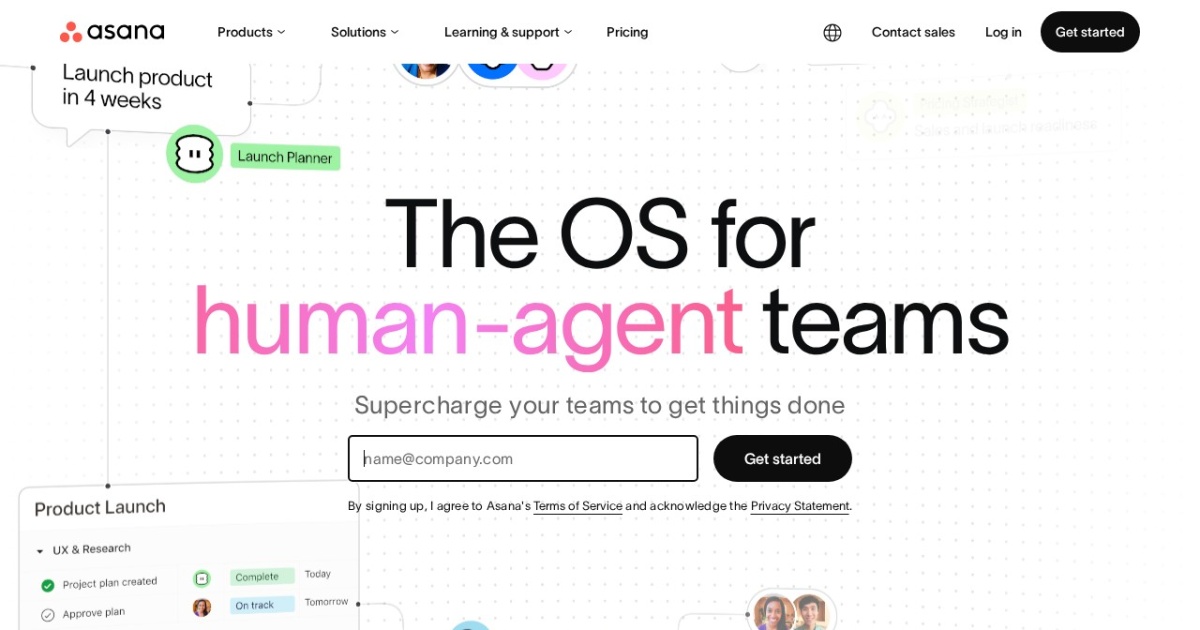
You can clone the homepage in an afternoon; you cannot clone the decade-plus, venture-scale work-management engine and enterprise trust stack underneath it.
You can clone the landing page over a weekend, but not the 131,000+ paying customers, the 21,000+ enterprise accounts, or the switching costs of a company's entire workflow living inside Asana's Work Graph.
Not worth cloning as a business — the landing page is trivial but valueless without the product, and the product itself is a decade of enterprise engineering (real-time sync, permissions, AI orchestration, integrations) competing in a market already dominated by well-funded incumbents; a prompt-built clone would have zero differentiation and no moat against Asana, Monday.com, or ClickUp.
Massive and growing: the project management software market is projected to reach roughly $9.76B in 2025 and expand toward $20.2B by 2030 at a ~15.65% CAGR, with Asana holding a leading position among mid-market/enterprise "Collaborative Work Management" tools.
$50-300 for a static/CMS-backed landing clone; full product would run into $100k+/mo at scale (compute, storage, AI inference, support infra)
A landing-page clone alone generates no revenue; a real competitor would need to replicate seat-based SaaS pricing ($10-45/user/mo) plus enterprise contracts, which requires the full backend, sales team, and years of trust-building — not something a cloned front end can monetize on its own.
Monday.com, Jira (Atlassian), Smartsheet, Wrike, Trello, ClickUp, Notion, Basecamp
Freemium SaaS: free Personal tier (up to 2 users) → per-seat paid tiers Starter (~$10.99/user/mo annual), Advanced (~$24.99/user/mo annual), Enterprise and Enterprise+ (custom pricing) with add-ons like Timesheets & Budgets and AI Teammates.
Large, established enterprise SaaS traffic (tens of millions of monthly visits industry-wide for the category); Asana reported Q4 revenue of $188.3M with double-digit YoY growth, indicating a large and still-growing user base.
- Asana trademark/brand protected
- Enterprise data residency/compliance claims (HIPAA, SOC2-type) cannot be legitimately replicated without real audits
- Publicly traded company (NYSE) — heavy IP/patent portfolio around Work Graph
Next.js (App Router) + Supabase/Postgres (auth, DB, realtime) + Stripe (seat billing) + Vercel hosting + Contentful/Sanity for marketing CMS content
Vercel's Next.js SaaS Starter or Supabase Next.js template for the app shell; a Tailwind marketing template for the landing page
- 1.Fork a Next.js SaaS starter and wire Supabase auth + Postgres schema for orgs/projects/tasks/users
- 2.Build the landing/marketing pages (hero, pricing table, localized routes) as static/SSR pages fed by a headless CMS
- 3.Implement core task/project CRUD with a Kanban/list/calendar view using a state library (Zustand/React Query) synced via Supabase Realtime channels
- 4.Add Stripe Billing for per-seat subscription tiers mirroring Free/Starter/Advanced/Enterprise
- 5.Layer in permissions, SSO stub (e.g. WorkOS) for enterprise-tier gating
- 6.Add basic automation rules engine (trigger/action tables) and a simple AI task-summarization feature via an LLM API
- 7.Set up DataDog/Sentry for error tracking and OneTrust-style consent banner for compliance
▸Technical evidencefacade · hidden · 9 signals · DR 91ShowHide
A prompt can nail the Next.js marketing site: hero copy, pricing table, localized routes (/id, /de, /es, etc.), and CMS-driven content blocks with stock imagery from a CDN.
Behind the marketing shell sits a full multi-tenant SaaS: real-time task/project sync engine ("Work Graph"), permissions & SSO/SCIM, billing engine with seat-based metering, AI agent orchestration (AI Studio/AI Teammates, recently bolstered by the StackAI acquisition), workflow automation rules engine, file storage, audit logging, and dozens of third-party integrations (Slack, Salesforce, Tableau, Zoom, AWS Q Business) — years of enterprise engineering.
You could build it — but that moat means you can't win. Find a better bet.
Analyze a different idea →