Airtable
7/12/2026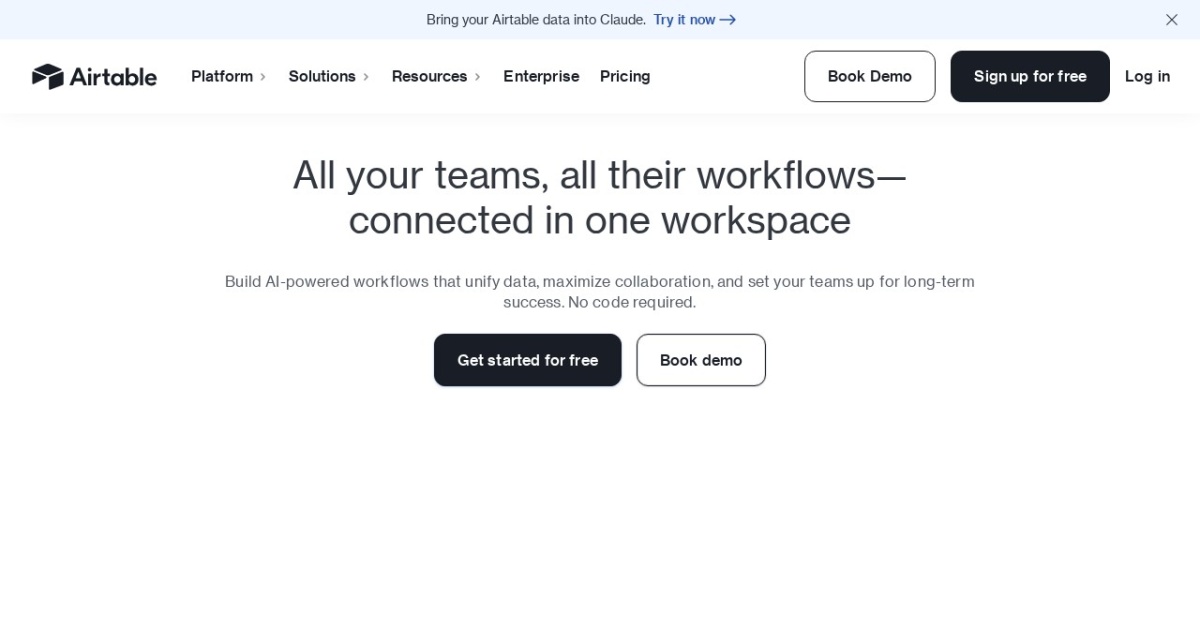
You can clone the brochure in a weekend; you cannot clone the decade-plus, $1.4B-funded real-time database engine hiding behind it.
The landing page is a weekend clone; the 500,000+ org install base, 13 years of relational-database engineering, and Fortune-100 enterprise trust are not.
Not worth cloning as a full product — the backend is a multi-year, venture-scale engineering effort (real-time collaborative DB, automations, AI agents, enterprise security) that no amount of prompting reproduces; only the marketing shell is realistically clonable, and it has zero standalone business value without the underlying app.
Massive and growing: Airtable itself is estimated at $300-600M+ ARR with strong enterprise net dollar retention, competing in the multi-billion-dollar no-code/low-code and AI workflow productivity market against Notion, Monday.com, Smartsheet, Asana, and ClickUp.
$50–500 for a bare-bones clone (hosting + Postgres + basic realtime), scaling into thousands/month once you approximate real-time collaborative editing, file storage, and automation infra at any real usage.
A landing-page-only clone earns nothing on its own; a functioning spreadsheet-database SaaS could monetize via per-seat subscriptions like the original, but must out-build a category leader with 13 years of head start and $1.4B in funding.
Notion, Smartsheet, Monday.com, Asana, ClickUp, Coda, NocoDB
Freemium SaaS, per-editor seat pricing: Free, Team ($20/seat/mo annual), Business ($45/seat/mo annual), custom Enterprise Scale, plus paid add-ons for Portals (external guest access) and AI credit packs.
Large and enterprise-heavy — serving 500,000+ organizations and reportedly 15M+ monthly active users, still growing via AI-native product push (Omni, Field Agents, Superagent).
- Airtable trademark/brand
- Enterprise data compliance (SOC 2, SSO) expectations if competing seriously
- API rate-limit and ToS restrictions on scraping/replicating their public API docs verbatim
Next.js + Sanity (headless CMS) + Tailwind + Vercel for the landing page; if attempting the actual product, Postgres + a CRDT/OT realtime layer (e.g. Yjs) + Node/Go API + Auth0/Clerk + Stripe, deployed on AWS/GCP with a dedicated data team
Vercel Next.js SaaS starter + Sanity's Next.js template for the marketing site
- 1.Fork a Next.js + Sanity starter and recreate the nav mega-menus, hero, and pricing sections from the crawled HTML
- 2.Wire a Sanity dataset for blog/case-study content and marketing copy
- 3.Add Stripe checkout stubs and a fake pricing page matching the tiered per-seat model
- 4.For a real product MVP, spin up Postgres with a flexible schema (EAV-style) to mimic bases/tables/fields
- 5.Layer Yjs or similar CRDT for basic real-time multi-user grid editing
- 6.Build a minimal REST API mirroring Airtable's public API docs for record CRUD
- 7.Stop there — automations, AI agents, and enterprise SSO/compliance are multi-quarter efforts each
▸Technical evidencefacade · hidden · 5 signals · DR 91ShowHide
A prompt can nail the Next.js marketing page — hero, nav mega-menus, feature sections, pricing cards, testimonials, all pulled from a Sanity CMS — in an afternoon of iteration.
Behind the marketing shell sits a real-time collaborative relational-database engine (grid/kanban/gallery/calendar views, formulas, linked records, permissions), a full REST/GraphQL-style API, an automations/workflow engine, AI agent infrastructure (Omni, Field Agents, HyperDB up to 100M rows), SSO/enterprise security, billing, and sync connectors to Salesforce/Snowflake/Databricks — none of which is visible in the crawled HTML/JS.
You could build it — but that moat means you can't win. Find a better bet.
Analyze a different idea →