Readwise / Readwise Reader
10/6/2026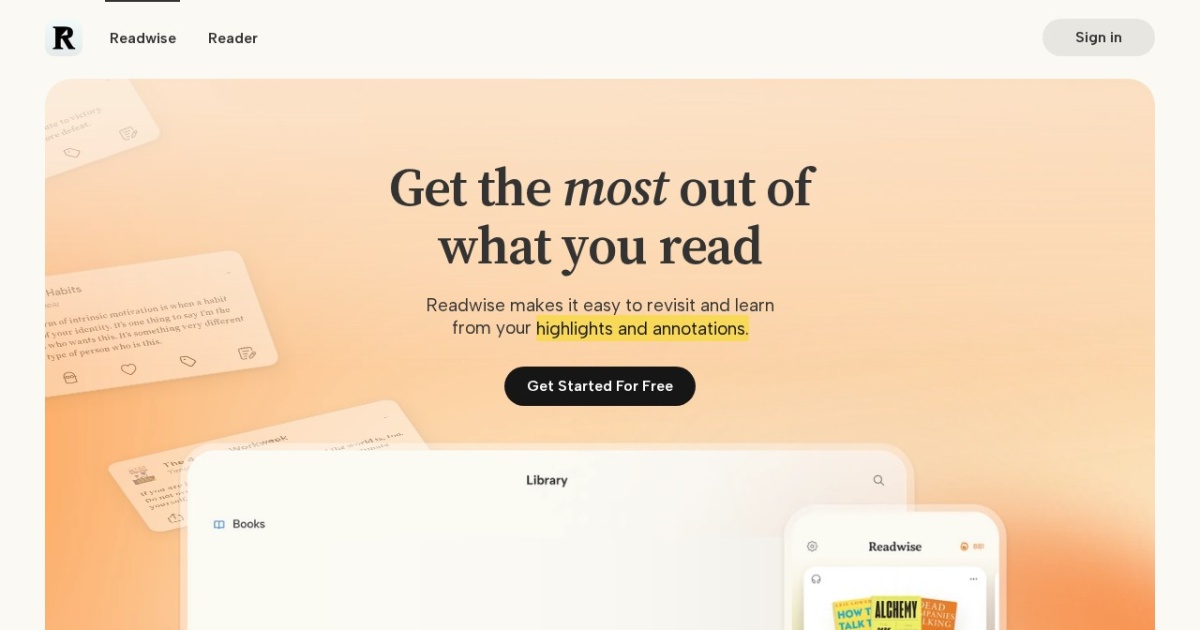
You can clone the login page in an afternoon; you cannot clone eight years of format parsers, sync integrations, and a spaced-repetition engine that actually works.
The login form is trivial to copy; the 8-year library of format parsers, sync integrations, and a habit-forming spaced-repetition engine with a loyal paying user base is not.
Not worth cloning as a full product — the moat is the years of integration/parsing work and retention habit loop, not the UI; a prompt-built clone would only ever be a shallow bookmarking app competing in an already crowded, low-differentiation tier (Raindrop/Instapaper already own that space for free).
Read-it-later/PKM tools are a durable niche with real paid demand; Pocket's July 2025 shutdown pushed a wave of displaced users toward alternatives like Readwise Reader, Matter, and Instapaper, and Readwise itself has grown to a multi-million registered-user base.
$500–3,000+ (scales with storage/parsing/AI inference and email delivery at user volume)
Subscription SaaS at ~$120/yr per full-plan user is proven profitable at scale, but running a clone cheaply requires solving the same expensive problems (robust article extraction, PDF/EPUB rendering, email ingestion, AI summarization costs) before any revenue arrives.
Matter, Instapaper, Pocket (shut down), Raindrop.io, Inoreader, Feedly, Omnivore (shut down), GoodLinks, Karakeep, Marqly
Freemium-less subscription SaaS: no permanent free tier, 30-day trial, then Lite ~$5.59/mo (highlight review only) or Full ~$9.99/mo billed annually (includes Reader app), billed monthly at a premium.
~690k monthly site visits per third-party estimate, growing (~19% MoM in one estimate); registered users reportedly in the multiple millions with continued post-Pocket-shutdown growth.
- Relies on scraping/parsing third-party content (articles, RSS, PDFs) which can raise copyright/ToS issues at scale, dependent on maintaining OAuth partnerships with PKM tools (Notion, Evernote, etc.) that can change APIs anytime, competitive pricing pressure from free alternatives (Raindrop, Instapaper)
Next.js + Postgres (Supabase) for auth/DB + S3-compatible storage for saved content + a headless browser/readability service (e.g. Mercury Parser alternative) for article extraction + Stripe for billing + Resend/Postmark for email digests + Vercel/Fly.io hosting
Supabase Next.js SaaS starter (auth + Stripe billing pre-wired)
- 1.Stand up auth (email/password + Apple/Google OAuth) and a Postgres schema for users, documents, highlights, tags
- 2.Build an ingestion service: URL fetch + Readability.js extraction, RSS polling, and a PDF/EPUB parser (pdf.js, epub.js)
- 3.Build the reader UI: inbox/library views, annotation/highlighting, and a spaced-repetition review queue + daily email job
- 4.Wire Stripe subscriptions (trial, monthly/annual tiers) and gate Reader access behind plan status
- 5.Add export integrations one at a time (Notion, Obsidian via API/webhooks) since each is its own OAuth + mapping project
- 6.Add observability (Sentry) and bot protection (Cloudflare Turnstile) on signup/login, matching the detected stack
- 7.Ship a minimal iOS/Android wrapper (or PWA) last, once core sync/parsing is solid
▸Technical evidencefacade · hidden · 1 signalsShowHide
A prompt can nail the marketing landing page, login/signup forms, and pricing page layout in a few hours — it's standard SaaS marketing HTML with Cloudflare Turnstile bot protection bolted on.
Behind the login wall sits years of real engineering: a universal "Reader" ingestion pipeline (web articles, RSS, PDFs, EPUBs, newsletters, YouTube transcripts, Twitter/X threads) with parsers/converters for each format, bidirectional sync integrations with Kindle, Instapaper, Pocket, iBooks, Twitter, and PKM tools (Notion, Obsidian, Roam, Evernote, Logseq), a spaced-repetition review/email engine, "Ghostreader" AI features, mobile apps (iOS/Android), a public API/MCP/CLI surface, billing/subscription management, and observability (New Relic, Rollbar) at production scale.
You could build it — but that moat means you can't win. Find a better bet.
Analyze a different idea →