Obsidian
10/2/2026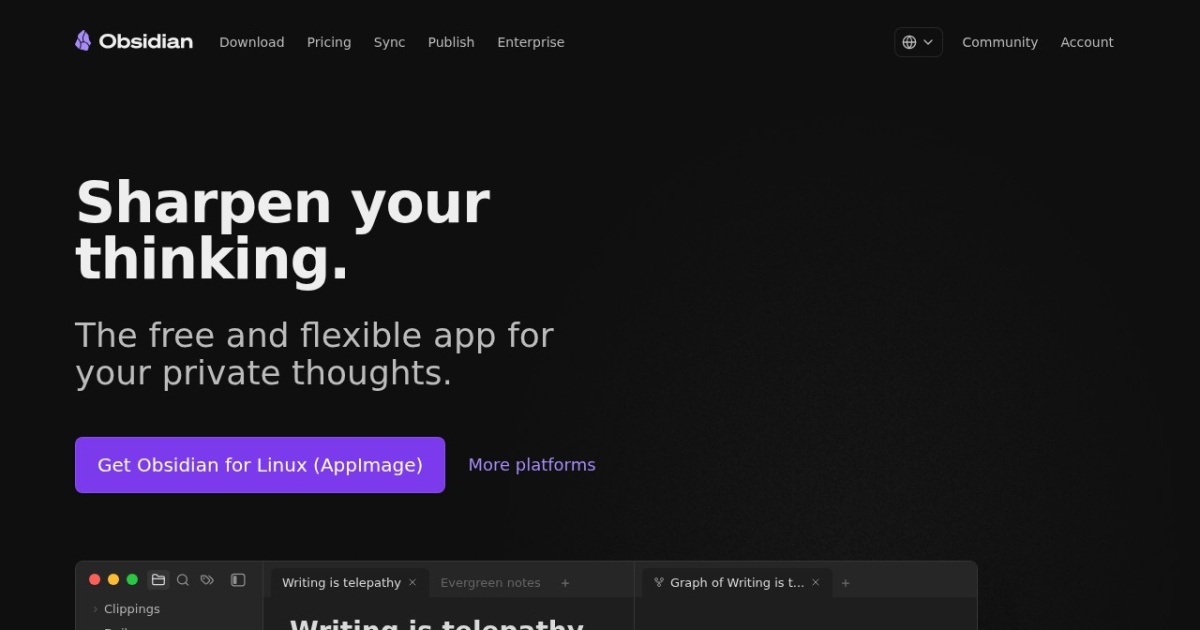
You can clone the brochure in a weekend; you cannot clone a decade-strength Electron app, a mature plugin ecosystem, and an encrypted sync backend with a prompt.
You can clone the landing page in an afternoon, but not the plugin ecosystem, the local-first file-format trust, or the loyal power-user community built over 5+ years.
Not worth it as a clone play: the landing page is trivial, but the actual moat is the native app + plugin ecosystem + 5+ years of trust in a local-first file format, none of which a prompt can produce. The business only works because of the app that already exists — cloning the marketing shell gets you a pretty page with nothing to sell.
Large and growing PKM/note-taking market; Obsidian reportedly has an active user base that grew 22 percent year-over-year to roughly 1.5 million users and an estimated $25 million in annual revenue by April 2026, holding a strong niche position among developers where it reportedly beats Notion in surveys.
$500–5k+ (scales with sync storage/bandwidth and Publish hosting, plus app signing/distribution infra)
Obsidian's actual model keeps the core app free and monetizes thin, high-margin add-ons: You only pay for optional add-ons: Obsidian Sync at $4/user/month (annual) to sync notes across devices, and Obsidian Publish at $8/site/month (annual) to turn notes into a website. A clone could copy this freemium-addon model, but without the installed base the sync/publish revenue has no one to sell to.
Notion, Logseq, Roam Research, Anytype, Craft, RemNote, Joplin, Tana, Capacities
Freemium: Obsidian's pricing is best described as "freemium," but probably not in the way you're used to. The core app, with all its powerful features, is completely free. Paid add-ons are Sync (~$4-5/user/mo) and Publish (~$8-10/site/mo), plus an optional one-time Catalyst donation and a commercial license.
Large, steady/growing — millions of installs, ~1.5M active users and reportedly ~8% of the note-taking/PKM market niche, strongest among developers.
- Trademark: 'Obsidian' name/logo are protected
- Core app distributed via GitHub releases — redistributing binaries as your own could violate licensing/ToS
- Community plugin ecosystem is a de facto moat not reproducible without opening it up the same way
Marketing site: Next.js + Tailwind + a static content/MDX store, deployed on Vercel. (Full product would require Electron/Tauri for desktop, Capacitor for mobile, a CRDT or diff-based sync service e.g. built on Postgres + S3 + WebSockets, and Stripe for billing.)
Fork a Tailwind marketing template (e.g. Vercel's 'Nextjs Marketing Starter') for the landing/pricing/download pages only.
- 1.Scaffold Next.js site with dark theme Tailwind matching Obsidian's visual system (hero, download CTA, pricing cards)
- 2.Build /download page with OS-detection and static links to pre-built installer artifacts
- 3.Build /pricing and /sync pages as static content with Stripe Checkout links for Sync/Publish-style subscriptions
- 4.Add i18n routing + language picker mirroring the locale-redirect logic seen in the crawl
- 5.Stub a fake 'Sync' and 'Publish' CTA that actually just links out or shows a waitlist, since the real services require building a native app + encrypted sync backend first
- 6.(If going further) prototype a minimal Electron Markdown editor with local file storage to have *something* behind the download button
▸Technical evidencefacade · hidden · 5 signalsShowHide
A prompt can easily nail the marketing site — the Tailwind-styled landing/download/pricing/sync pages, i18n language switcher, and static content blocks. It cannot touch what actually makes Obsidian valuable: the native desktop/mobile app itself.
The real product is a full cross-platform Electron/Capacitor app with a plugin API, a local-first Markdown engine, an end-to-end encrypted sync service (Sync), a static site generator/host for Publish, licensing and payment processing, and release distribution via GitHub (seen in the detected release-download endpoints for v1.13.7/v1.13.8 installers across OS/architectures).
You could build it — but that moat means you can't win. Find a better bet.
Analyze a different idea →