SurveyMonkey
10/17/2026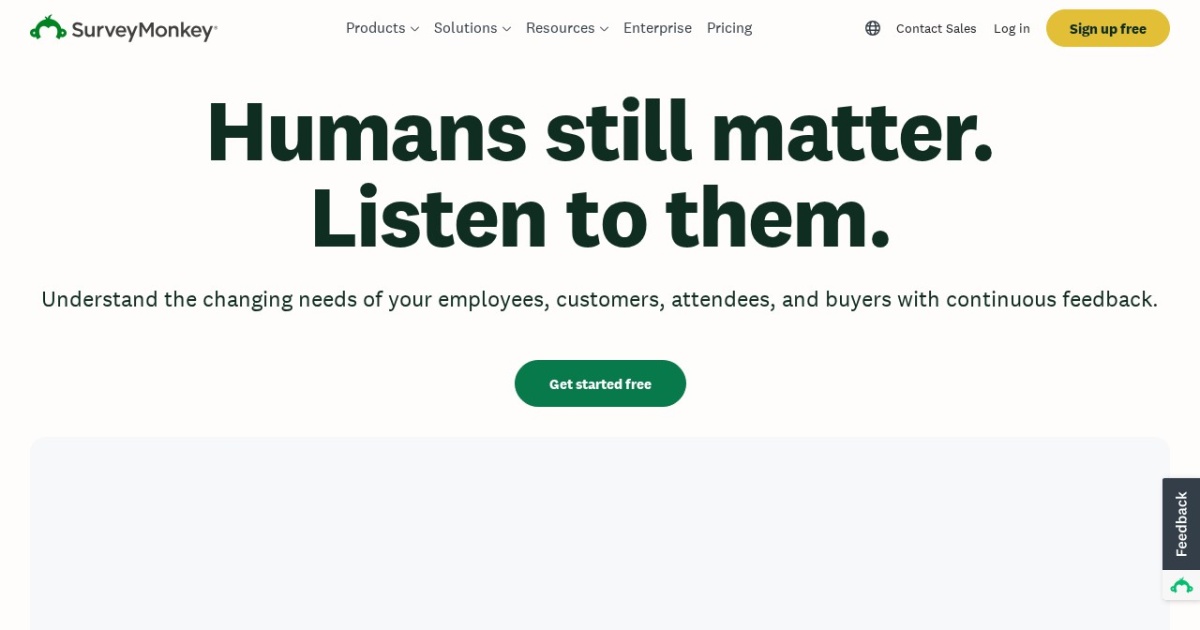
You can clone the homepage in an afternoon, but SurveyMonkey's actual product is a two-decade-deep survey engine, panel marketplace, and enterprise compliance stack that no prompt will ever touch.
You can fork the landing page in a weekend, but not 17 million active users, 84 billion answered questions, and a 25-year-old enterprise survey-data engine.
The landing page is trivial to clone and not worth it standalone; the real business (survey builder, response engine, analytics, panel marketplace, enterprise compliance) requires years and millions in engineering — only worth attempting if targeting a narrow underserved niche (e.g., a vertical-specific survey tool) rather than a full SurveyMonkey replica.
Online survey software is a large, fast-growing market estimated around $5-8B in 2026 with double-digit CAGR (13-18%) through the early 2030s, driven by AI analytics and growing demand for customer/employee feedback tools.
$500-5,000+ depending on scale (hosting, DB, email delivery, CAPTCHA, analytics/observability SaaS)
A clone could monetize via freemium subscription tiers (individual/team/enterprise) like the original, but competing against SurveyMonkey's brand, 17M+ user base, and free Google Forms alternative makes customer acquisition the real cost, not infrastructure.
Google Forms, Typeform, Qualtrics, JotForm, Alchemer, Medallia, SurveySparrow, Formstack, QuestionPro
Freemium SaaS: free tier with limited responses/questions, paid individual/team plans (~$25-99/mo), and custom enterprise pricing with SSO, advanced analytics, and audience panel access.
Large, established global traffic (SurveyMonkey reports 17M+ active users and serves 300K+ organizations); market position is flat-to-growing amid rising competition from free tools like Google Forms.
- Trademark/brand protection on SurveyMonkey name and assets
- Enterprise customers require SOC2/GDPR/HIPAA compliance to compete credibly
- Market research audience panel involves data-licensing/partnership agreements not replicable by scraping
- Crowded, low-differentiation market with free alternatives (Google Forms) commanding largest share
Next.js (App Router) + Supabase/Postgres (DB & auth) + Stripe (billing) + Resend/SendGrid (email distribution) + Recharts/D3 (analytics dashboards) + Vercel (hosting)
Vercel SaaS Starter or Supabase Next.js template as the auth+billing scaffold
- 1.Clone the marketing site (homepage, pricing, product pages) 1:1 with Next.js + Tailwind
- 2.Build a drag-and-drop survey builder (question types, logic branching) as the core editor
- 3.Implement a public survey-response collector with unique links, embeds, and rate-limiting/CAPTCHA
- 4.Design a Postgres schema for surveys, questions, responses, and build a GraphQL or REST API layer
- 5.Build an analytics dashboard (response rates, cross-tabs, sentiment/AI summarization) on top of response data
- 6.Add Stripe subscription billing with tiered plans (individual/team/enterprise) and usage limits
- 7.Layer in enterprise features incrementally: SSO/SAML, team roles, audit logs, integrations (Slack, Salesforce, HubSpot)
▸Technical evidencefacade · hidden · 8 signalsShowHide
A prompt can clone the marketing homepage, pricing grid, and product pages — Next.js static sections with pricing cards, feature carousels, and testimonial blocks are trivial to replicate visually.
Behind the marketing shell sits a 25+ year-old survey-building engine, response collection pipeline, statistical analytics/reporting layer, GraphQL API, enterprise SSO/SAML, AI-powered question generation, a market-research audience panel marketplace, and dozens of native CRM/collaboration integrations serving 300K+ organizations.
You could build it — but that moat means you can't win. Find a better bet.
Analyze a different idea →