Roam Research
10/3/2026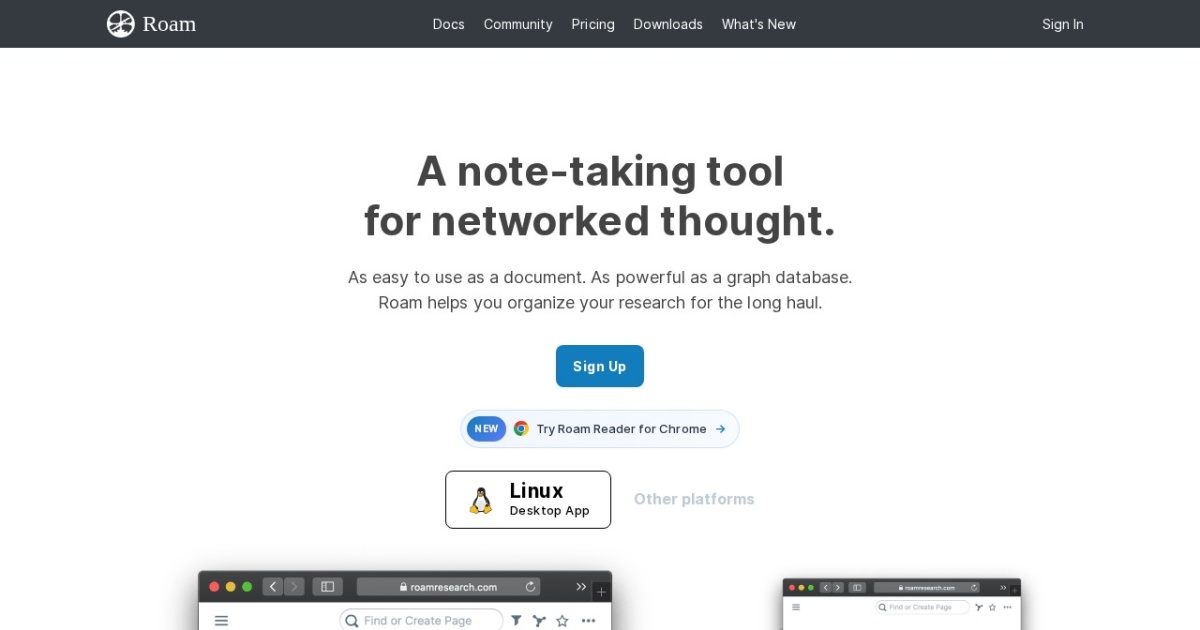
You can clone the "note-taking cult" homepage in an afternoon, but the actual product is a multi-year distributed-systems problem disguised as a text editor.
The landing page is trivial to copy, but the years of accumulated personal knowledge graphs locked in each power-user's account are not — though that moat is visibly eroding as free alternatives catch up.
Not worth it as a direct clone: the landing page is a trivial prompt job, but the real product requires a distributed realtime sync engine, a custom query language, and years of edge-case hardening — while the market has largely moved to free alternatives (Obsidian, Logseq) that already replicate the core value prop at $0.
Note-taking/PKM ("tools for thought") is a crowded, mature niche now dominated by free local-first tools; reviewers increasingly frame Roam as a legacy pioneer whose feature edge has been closed by bidirectional links, block references, and a graph of connected ideas that "every serious note tool has" six years later.
$50–300 (Firebase/Firestore + hosting + CDN + Intercom/analytics tiers at small scale)
A clone could only compete by undercutting on price or targeting a specific underserved workflow (e.g. AI-native networked notes), since block-level linking and bidirectional references are now available in free tools like Logseq and mature ecosystems like Obsidian, making a paid $15/mo subscription a hard sell without a differentiated hook.
Obsidian, Logseq, Notion, Tana, RemNote, Craft Docs, Reflect, Capacities, Mem
Subscription SaaS: no free tier, Pro at roughly $15/mo or $165/yr, plus a discounted long-term "Believer" plan around $500 for 5 years.
Mature/flat-to-declining mindshare — multiple 2026 reviews describe Roam as a "pioneer" being passed by newer free tools rather than a growth story.
- No moat on core features anymore — bidirectional links/block refs are now free in Obsidian/Logseq
- Premium pricing with no free tier in a market full of $0 alternatives
- Cloning the brand/community aspect (not just code) is the actual hard part
Next.js (marketing site) + Supabase (Postgres, Auth, Realtime) or Firebase (to match existing signals) + Yjs/Automerge for CRDT block sync + Stripe for billing + Vercel/Firebase Hosting
Vercel SaaS Starter for the marketing/billing shell; fork an open-source outliner like Logseq or AFFiNE for the actual networked-notes engine instead of building from scratch
- 1.Rebuild the static marketing page (hero, feature sections, pricing table) with a prompt — trivial, 1-2 hours
- 2.Stand up auth + billing shell (Supabase/Firebase Auth + Stripe subscriptions) for the signup funnel
- 3.Fork an existing CRDT-based outliner (Logseq/AFFiNE) rather than writing block-reference/Datalog logic from scratch
- 4.Wire a WebSocket/Yjs provider for realtime multiplayer block editing and presence
- 5.Add bot protection (reCAPTCHA) and support widget (Intercom) to match observed signals
- 6.Build the query layer (Datalog-like or simplified filter/search) incrementally — this is the hardest and most time-consuming piece
- 7.Ship offline-first sync + conflict resolution last, as it's the core technical moat of the real product
▸Technical evidencefacade · hidden · 7 signalsShowHide
A prompt can nail the marketing shell in an afternoon: hero copy, feature sections, pricing table, and fonts/CSS pulled from Blueprint/Tailwind — it's a static informational page with no interactivity beyond links to the app.
Behind the marketing page sits a real-time, offline-capable collaborative outliner with a custom Datalog query engine, Firebase auth/DB, raw WebSocket sync for multiplayer block editing, App Check/reCAPTCHA bot protection, and years of conflict-resolution/CRDT-style logic for networked knowledge graphs.
Clonable and beatable — the fun kind.
Get the full build plan →