Front (front.com)
9/28/2026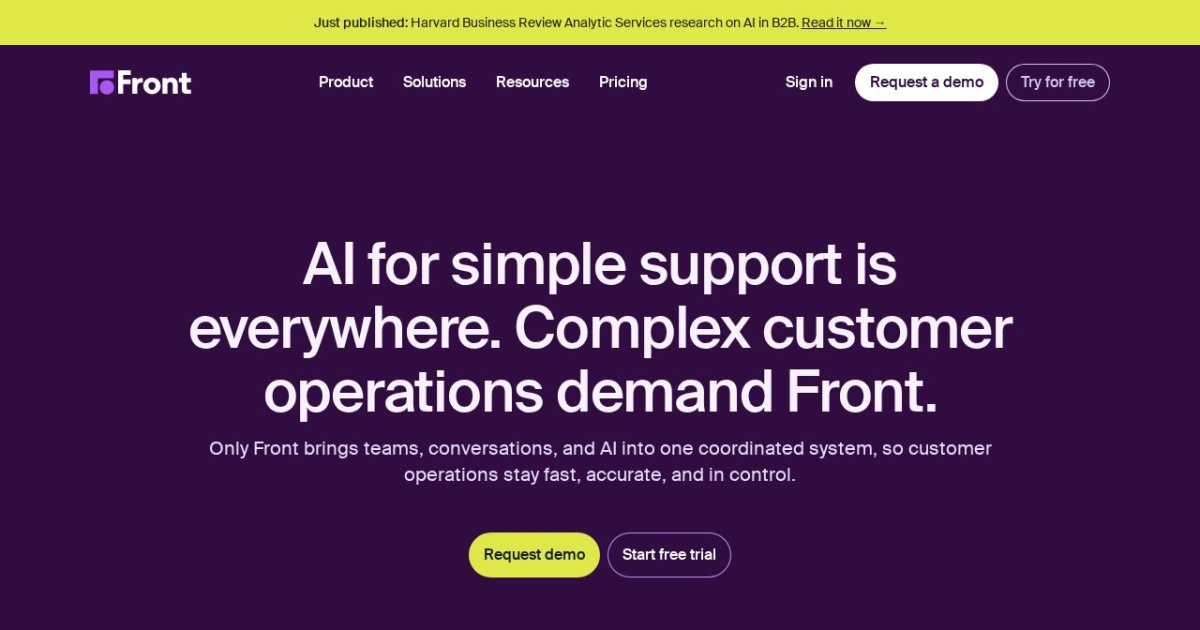
You can clone the brochure in an afternoon; you cannot clone the eight-year-old omnichannel inbox and AI engine that actually sells it.
The landing page is a weekend clone; the 9,000+ paying customers, $200M+ raised, integration marketplace network effects, and 8 years of email/AI infrastructure are not.
Not worth cloning as a business — the landing page is trivial but the real product (omnichannel inbox, AI triage, workflow engine, 9,000+ customer trust/integration ecosystem) took Front $200M+ and 8+ years to build against entrenched incumbents like Zendesk and Intercom; a solo/small team clone has no realistic path to compete on the actual product even though the marketing site is a quick prompt job.
Customer service / shared-inbox software is a large, mature, fast-AI-shifting market with entrenched players.
$500-3,000 for a bare-bones clone (email/SMS APIs like Postmark/Twilio, Postgres/hosting, AI inference costs) scaling quickly with usage and support volume
Seat-based SaaS pricing ($25-$105+/seat/mo per Front's own tiers) is proven to work at scale, but a clone would face a saturated, well-funded competitive set and long enterprise sales cycles before profitability.
Zendesk, Intercom, Help Scout, Freshdesk, Hiver, Missive, Gorgias, Kustomer, HubSpot Service Hub
Per-seat SaaS subscription with tiered plans (Starter/Professional/Enterprise), reportedly around $25/$65/$105+ per user/month billed annually, plus paid add-ons (AI Copilot, Smart QA) and custom enterprise contracts with mandatory onboarding fees above $25k.
Large B2B SaaS with ~9,000+ paying business customers and ~$100M ARR reported for 2025, growing.
- Front trademark/brand
- Enterprise customer data (email/SMS content) requires serious security/compliance (SOC2, GDPR) to compete credibly
- Highly saturated market with entrenched, well-funded incumbents (Zendesk, Intercom)
- AI feature parity requires ongoing model costs and tuning
Next.js (App Router) + Tailwind for the marketing site; for a real product clone: Node/TypeScript backend + Postgres + Redis (real-time) + Postmark/SendGrid + Twilio (SMS/WhatsApp) + OpenAI/Anthropic APIs for AI features + Auth0/Clerk for auth + Stripe for seat billing, deployed on Vercel/AWS
Vercel's Next.js SaaS starter or Cal.com's repo structure as a scaffold for marketing site; for the backend, fork an open-source helpdesk like Chatwoot as the real starting point instead of building from scratch
- 1.Clone the landing/pricing/product-tour pages with Next.js + Tailwind, matching hero, nav mega-menu, and pricing tiers
- 2.Wire up OneTrust cookie consent, HubSpot tracking, and an embeddable interactive demo (Navattic or a custom scroll-driven walkthrough) for visual parity
- 3.Stand up Chatwoot (or similar OSS helpdesk) as the real shared-inbox backend instead of building from zero — customize UI to match Front's brand
- 4.Integrate email (Postmark/SES) and SMS/WhatsApp (Twilio) channels into the inbox with webhook ingestion and threading logic
- 5.Add a rules/automation engine (simple DSL + worker queue) for routing, tagging, and assignment
- 6.Layer AI features: ticket classification, reply drafting, and QA scoring via OpenAI/Anthropic function calls with a review-and-approve UI
- 7.Add Stripe seat-based billing with usage tiers mirroring Front's $25/$65/$105 pricing, plus admin/org/permissions model
▸Technical evidencefacade · hidden · 8 signalsShowHide
A prompt can nail the Next.js marketing site — hero, pricing cards, product-tour pages, nav mega-menus, cookie banner and blog layout — in a day or two of iteration.
Behind the marketing shell sits a full multi-channel inbox/helpdesk product: email/SMS/WhatsApp/chat ingestion and sending infrastructure, shared-inbox real-time sync, workflow/automation rules engine, AI classification & drafting models, analytics/reporting pipeline, permissions & seat-based billing, plus CRM/marketing (HubSpot), support (Intercom/Zendesk-style), commerce, cookie-consent (OneTrust), Optimizely A/B testing, Navattic interactive demos and Qualified chat-routing integrations — none of which is visible in the crawled HTML.
You could build it — but that moat means you can't win. Find a better bet.
Analyze a different idea →