Zapier
7/13/2026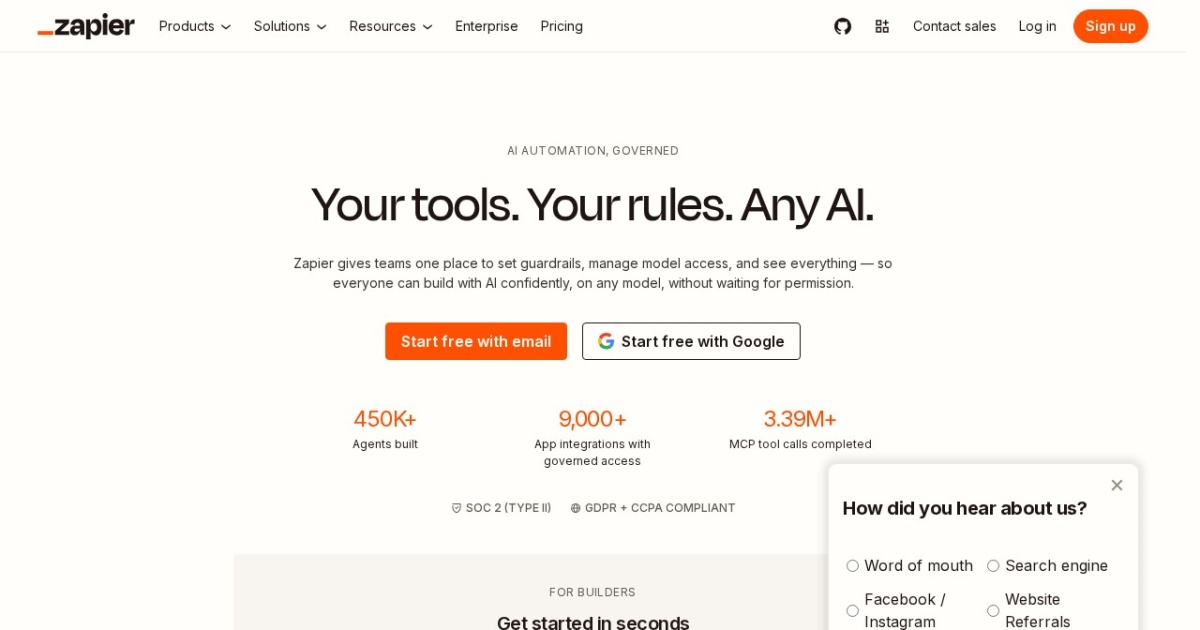
You can clone the homepage in an afternoon; you cannot clone a decade-old integration marketplace connecting 9,000 apps that took $1.4M in funding and a decade to build into a $5B company.
The homepage is a weekend clone; the 9,000-app integration graph, 100k+ paying customers, and 3M-user workflow network built over 14 years is not.
Not worth cloning as a business — the landing page is trivial to fake but worthless without the automation engine, and building real parity means competing against a 14-year, $5B, network-effect-driven incumbent in an already crowded field (Make, n8n, Workato, Power Automate); only worth it as a learning exercise or a narrow vertical-specific automation niche, not a Zapier clone.
Workflow automation/iPaaS is a large, fast-growing market accelerated by AI-agent demand; Zapier itself is estimated near $310–400M ARR and a ~$5B valuation with 100k+ paying customers.
$5k-$50k+ to run even a thin clone at small scale (per-connector OAuth infra, task-execution workers, DB, queueing, AI model costs) — far above typical marketing-site hosting.
A cloned landing page alone makes no money; a real competitor needs the automation engine and would monetize via task-based subscription tiers like Zapier's own $19.99–$599+/mo plans, which is a crowded, capital-intensive fight against well-funded incumbents.
Make (Integromat), n8n, Workato, Microsoft Power Automate, Tray.io, Pabbly Connect, Integrately, Lindy AI, Gumloop, Relay.app
Freemium SaaS: free tier with limited tasks/2-step zaps, then tiered subscription plans (Professional ~$19.99/mo, Team ~$69/mo, Enterprise custom) priced by monthly task volume and features, bundling Tables/Forms/MCP into all paid tiers.
Very large, growing — 3M+ total users, 100,000+ paying customers, and ~$310-400M ARR trajectory as of 2024-2025.
- Trademark/brand imitation risk if cloning name/branding
- Massive licensing/partnership complexity to replicate 9,000+ app integrations legitimately (each requires API/OAuth agreements)
- Regulatory/data-privacy obligations (handles customer data across thousands of third-party apps)
Next.js (App Router) + Vercel hosting + Framer Motion for animations + Cloudinary for media + Supabase/Postgres only if adding a toy backend; real automation engine would need Node/Temporal workers + Postgres + Redis queue + OAuth2 provider integrations
Vercel's Next.js SaaS marketing template + shadcn/ui component kit
- 1.Fork a Next.js marketing starter and replicate the header/hero/section layout seen on zapier.com
- 2.Recreate product sub-pages (/workflows, /tables, /forms, /agents) as static content-driven routes with Cloudinary-hosted images/video
- 3.Wire up Optimizely or a lightweight feature-flag lib only if A/B testing is required; otherwise skip
- 4.Add OneTrust or a simple cookie-consent banner + GTM snippet for parity
- 5.If building an actual MVP automation core: pick 5-10 popular APIs, build OAuth connect flows, a trigger-poller, and a simple task queue (BullMQ/Temporal) to chain actions
- 6.Add metered billing via Stripe usage-based pricing to mimic the task-based subscription model
- 7.Layer a support widget (Intercom/Crisp) and basic analytics (PostHog) to match observed backend signals
▸Technical evidencefacade · hidden · 10 signalsShowHide
A prompt tool can recreate the marketing shell — hero copy, product-tile sections for Workflows/Tables/Forms/Agents/Canvas, video/image blocks, and a Next.js/Framer-style layout with cookie-consent and A/B test scaffolding.
Behind the landing page sits Zapier's actual product: a workflow execution engine orchestrating 9,000+ app integrations with per-app OAuth/API credential management, a task queue processing billions of automations/month, tiered metered billing, an AI agent runtime (MCP, agent-to-agent orchestration), a Tables/Forms mini-database product, and enterprise-grade governance/SSO — plus marketing infra (Optimizely experiments, Cloudinary media pipeline, Segment/analytics, Intercom-style support, CRM).
You could build it — but that moat means you can't win. Find a better bet.
Analyze a different idea →