PagerDuty
7/26/2026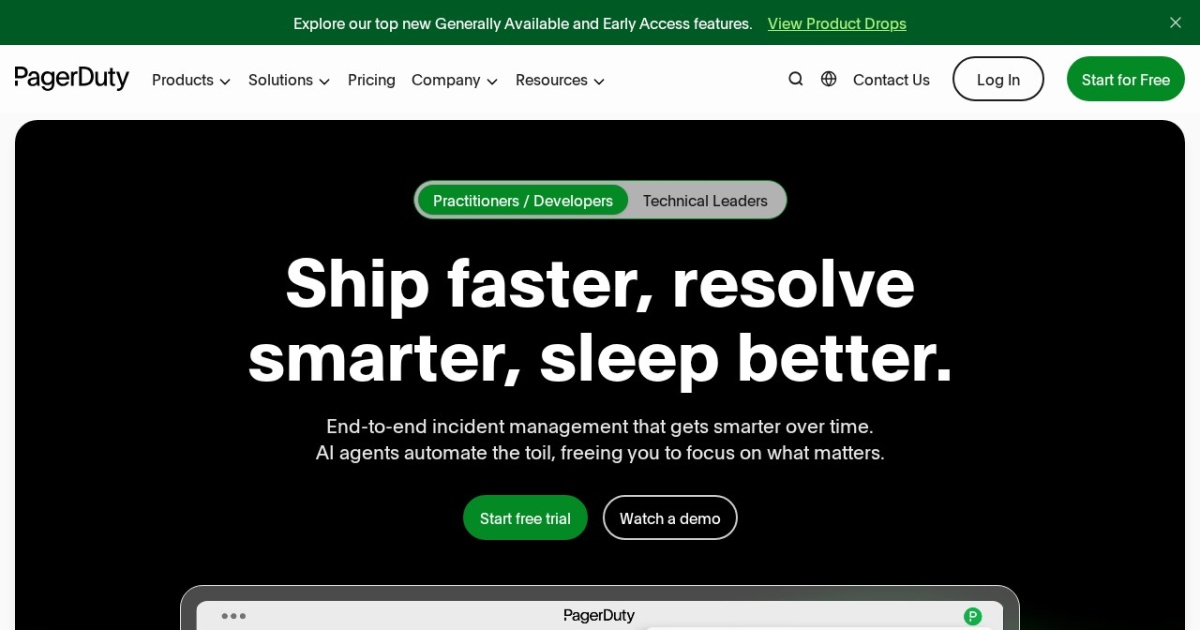
You can clone the website in a weekend; you cannot clone the pager that has to wake up an engineer at 3am with five-nines reliability.
The landing page is a weekend clone; the 750+ integrations, Fortune-100 install base, and compliance certifications behind it took 15+ years to build.
Not worth cloning as a business — the landing page is trivial to fake but valueless without the alerting engine, and the real product requires years of reliability engineering, hundreds of integrations, and enterprise trust (compliance, SLAs) that no amount of prompting reproduces; competing on price against cheaper modern entrants (incident.io, Rootly, FireHydrant) is a more realistic path than cloning PagerDuty wholesale.
Incident management/on-call/AIOps is a large, growing enterprise category. PagerDuty differentiates on depth of enterprise features, compliance posture (FedRAMP Low Authorization achieved in 2025), 750+ out-of-box integrations, and its dominant market share among Fortune 100 companies (68% penetration). The space is being pressured by cheaper, more modern entrants and by observability vendors bundling incident response.
$50-300 for a marketing-site clone (Vercel/Next.js hosting + headless CMS + Algolia + Segment tiers); a real incident-alerting backend would cost tens of thousands/month (SMS/voice gateways, redundant infra, SLAs)
A cloned landing page alone generates no revenue — it's a lead-gen funnel for a SaaS product. Building the underlying alerting/on-call product to actually monetize would require rebuilding paging infrastructure, integrations, and enterprise trust that a small team cannot realistically deliver profitably against an entrenched incumbent.
Opsgenie (Atlassian), Splunk On-Call (Cisco), Datadog Incident Response, incident.io, FireHydrant, Rootly, xMatters, Grafana OnCall, ServiceNow, BigPanda, Moogsoft
Freemium → per-seat SaaS tiers: the cheapest paid PagerDuty plan is the Professional plan at $21 per user per month when billed annually, supporting basic on-call scheduling, notifications, SSO, and integrations, up to a custom-priced Enterprise/Digital Operations tier plus paid add-ons for AIOps, status pages, and runbook automation.
Large, established enterprise SaaS with global traffic (millions of visits/mo range typical for a public company of this scale); flat-to-growing given AI/AIOps push and FedRAMP expansion.
- Trademark/brand — 'PagerDuty' name and UI are protected
- Enterprise compliance claims (FedRAMP, SOC2) cannot be legitimately replicated by a clone
- Scraping WordPress JSON endpoints for content may violate ToS
- No realistic regulatory/compliance path for a clone entering incident-management space for regulated industries
Next.js (App Router) + Tailwind for the marketing site; headless CMS (Sanity/Contentful/WordPress) for content; Algolia for search; Segment + Cloudflare for analytics; Vercel hosting
Vercel's Next.js SaaS marketing template (or 'Taxonomy' Next.js starter) + a headless CMS starter kit
- 1.Scaffold Next.js app with App Router, set up marketing routes (/, /pricing/*, /platform/*, /contact-us, /sign-up)
- 2.Wire a headless CMS (WordPress REST API or Sanity) to drive page content and enable /de, /fr locale variants via next-intl
- 3.Integrate Algolia/Typesense for the /search page against indexed CMS content
- 4.Add Segment snippet + Cloudflare Insights + OneTrust cookie consent banner for parity with observed 3rd-party scripts
- 5.Build pricing tables and comparison pages as static/CMS-driven components
- 6.Add a simple contact/sign-up form posting to a serverless function → CRM (HubSpot/Salesforce) or email service
- 7.Skip the actual incident-management backend entirely — it is out of scope for a prompted clone; if desired, fake it with a demo dashboard using mock WebSocket data only
▸Technical evidencefacade · hidden · 9 signals · DR 84ShowHide
A prompt can clone the marketing shell: Next.js SSR pages, hero sections, pricing tables, blog/CMS-fed content, language variants, and the search/contact forms wired to a headless CMS.
Behind the marketing site sits a decade-old, mission-critical incident-alerting platform — real-time event ingestion, on-call scheduling engines, multi-channel dispatch (SMS/voice/push), 750+ native integrations, ML-based event correlation (AIOps), SSO/enterprise auth, compliance certifications (FedRAMP), and a global reliability infrastructure that pages people at 3am with 99.99%+ delivery guarantees.
You could build it — but that moat means you can't win. Find a better bet.
Analyze a different idea →