Chargebee
10/12/2026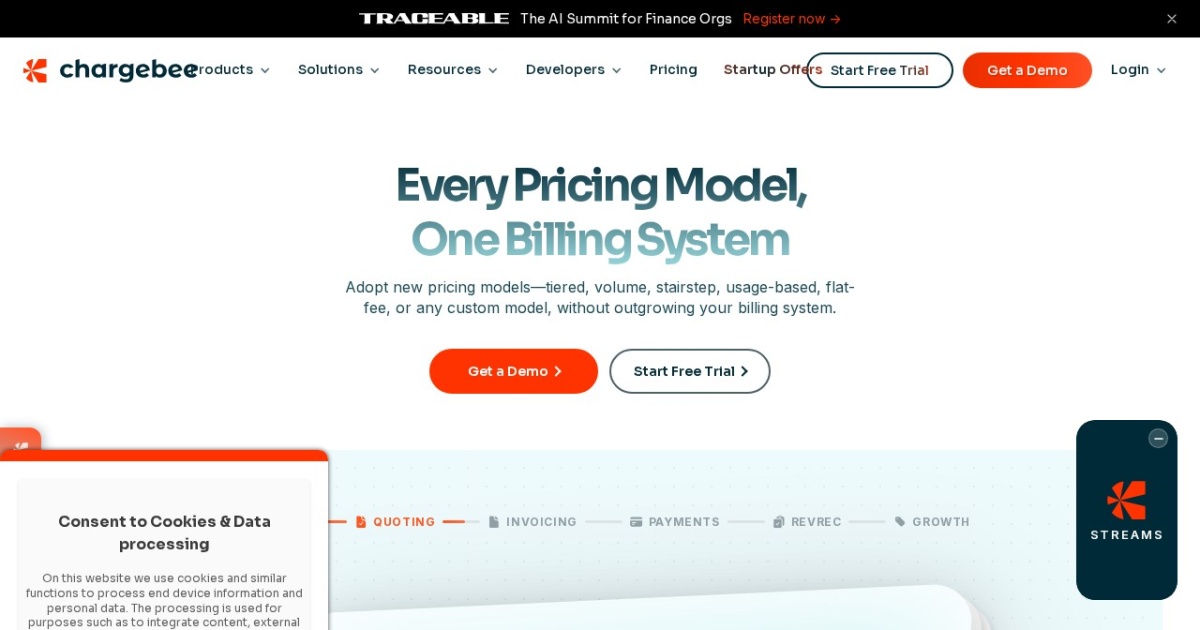
You can clone the glossy Nuxt landing page in a weekend, but you'd be cloning the wrapper around a $3.5B fintech core that took a decade and half a billion dollars to build.
You can clone the pretty pricing page in an afternoon, but not 18,000 paying customers, PCI-DSS certification, a Gartner Magic Quadrant Leader badge, or $475M in investor capital.
Not worth cloning as a business — the landing page is trivial to fake but worthless without the regulated, capital-intensive billing infrastructure behind it; this is a "don't" unless the goal is purely a design portfolio piece.
Huge and growing: the subscription-billing/recurring-revenue software market spans Stripe Billing, Zuora, Recurly, Maxio, Zoho Billing, Paddle, and others, with the subscription economy broadly valued in the hundreds of billions to trillions globally.
$50-300 for a basic clone landing page + CMS; a real billing backend would run $5k-50k+/mo at scale (PCI compliance, payment processing infra, databases, support tooling)
The landing page alone generates no revenue; monetizing a real clone requires becoming a licensed payments/billing processor with PCI compliance, gateway partnerships, and enterprise sales — a multi-year, capital-intensive undertaking, not a prompt-and-launch business.
Stripe Billing, Zuora, Recurly, Maxio, Paddle, Zoho Billing, Sage Intacct, Orb, Younium, Lago
Tiered SaaS subscription pricing (e.g. Starter/Performance/Enterprise, roughly $249-$599+/mo plus revenue-based fees) upsold with enterprise contracts and an AI payments add-on (INAI acquisition).
Large B2B SaaS audience; Chargebee reported $202.6M 2024 revenue (+62.9% YoY) across 18,000+ customers, indicating strong and growing enterprise demand.
- PCI-DSS compliance required for any real payments handling
- Regulated financial services space (money movement, tax, revenue recognition)
- Trademark/brand infringement if visually copying Chargebee
- Exclusive enterprise partnerships and Gartner-recognized positioning not replicable
Nuxt 3 + Tailwind for the frontend; Sanity or Contentful as headless CMS; Supabase/Postgres only if building a toy backend; Stripe Connect/Billing if actually attempting real subscription logic
Nuxt 3 'Nuxt Content' marketing starter or a Tailwind UI landing template
- 1.Scaffold Nuxt 3 app and port the Tailwind design tokens/utility classes from the crawled HTML
- 2.Build CMS-driven content blocks (hero, logos, testimonials, pricing tiers) wired to Sanity/Contentful
- 3.Recreate pricing page tables and comparison grids as static components fed by CMS data
- 4.Add Intercom/Zendesk widget, GTM, and a CAPTCHA-protected demo-request form posting to a serverless function or CRM webhook
- 5.Stub '/trial-signup' and '/schedule-a-demo' with simple forms (no real billing logic) that hit a lead-capture backend like HubSpot or a Postgres table
- 6.If attempting real functionality, integrate Stripe Billing as the actual payment/subscription engine rather than building one from scratch
▸Technical evidencefacade · hidden · 9 signalsShowHide
A prompt can replicate the Nuxt-based marketing site's look: hero sections, pricing tables, testimonial carousels, and the Tailwind-driven responsive layout with CMS-fed content blocks.
Behind the marketing shell sits a full PCI-compliant subscription billing engine: multi-gateway payment orchestration, dunning/revenue-recovery logic, tax engines, revenue recognition (ASC 606/IFRS 15), usage metering at scale, a public API/webhook platform (apidocs.chargebee.com), and an AI payments acquisition (INAI) — none of which is visible in the crawled HTML/JS.
You could build it — but that moat means you can't win. Find a better bet.
Analyze a different idea →