How is Typeform built — and could you clone it?
Last analyzed 7/13/2026 · full report
https://typeform.com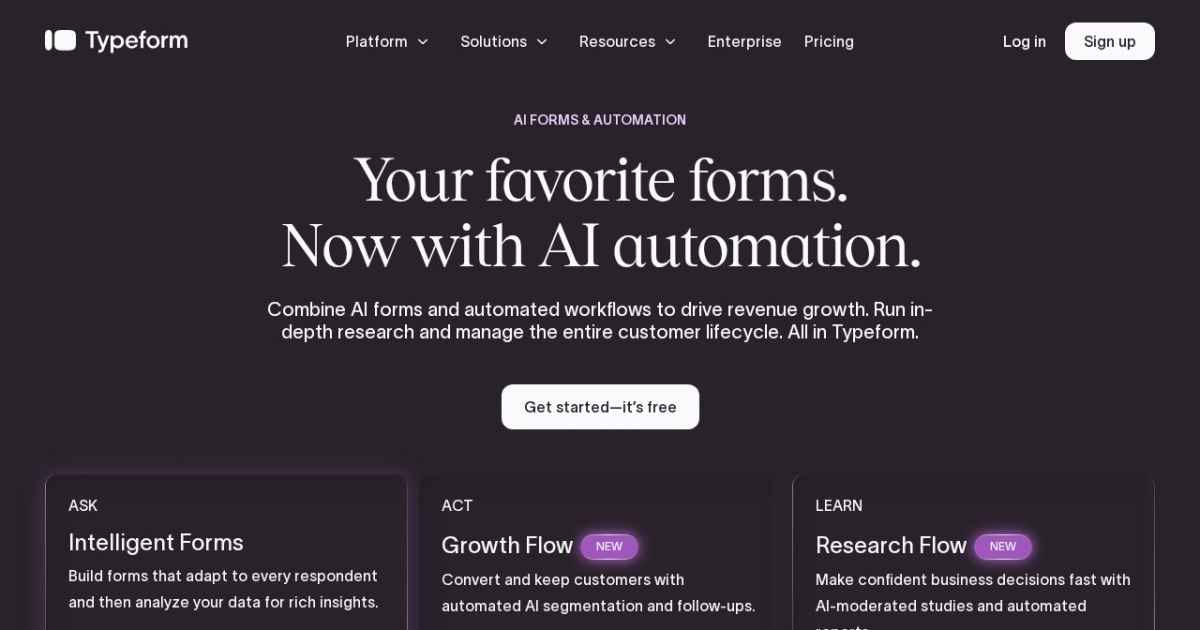
You can clone the pretty brochure in an afternoon, but the actual product — a decade-old conversational form engine with AI, payments, and enterprise compliance — is not a weekend prompt away.
The landing page is a weekend Webflow clone; the 14-year-old form-building category leader with millions of users, deep integrations, and enterprise trust is not.
Not worth building as a full clone — the market is crowded with well-funded, feature-complete alternatives and the real product requires months of backend work (payments, AI, compliance); but a narrow niche fork (e.g., generous-free-tier conversational form builder) could carve a small profitable slice given persistent complaints about Typeform's response caps and pricing.
Large and growing: the online form/survey builder space includes dozens of active competitors and is expanding due to AI-driven lead qualification and conversational forms.
$500–5,000+ depending on video/AI usage and response volume (hosting, DB, video storage, AI API calls, email/CRM integrations)
A clone could monetize via the same metered-response SaaS model Typeform uses, but margins depend on undercutting Typeform's widely-criticized pricing (its business model feels hostile with essential features like CAPTCHA locked behind expensive plans and it hard to access your own data if you downgrade) — several challengers (Formbricks, Tally, forms.app) already compete directly on generous free tiers.
Jotform, SurveyMonkey, Tally, Fillout, Paperform, involve.me, Formbricks, SurveySparrow, HubSpot Forms, Google Forms
Freemium metered-response SaaS: free tier (10 responses/mo) → Core plans Basic/Plus/Business (~$25-99/mo based on response volume) → Growth plans Essentials/Pro (~$199-349/mo) for lead-gen/CRM features → custom Enterprise/Talent plans with SSO, HIPAA, dedicated CSM.
Large established traffic base (~49,000+ companies reportedly use Typeform per Datanyze) though ranked outside the top tier of form builders (#7) by some market-share trackers; flat-to-growing amid intensifying AI-conversational-forms competition.
- Trademark/brand recognition risk if cloning name/design too closely
- Enterprise compliance claims (HIPAA, GDPR, SOC2) require real audits, not just UI copy
- Payment processing (Stripe/PayPal) requires proper PCI compliance
- Crowded competitive market with many funded incumbents
Next.js + Supabase (Postgres, auth, storage) + Stripe for payments + Resend/SendGrid for email + Cloudflare Stream or Mux for video questions + OpenAI API for AI question generation
Vercel SaaS Starter or Supabase Next.js SaaS template
- 1.Fork a Next.js + Supabase SaaS starter for auth, billing, and multi-tenant workspaces
- 2.Build the form editor UI (drag-and-drop question blocks, logic-jump graph) as the core differentiator
- 3.Build the public form renderer (one-question-at-a-time UX, animations, mobile-responsive)
- 4.Add response storage + a basic analytics/reporting dashboard (drop-off rates, completion funnels)
- 5.Integrate Stripe Checkout for payment-collection forms and Stripe Billing for the SaaS subscription tiers
- 6.Add Zapier/webhook + native Slack/HubSpot/Salesforce integrations for lead routing
- 7.Layer in AI features (OpenAI-powered question suggestions, lead scoring) and video question support via Mux
- 8.Clone the Webflow marketing site 1:1 with a static site generator for the front door
▸Technical evidencefacade · hidden · 10 signals · DR 93ShowHide
A prompt can trivially clone the Webflow-built marketing site — hero copy, feature sections, pricing tables, and CTAs — since it's just static HTML/CSS with GTM, OneTrust cookie banner, and a few animation scripts.
Behind the marketing site sits the actual Typeform product: a form-rendering/logic-jump engine, response storage and analytics pipeline, video hosting for VideoAsk-style questions, AI question-generation and lead-enrichment services, Stripe/PayPal payment collection, Salesforce/HubSpot/CRM integrations, SSO/SAML, HIPAA/GDPR compliance infrastructure, and a partner/affiliate tracking system (PartnerStack) — none of which is visible in the crawled HTML.
You could build it — but that moat means you can't win. Find a better bet.
Analyze a different idea →