How is Trello (Atlassian) built — and could you clone it?
Last analyzed 7/12/2026 · full report
https://trello.com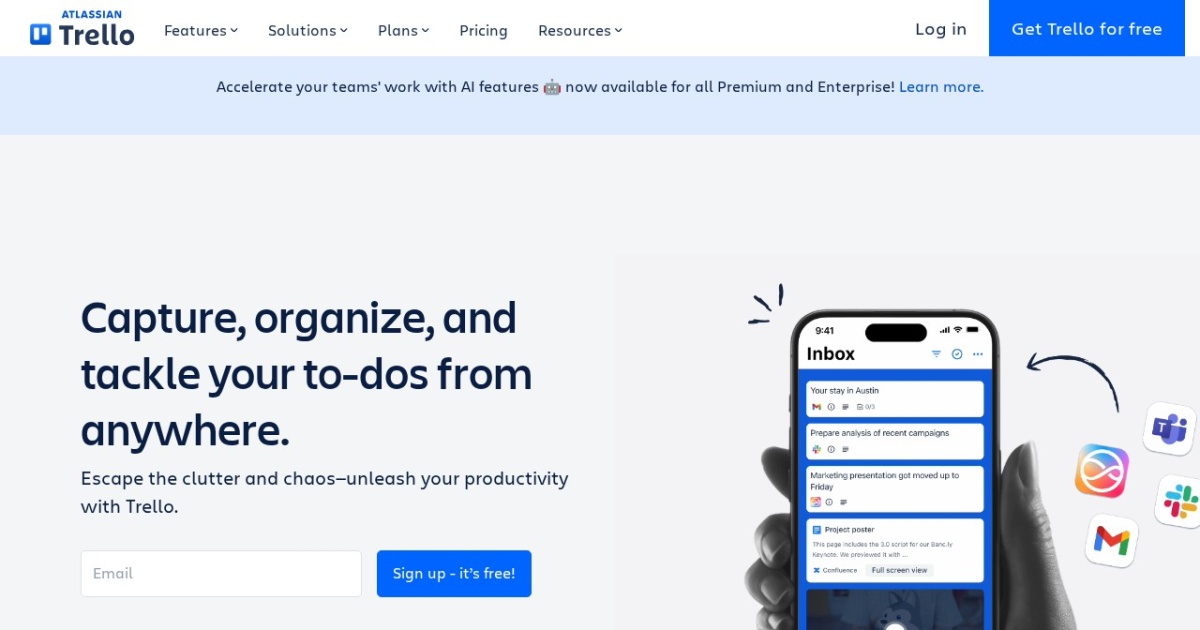
You can clone Trello's homepage in a weekend, but you'll spend the rest of your life trying to clone the drag-and-drop sync engine and Butler automation that actually make it a product.
You can clone the kanban board in a weekend, but not Atlassian's 50M-user network, decade of trust, and 200+ Power-Ups ecosystem.
Not worth it as a Trello competitor — the landing page is trivial to fake but the real product (real-time collaborative boards, automation engine, integrations marketplace, enterprise security) is a years-long, well-funded engineering effort competing in a saturated market against a free incumbent with 50M+ users; only worth it as a portfolio/learning exercise, not a business.
Massive and mature: Trello draws tens of millions of monthly visits and 50M+ registered users, but the broader kanban/PM space is crowded with entrenched, well-funded competitors.
$50–500 for a small-scale kanban clone (hosting, Postgres, websocket server, S3-like storage); scales into thousands with real usage
A clone could monetize via freemium subscriptions (per-seat pricing) like the original, but competing against a free, entrenched incumbent with network effects and a 200+ integration marketplace makes user acquisition extremely costly.
Asana, Monday.com, ClickUp, Notion, Jira, Wrike, Airtable
Freemium SaaS: free tier (10 boards/workspace) → Premium and Enterprise per-user monthly/annual subscriptions with advanced security, automation (Butler), and admin controls; part of Atlassian's broader ~$5.2B/year revenue portfolio.
~10-75M monthly visits to trello.com (estimates vary by source), largely direct/returning-user traffic; roughly flat to slightly growing.
- Trello/Atlassian trademark and brand protection
- Bot/CAPTCHA protection on signup suggests anti-scraping and anti-abuse enforcement
- Power-Ups marketplace and third-party integrations imply partnership agreements not replicable by a clone
- Enterprise customers require SOC2/compliance certifications to compete credibly
Next.js (marketing + app shell) + Supabase (Postgres, Realtime, Auth, Storage) + Stripe for billing + Vercel hosting
Vercel/Supabase 'Kanban board' starter template or Taskade/Planka open-source kanban clone as base
- 1.Fork an open-source kanban clone (e.g. Planka, Wekan) or start from a Next.js + Supabase realtime starter for the board/card data model
- 2.Rebuild the marketing site (hero, pricing, feature pages) as static Next.js pages matching the crawled route structure (/home, /pricing, /inbox, /planner, /butler-automation, /power-ups, /templates, /integrations)
- 3.Implement auth via Supabase Auth or Clerk with email/OAuth (Google) sign-up flow mimicking id.atlassian.com's signup redirect
- 4.Build the core board/list/card CRUD with drag-and-drop (dnd-kit) and wire to Supabase Realtime channels for multi-user sync
- 5.Add a lightweight automation engine (Butler-equivalent): a rules table + serverless functions triggered on card events
- 6.Integrate Stripe for Free/Premium/Enterprise tiers with per-seat billing
- 7.Add a Power-Ups style plugin API (webhook + iframe embed spec) if pursuing marketplace parity — otherwise skip for MVP
▸Technical evidencefacade · hidden · 5 signals · DR 91ShowHide
A prompt tool can trivially clone the marketing pages (hero, pricing table, feature pages for Inbox/Planner/Butler/Power-Ups) as static Next.js pages with Atlassian-style fonts and layout.
Behind the marketing shell sits Atlassian's real-time board/card sync engine, a multi-tenant Postgres/Cassandra data layer, OAuth/SSO auth (id.atlassian.com), a 200+ app Power-Ups marketplace, Butler's rules-based automation engine, billing/subscription infrastructure, and enterprise admin/security tooling — none of which is visible in the crawl but all of which are load-bearing.
You could build it — but that moat means you can't win. Find a better bet.
Analyze a different idea →