How is Todoist built — and could you clone it?
Last analyzed 9/26/2026 · full report
https://todoist.com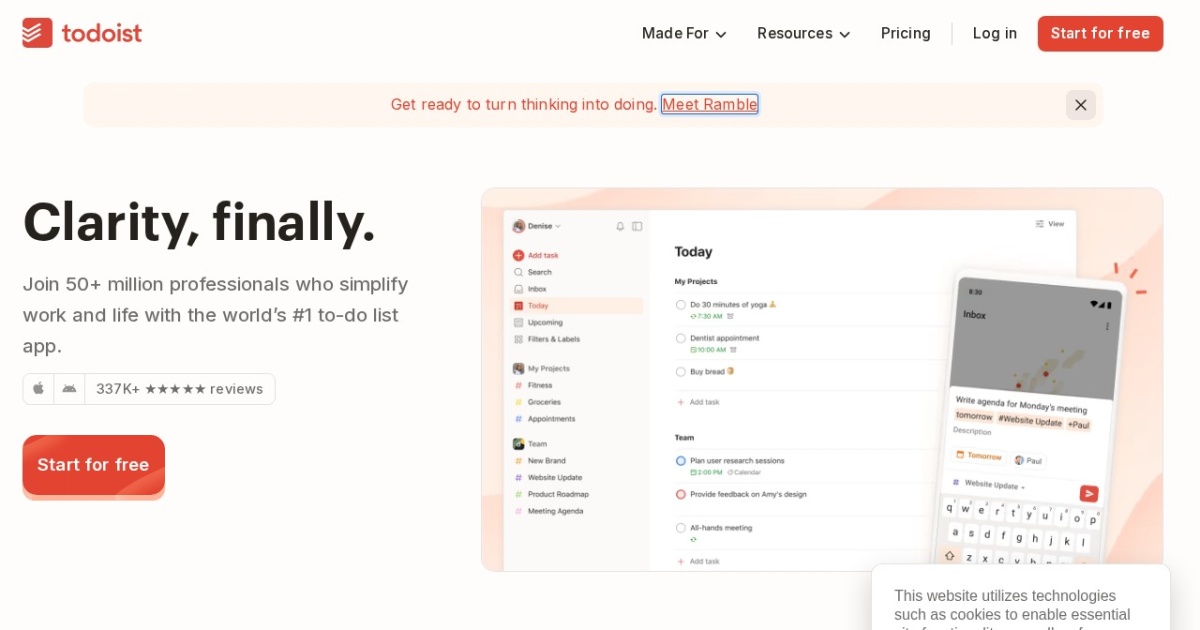
You can clone the billboard in an afternoon; you cannot clone the 15-year-old sync engine and 30-million-user habit loop hiding behind the "Sign up" button.
The landing page is a weekend clone; the 30-million-user install base, cross-platform sync reliability, and collaborative-project network effects are not.
Not worth cloning as a business — the landing page is trivial but the real product is a mature, deeply-integrated multi-platform sync system defending a 30M-user base; a clone would only be useful as a portfolio/demo piece, not a viable competitor.
Task/productivity management is a large, mature, highly competitive market with steady demand; Todoist itself is described as a "free plan, unlimited at $7/user/month" service trusted by tens of millions, though the category has fragmented with AI-first and voice-first entrants pressuring incumbents.
$50-300 (hosting + Postgres/Redis + push notification services + CDN) for a small-scale clone; grows fast with real-time sync fan-out at any real user count
A cloned landing page earns nothing on its own; monetizing would require rebuilding the entire sync/collaboration backend and competing on price against cheaper entrants like TickTick, which is already squeezing Todoist after its "Pro plan price in December 2025 to $5/month billed annually" increase.
TickTick, Any.do, Things 3, Sunsama, Microsoft To Do, ClickUp, Asana, Notion, quik.md
Freemium SaaS: free 'Beginner' tier capped on projects, paid Pro (~$5-7/mo) and per-seat Business (~$8-10/user/mo) tiers, historically raising prices to fund added AI features like Ramble and Task Assist.
Tens of millions of registered users (Todoist markets itself as trusted by 30 million people and teams); site traffic is large and stable/growing given its long-standing top ranking in the to-do app category.
- Todoist trademark/brand cloning risk if copy or design is reused verbatim
- Cloudinary asset URLs are first-party and licensed, not reusable
- Competing on price is hard post price-hike since cheaper alternatives (TickTick, Microsoft To Do) already undercut it
Next.js (marketing) + Supabase/Postgres (auth, DB, realtime) + Stripe (billing) + Cloudinary (media) + Vercel (hosting)
Vercel's Next.js SaaS Starter or Astro marketing template, paired with a Supabase realtime-todo starter for the app shell
- 1.Fork a Next.js/Astro marketing starter and rebuild the hero, feature pages (/task-management, /project-management, /time-management) and pricing page from the crawled copy
- 2.Wire Cloudinary for product screenshots/looping demo videos exactly as seen in the imagist asset URLs
- 3.Add Osano-style cookie consent + GTM with default-denied consent state to match the observed pattern
- 4.Stand up Supabase (Postgres + Row Level Security) for users, projects, tasks, and a realtime channel for live task sync across sessions
- 5.Implement recurring/natural-language due-date parsing (chrono-node) and a basic offline-first cache (IndexedDB + background sync)
- 6.Add Stripe subscriptions for Pro/Business tiers with per-seat billing logic
- 7.Build minimal mobile/web parity via a PWA shell before ever attempting native iOS/Android apps
▸Technical evidencefacade · hidden · 5 signalsShowHide
A prompt can nail the marketing site: hero copy, feature pages (task/project/time management), Cloudinary-hosted product videos, and responsive Astro-style layout with consent/analytics scripts wired up.
Behind the marketing shell sits a mature, multi-platform sync engine (web, iOS, Android, desktop, browser extensions, email/calendar integrations) with real-time collaboration, offline-first conflict resolution, recurring-task NLP parsing, notifications, Karma gamification, 60+ third-party integrations, SOC2-compliant auth/billing, and now AI features (Ramble voice capture, Task Assist) — none of which is visible in the crawled HTML/JS.
You could build it — but that moat means you can't win. Find a better bet.
Analyze a different idea →