How is Statuspage.io (Atlassian) built — and could you clone it?
Last analyzed 7/26/2026 · full report
https://statuspage.io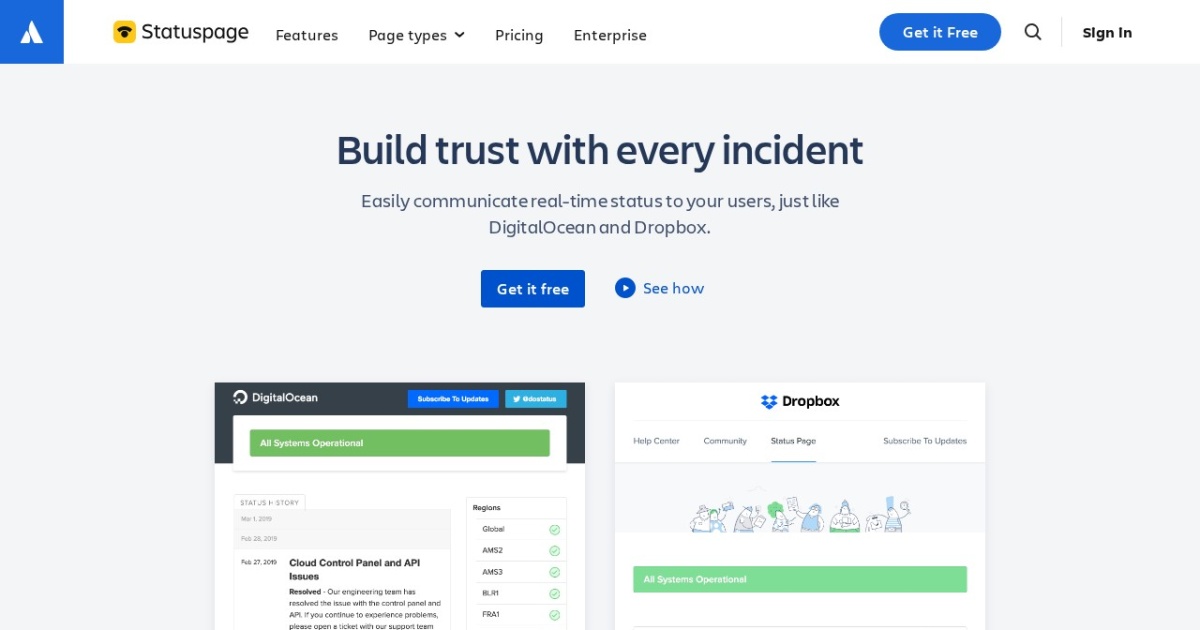
You can clone the brochure in an afternoon, but the actual product is a mature multi-tenant incident-comms platform Atlassian has hardened for a decade.
The landing page is trivial to clone; the moat is Atlassian's brand, decade-plus incumbent install base, and deep Jira/Opsgenie/Guard ecosystem lock-in.
The landing page alone isn't a business — it's just marketing collateral; cloning only the facade has no standalone value. Building the full product is technically approachable (CRUD + notifications + multi-tenant pages) but commercially crowded with well-funded, cheaper alternatives (Instatus, Better Stack, Hyperping) already eating Atlassian's lunch on price and modern UX, making it a tough, low-differentiation market to enter from scratch.
Status-page/incident-communication is an established, growing niche within IT monitoring/incident management, with dozens of active competitors and steady enterprise demand tied to SaaS uptime transparency requirements.
$20–150 for a bare-bones clone (hosting + transactional email/SMS + status DB); scales quickly with subscriber notification volume (SMS/email costs)
Real product could monetize via tiered SaaS subscriptions (as incumbents do, $29-$1,499/mo), but margins get eaten by SMS/notification costs and the market is crowded with cheaper, more modern alternatives undercutting Atlassian on price.
Instatus, Better Stack (Betterstack), Hyperping, UptimeRobot, StatusGator, Freshstatus, Statuspal, OpenStatus, Cachet (open-source), Incident.io
Tiered SaaS subscriptions split across public-page, private-page, and audience-specific-page pricing lines, from a free tier (100 subscribers) up to $1,499/mo enterprise, plus Atlassian Guard SSO add-on bundling.
Large, established traffic as an Atlassian product line (millions of end-users viewing status pages); flat-to-declining new-customer growth per market commentary noting newer entrants overtaking it on price/features.
- Atlassian trademark/brand
- Highly commoditized/competitive space with many cheaper incumbents
- Notification costs (SMS) can erode margins at scale
- No exclusive data/tech moat if rebuilt from scratch
Next.js + Supabase (Postgres, Auth, Realtime) + Twilio (SMS) + Resend/Postmark (email) + Stripe (billing) + Vercel
Vercel SaaS Starter or Supabase Next.js template
- 1.Fork a Next.js + Supabase SaaS starter for auth, org/team multi-tenancy, and Stripe billing scaffolding
- 2.Design schema: organizations, status_pages, components, incidents, incident_updates, subscribers, metrics
- 3.Build public status page renderer (SSR, custom domain support) + private/authenticated page variant with invite-based access
- 4.Add subscriber notification pipeline: email via Resend/Postmark, SMS via Twilio, Slack/Teams via webhooks, triggered on incident_updates insert (Supabase Realtime or DB triggers)
- 5.Build incident management dashboard (CRUD for incidents/components/metrics) with role-based team member access
- 6.Implement integrations marketplace stubs (Slack, PagerDuty, Datadog webhooks) and a public REST API for status data
- 7.Recreate the marketing site with Contentful (or MDX) for localized content, reCAPTCHA on forms, and a cookie-consent banner (OneTrust equivalent) — deploy on Vercel
▸Technical evidencefacade · hidden · 7 signals · DR 89ShowHide
A prompt can quickly recreate the marketing page: hero copy, feature grids, pricing tables, and CTA buttons pulled from a headless CMS, styled with Atlassian's design system fonts.
Behind this landing page sits the actual Statuspage SaaS product: multi-tenant incident management, real-time public/private status pages served on custom domains, subscriber notification pipelines (email/SMS/Slack/Teams/webhook), metrics ingestion, 150+ third-party integrations, SSO/Atlassian Guard auth, billing/subscription infrastructure, and Atlassian's internal Contentful-driven CMS and localization pipeline across 12+ languages.
You could build it — but that moat means you can't win. Find a better bet.
Analyze a different idea →