How is Skool.com built — and could you clone it?
Last analyzed 10/15/2026 · full report
https://skool.com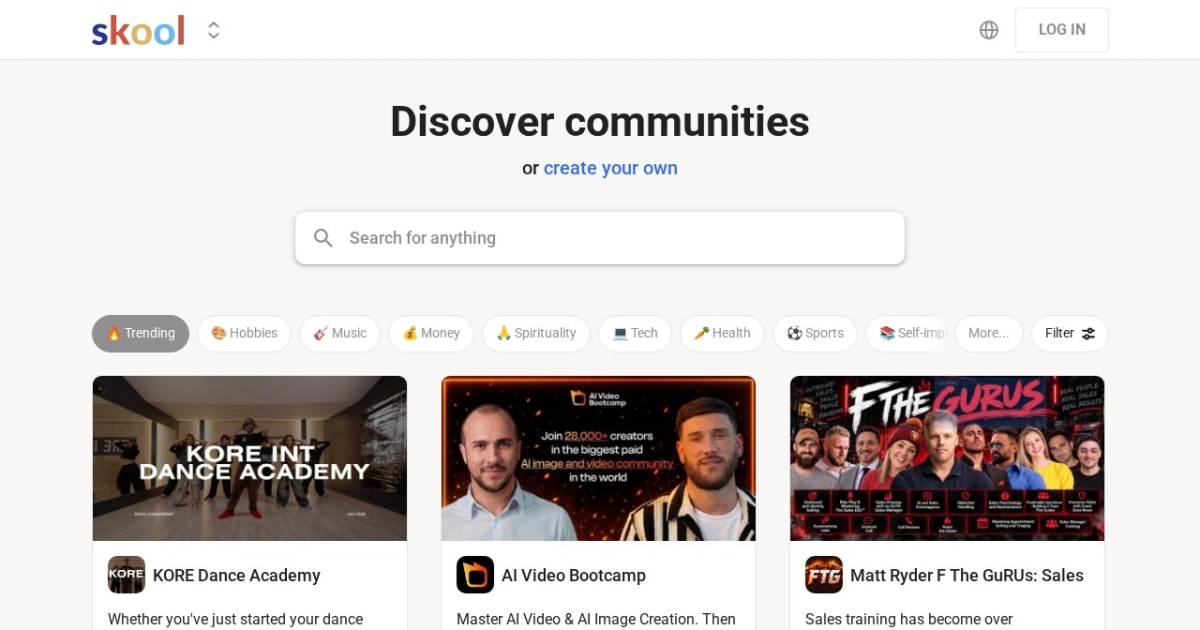
The homepage is a blank box behind a bot-wall, but what it gates is a venture-scale, billion-dollar community-and-payments engine you cannot prompt your way into.
You can clone the sparse landing page in an afternoon, but not the ~37M monthly visits, Alex Hormozi-fueled creator network, or the built-in payments rails processing millions in community subscriptions.
Not worth it as a head-on clone: the landing page is a non-issue, but the real product is a mature, capital-backed, network-effects-driven community/LMS/payments platform competing in a crowded field (Circle, Mighty Networks, Kajabi) — a solo prompt-built clone has no distribution and no realistic path to compete.
Massive and growing creator-economy/community-platform market; Skool itself pulls roughly 37-38M monthly visits and is reported to be valued north of $1B following an a16z-led growth round.
$500–3,000 (hosting, video/CDN storage, DB, payment processing fees, bot-protection/WAF)
A clone could copy the flat-fee-plus-transaction-percentage model ($9-99/mo + 2.9-10% take rate) seen across competitors, but without existing creator distribution it would need to win creators away from an entrenched, Hormozi-endorsed network — a very hard sell.
Circle, Mighty Networks, Kajabi, Podia, Heartbeat, Discord, Patreon, Whop, Teachable, Thinkific
Freemium-flat-fee SaaS: Hobby $9/mo (10% transaction fee) and Pro $99/mo (tiered ~2.9-3.9% transaction fee), charged per community, plus built-in payment processing margin.
~37-38M monthly visits, growing slightly month-over-month (e.g. +2.97% Nov→Dec per Semrush)
- Bot/scraping protection (AWS WAF) actively blocks automated crawling/cloning attempts, payment processing requires money-transmission/PCI compliance, competing against an entrenched network with celebrity-creator backing (Alex Hormozi) makes customer acquisition extremely difficult
Next.js + Postgres (Supabase) for data/auth, Stripe Connect for payments/subscriptions + transaction fees, Mux or Cloudflare Stream for video hosting, Pusher/Ably for real-time feed & chat, Algolia for search, hosted on Vercel
Supabase Next.js SaaS starter (auth + Stripe billing pre-wired)
- 1.Scaffold community data model: groups, members, roles, posts, comments, points/levels
- 2.Build gamification engine: point rules, leaderboard rankings, level-based unlocks
- 3.Integrate Stripe Connect for creator payouts with tiered platform transaction fees
- 4.Add course module: video upload/hosting via Mux, drip-release logic by join-date
- 5.Implement real-time feed/notifications via websockets (Pusher) for live discussion
- 6.Build mobile-responsive PWA or React Native wrapper for app parity
- 7.Add admin analytics dashboard (MRR, LTV, traffic sources) and bot/spam protection
▸Technical evidencefacade · hidden · 1 signalsShowHide
A prompt can trivially recreate Skool's simple, minimal marketing shell (logo, sign-up CTA, maybe a feature list) — it's visually plain by design.
Behind the AWS WAF bot-challenge sits a full community operating system: real-time group feeds, gamified points/levels/leaderboards, course hosting with video delivery, built-in payments/subscription billing with tiered transaction fees, member management across thousands of paid communities, mobile apps, and search/analytics infrastructure serving ~37M monthly visits.
You could build it — but that moat means you can't win. Find a better bet.
Analyze a different idea →