How is Retool built — and could you clone it?
Last analyzed 7/13/2026 · full report
https://retool.com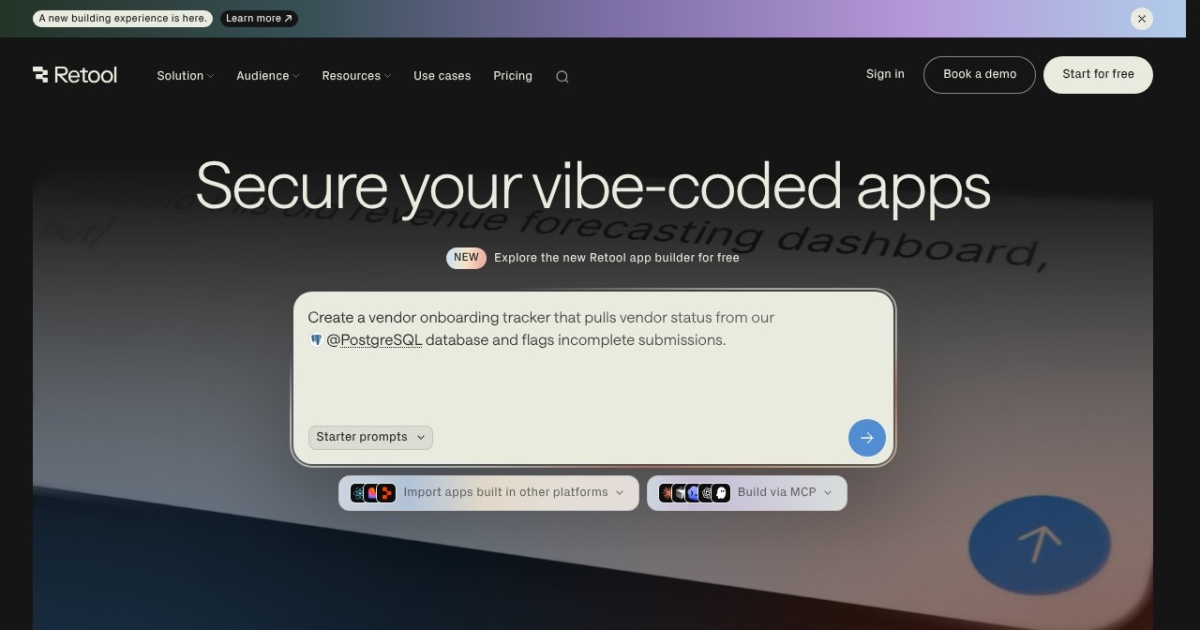
You can clone the brochure in an afternoon; the actual product is a $3.2B, 400-person, 9-year engineering effort you will never prompt into existence.
The landing page is a weekend clone; the 500,000+ apps built on Retool's engine, its enterprise sales motion, and a $3.2B valuation moat are not.
Not worth it as a full clone — the landing page is trivial but valueless alone, and the real product is a mature, capital-intensive enterprise platform with deep integration/security requirements; the market is real but already crowded with well-funded and open-source competitors (Appsmith, ToolJet, Budibase, Superblocks) undercutting on price and openness.
Low-code/no-code internal tooling is a large and growing category — Statista projects the broader low-code/no-code market to reach roughly $52.3B by 2026 — and Retool itself is estimated at ~$138M ARR in 2024 with a $3.2B valuation, reflecting strong enterprise demand for internal-tool builders.
$500-5,000+ (Postgres/DB hosting, sandboxed code execution infra, CDN, analytics/support SaaS) for a bare-bones builder clone at small scale; real production parity costs far more due to compute-heavy query/execution sandboxing.
A cloned landing page generates no revenue by itself; monetizing would require rebuilding the actual builder/runtime and competing on per-seat or usage-based pricing against well-funded incumbents and numerous open-source alternatives already undercutting Retool on price.
Appsmith, Budibase, ToolJet, Superblocks, DronaHQ, UI Bakery, Windmill, Microsoft Power Apps, OutSystems, Mendix, Refine, Jet Admin
Per-seat/usage-based SaaS subscription: free tier for small teams, paid tiers (~$10+/user/mo) scaling to custom enterprise pricing with SSO, audit logs, and on-prem/VPC deployment; enterprise sales motion layered on top of bottom-up developer adoption.
Large enterprise-focused site; Retool has raised $190M+ at a $3.2B valuation with an estimated ~$138M ARR in 2024, implying substantial, growing web/product traffic among developer and enterprise IT audiences.
- Trademark/brand (Retool name and logo)
- Proprietary JSON app format — not open, creating vendor lock-in that a clone would need its own strategy for
- Enterprise data-security/compliance expectations (SOC2, SSO, audit logs) required to compete credibly
- Crowded competitive field with well-funded incumbents and free open-source alternatives
Next.js (marketing site) + Node/Postgres backend + React-based drag-and-drop canvas (e.g. react-dnd/GrapesJS) + sandboxed code execution (isolated VM/Firecracker) + Auth0/Clerk for auth + Stripe for billing
Vercel Next.js SaaS starter for the marketing/pricing site; Appsmith or ToolJet open-source repo as a base to fork for the actual builder engine instead of building from scratch
- 1.Fork Next.js SaaS starter, rebuild homepage/pricing/use-case pages with Tailwind + CMS (Sanity/Contentful) for blog content
- 2.Wire up analytics (Segment) and support chat (Intercom) exactly as observed for feature parity of the shell
- 3.For the real product: fork an open-source low-code builder (Appsmith/ToolJet) rather than building the canvas/query engine from scratch
- 4.Add a query engine layer supporting SQL/REST/GraphQL connectors with credential vaulting
- 5.Implement sandboxed JS/Python execution for custom logic (isolated-vm or Firecracker microVMs)
- 6.Add RBAC, audit logging, and SSO/SAML for enterprise-readiness
- 7.Build usage-based or per-seat billing via Stripe and self-serve signup flow
▸Technical evidencefacade · hidden · 9 signals · DR 80ShowHide
A prompt can replicate the marketing site: Next.js homepage, pricing tables, use-case pages, customer logo walls, and blog-style CMS content with dark-mode styling.
Behind the marketing shell sits Retool's actual product — a full low-code IDE with a drag-and-drop app builder, live database/API/GraphQL query engine, JS/Python/SQL execution sandbox, workflow scheduler, version control, RBAC/audit logging, on-prem/VPC deployment options, and dozens of pre-built data-source connectors — none of which is visible in the crawled HTML/JS.
You could build it — but that moat means you can't win. Find a better bet.
Analyze a different idea →