How is PlanetScale built — and could you clone it?
Last analyzed 7/27/2026 · full report
https://planetscale.com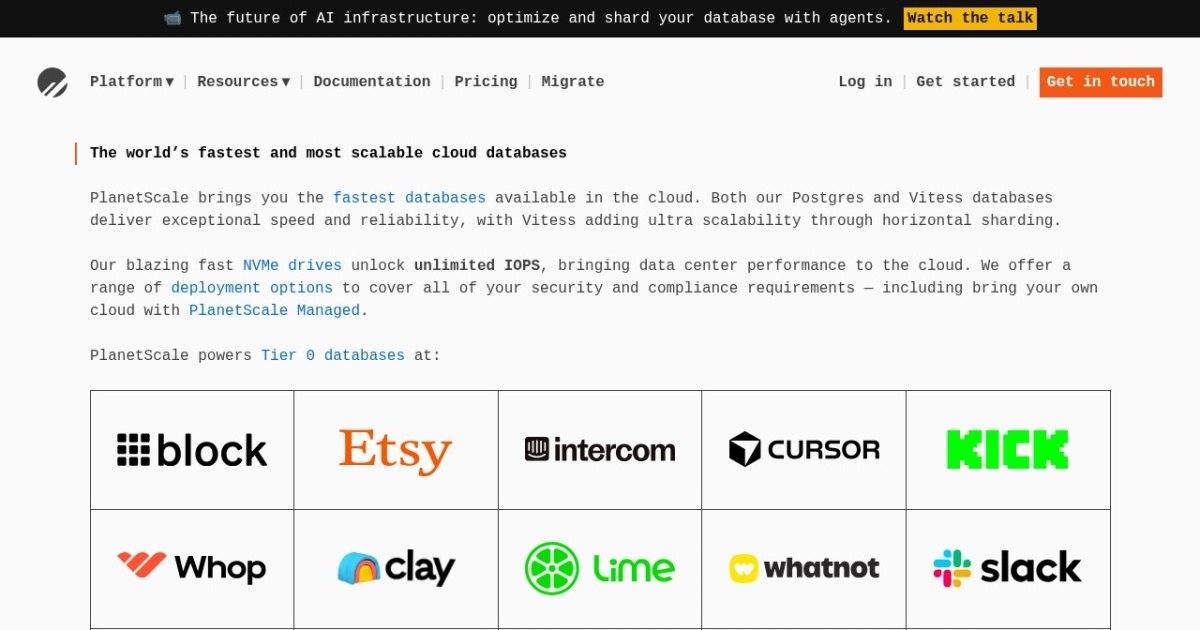
You can clone PlanetScale's website in an afternoon; you cannot clone PlanetScale — that requires reinventing distributed MySQL sharding and years of infrastructure engineering.
The landing page is a weekend clone; the moat is a $1B-valuation, $105M+-funded distributed database engineered by Vitess's original creators and battle-tested at Cash App, Etsy and YouTube-scale workloads.
Not worth cloning as a real business — the visible site is trivial to copy but is worthless without the underlying sharded database engine, which took the Vitess co-creators years and $100M+ to build; at most this is a portfolio exercise in marketing-page replication, not a viable SaaS competitor.
The DBaaS market is large and growing — the database-as-a-service market is booming, with projections exceeding $132 billion by 2033, and PlanetScale competes against Neon, CockroachDB, Supabase, TiDB Cloud, AWS Aurora/RDS, and Google Cloud SQL in a crowded, fast-moving space.
$20-100 (marketing site clone only, hosting+forms); N/A for the real product which requires bare-metal/cloud infra spend in the millions
A cloned landing page has no product behind it and can't generate DBaaS revenue; PlanetScale itself monetizes via metered row-read/write and storage pricing plus enterprise contracts, only viable at serious infra scale and capital ($1B valuation, $105M+ raised).
Neon, CockroachDB, Supabase, TiDB Cloud, AWS Aurora/RDS, Google Cloud SQL, SingleStore, Turso, Upstash
Usage-based metered pricing (rows read/written + storage) with a low-cost entry tier plus enterprise/managed contracts; PlanetScale offers a "Scaler" plan that charges a monthly subscription of $29 per month with overages applied for additional rows read and written beyond their default allocations, and it recently added the $5 USD PS-5 node class provides an affordable way to access PlanetScale's platform without committing to the previous $30 USD minimum for high-availability clusters.
~400K visits/month per third-party estimate, established enterprise customer base (Cash App, Etsy)
- Trademark/brand (PlanetScale name, Vitess association)
- Deep technical moat means a clone cannot deliver real product value, only marketing appearance
- Enterprise/compliance claims (SSL, audit, deployment options) imply regulatory expectations a fake clone can't legally back
Next.js (App Router) + Tailwind CSS + Vercel for the landing/marketing clone only; real product would need Go/Rust + Vitess/MySQL fork + Kubernetes + bare-metal NVMe hosts + Stripe for billing
Vercel's Next.js marketing site template (e.g. Taxonomy or a SaaS landing starter)
- 1.Scaffold Next.js project, copy hero/nav/footer structure and Tailwind design tokens from the crawled HTML
- 2.Rebuild static pages: /, /pricing, /docs (MDX), /contact with a simple form-to-email (e.g. Resend or Formspree) instead of a real backend
- 3.Add Sentry + Cloudflare Analytics scripts to match observed telemetry for visual/functional parity
- 4.Stub a fake 'sign up' flow linking to a placeholder auth page (Clerk/Auth0) since real auth.planetscale.com is out of scope
- 5.Do NOT attempt to rebuild the database engine — if the goal is a real DBaaS, that's a multi-year systems engineering project (Vitess/MySQL sharding, replication, NVMe infra), not a prompt-buildable task
- 6.Deploy static/SSR site to Vercel; done for the facade
▸Technical evidencefacade · hidden · 9 signals · DR 78ShowHide
A prompt can trivially rebuild the marketing site: hero copy, logo grid, pricing table, docs nav, and a contact form that posts somewhere — it's a fairly standard Next.js/React SSR marketing shell with Tailwind styling.
Behind the facade is an actual distributed database company: a hosted/managed Vitess+MySQL and native Postgres platform with horizontal sharding, NVMe "Metal" bare-metal infra, non-blocking schema changes, branching/deploy-request workflows, row-based metered billing, auth, multi-region deployment, backups/HA, and enterprise compliance controls — none of which is reconstructable from HTML.
You could build it — but that moat means you can't win. Find a better bet.
Analyze a different idea →