How is Paddle built — and could you clone it?
Last analyzed 10/11/2026 · full report
https://paddle.com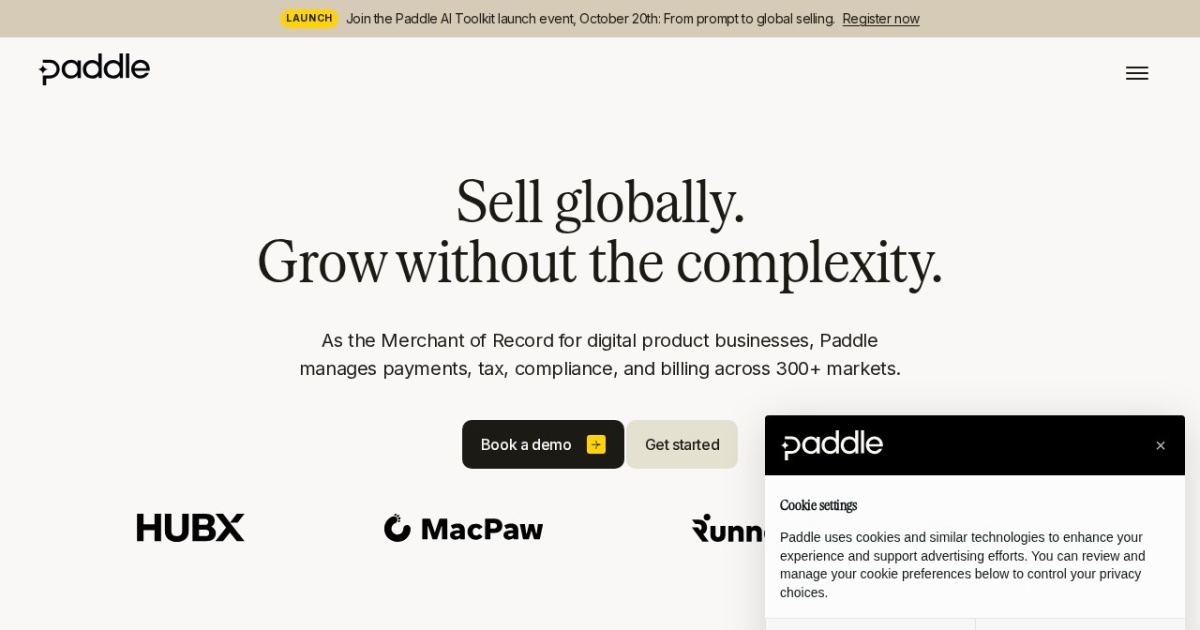
You can clone the yellow buttons and the FAQ accordion in an afternoon, but you can't prompt your way into becoming a licensed global tax remitter processing $36B in ARR.
The landing page is a weekend build; the Merchant-of-Record license, global tax compliance infrastructure, acquiring bank relationships, and 4,000+ customer base processing $36B in ARR are not.
Not worth cloning as a real business — the visible site is trivial to replicate but utterly worthless without the Merchant-of-Record infrastructure, tax licenses, and banking relationships that constitute Paddle's actual product; at best this is a portfolio/demo exercise, not a competitive venture.
Huge and growing — SaaS/digital-goods billing and Merchant-of-Record is a multi-billion dollar category with intense competition from Stripe, FastSpring, Lemon Squeezy, Chargebee, and newer entrants like Dodo Payments and Polar.
$0-20 for a static landing-page clone; real MoR infra (PCI compliance, tax engine, banking rails) would run into tens of thousands/month minimum
A landing-page clone has no monetization path on its own; the real business profits via a 5%+$0.50 transaction take-rate at massive volume, which requires regulatory licensing, acquiring bank partnerships, and capital no prompt-based clone can obtain.
Stripe (incl. Stripe Managed Payments/Billing), FastSpring, Lemon Squeezy, Chargebee, Recurly, PayPro Global, Dodo Payments, Polar, Gumroad
Transaction-based Merchant of Record fees — standard rate of roughly 5% + $0.50 per transaction, all-inclusive of payment processing, global tax compliance, subscription billing, and fraud/chargeback handling, with negotiated enterprise rates at scale.
Large B2B SaaS brand serving 4,000+ software companies processing $36B in ARR; traffic and market presence are substantial and growing, reinforced by category-leading domain adoption versus Chargebee/FastSpring/Lemon Squeezy.
- Regulated payments/Merchant-of-Record space requiring licensing, PCI-DSS compliance, and tax remittance obligations; prior FTC settlement exposure for payments processed on behalf of bad-actor customers; trademark/brand IP; heavy reliance on banking/acquirer partnerships not accessible to a clone
Next.js (App Router) + Tailwind/CSS variables for the design system + HubSpot embed for lead forms + a headless CMS (e.g. Sanity/Contentful) for the help center + Vercel hosting
Vercel's Next.js SaaS Starter or a Tailwind marketing template (e.g. Tailwind UI 'SaaS' kit)
- 1.Scaffold Next.js app with SSR routes matching /help, /billing, /billing-faqs, /billing/{checkout,subscriptions,payments,reporting,invoicing}
- 2.Rebuild the design system tokens (colors, type scale, spacing) from the extracted CSS variables
- 3.Wire a headless CMS (Sanity/Contentful) to drive help-center articles and FAQ content so non-devs can edit copy
- 4.Embed HubSpot forms (js.hsforms.net) for lead capture/demo requests
- 5.Stub a fake '/api-reference' docs page mirroring developer.paddle.com structure using Docusaurus or Mintlify
- 6.Add basic analytics/observability (PostHog or Sentry) to mimic the error/observability signal
- 7.Deploy to Vercel with a custom domain; skip all actual payment/tax backend since that is non-reproducible
▸Technical evidencefacade · hidden · 1 signalsShowHide
A prompt can nail the marketing site: Next.js landing pages, pricing/FAQ content, HubSpot lead-gen forms, and a help-center layout with SSR routing for /billing, /help, /billing-faqs.
Behind the facade is a licensed Merchant of Record: global payment processing across 200+ countries, automated VAT/GST/sales tax remittance in 100+ jurisdictions, PCI-compliant checkout, subscription billing engine with dunning/proration, fraud and chargeback handling, invoicing, a developer API/SDK platform, and the ProfitWell analytics data layer — none of which a prompt can replicate.
You could build it — but that moat means you can't win. Find a better bet.
Analyze a different idea →