How is Outseta built — and could you clone it?
Last analyzed 10/14/2026 · full report
https://outseta.com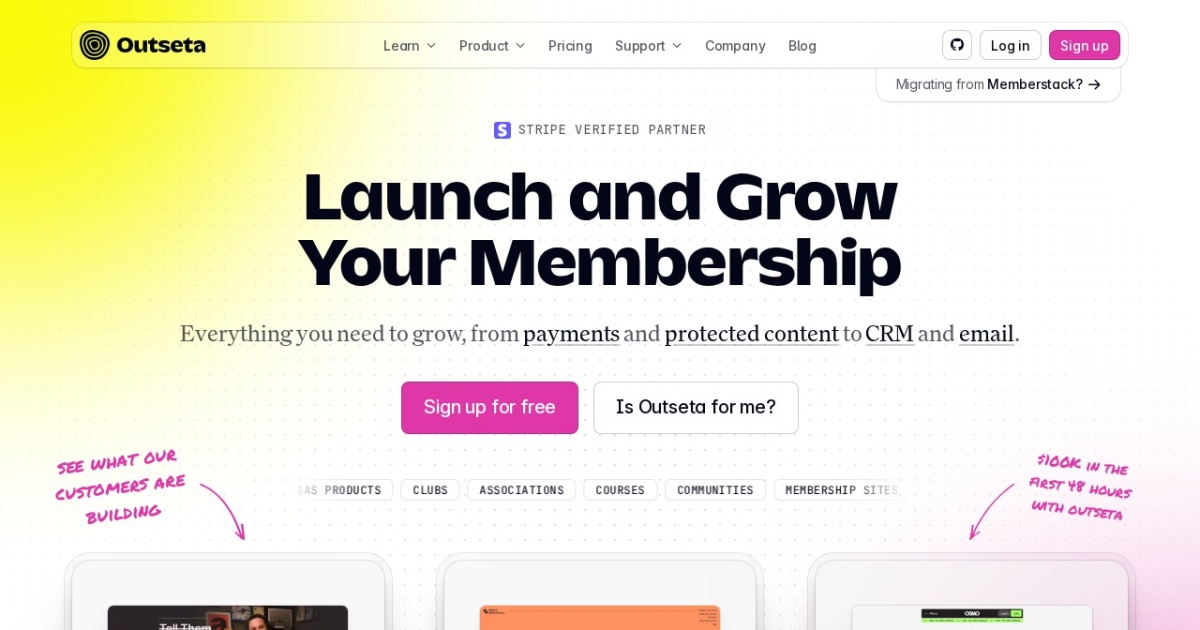
The landing page is a weekend Webflow clone; the actual product is a years-deep, multi-tenant billing/auth/CRM platform that other companies' revenue depends on — not something any prompt touches.
You can clone the landing page over a weekend, but not the years of billing/auth/CRM engineering and the live customer base already embedded in thousands of production websites.
Not worth cloning as a prompt project — the landing page is trivial but valueless alone, and the real product (what customers actually pay for and depend on for live auth/billing) is a multi-year, trust-critical backend that competes in an already-crowded market against well-funded incumbents; only worth pursuing as a genuine multi-month engineering effort, not a weekend clone.
Membership/subscription management software is a crowded but steady niche; competitors include Memberstack, MemberSpace, Circle.so, Memberful, Kajabi, Podia, and Wild Apricot. Outseta's niche angle is being the "all-in-one" bundle (billing+CRM+email+helpdesk) for lean SaaS startups, targeting the thousands of indie-hacker/bootstrapped SaaS builders rather than enterprise.
$500-5,000+ (Stripe integration, email sending infra, support/ticketing infra, multi-tenant DB hosting, security/compliance) to run even a minimal real clone at small scale
A clone could only make money by actually building the full billing/auth/CRM/helpdesk platform and competing on price/bundling — a legitimate but capital- and trust-intensive SaaS play, not a prompt-and-launch weekend project; revenue would come from the same subscription+transaction-fee model (~$47-159+/mo plus 1-2% transaction fees).
Memberstack, MemberSpace, Circle.so, Memberful, Kajabi, Podia, Wild Apricot, ClubExpress
Freemium-free trial → tiered SaaS subscription ($47/$97-159+/mo based on contact volume) plus a declining transaction fee (2% down to 0-1%) on payments processed through the platform.
Niche but established B2B SaaS tool category; moderate review volume (dozens of reviews across G2/Capterra/GetApp) suggests a real but modest customer base, steady rather than explosively growing.
- Handles live customer payment/auth data — any clone touching real money/PII needs PCI/GDPR compliance","Competing against funded, review-validated incumbents (Memberstack, Circle, Kajabi)","Trust-critical infrastructure (auth+billing) means switching/replication risk is high for any new entrant"
Next.js (marketing site) + Node/NestJS or Rails API + Postgres + Stripe Billing + Auth0/Clerk-style custom auth + SendGrid/Postmark for email + a ticketing system (e.g. built on Zendesk API or custom) + Redis for sessions + Vercel/AWS hosting
Webflow clone via a Next.js/Tailwind marketing template for the landing page; for the actual product, fork an open-source SaaS starter like 'SaaS Boilerplate' or 'Supabase + Stripe subscription starter' and heavily extend it
- 1.Clone the Webflow landing page structure (hero, pricing table, /vs comparison pages, testimonials) using Next.js + Tailwind, matching fonts (Fraunces, Chakra Petch) and GSAP scroll animations
- 2.Stand up Postgres schema for Accounts, People, Subscriptions, Deals (CRM), Support tickets
- 3.Integrate Stripe Billing for subscription + usage-based transaction fee billing, plus webhook handling for plan changes/cancellations
- 4.Build an embeddable JS widget (like outseta.min.js) exposing auth forms, gated content, and lead capture that any external site can drop in via script tag
- 5.Build CRM views (contact timelines, deal pipelines) and a help desk/ticketing module with a knowledge base
- 6.Add email marketing (broadcast + drip sequences) via a transactional+marketing email provider with list segmentation
- 7.Add reCAPTCHA, analytics (Plausible), and affiliate tracking (Rewardful) to match the marketing stack observed
▸Technical evidencefacade · hidden · 1 signalsShowHide
A prompt can nicely reproduce the Webflow marketing site — hero, pricing tables, comparison pages (/vs/*), testimonials, and the gated demo/brand pages — since it's standard responsive HTML/CSS with Webflow interactions and third-party embeds (GSAP, Chart.js, Plausible).
Outseta IS the backend: a multi-tenant SaaS platform providing embeddable auth, Stripe-integrated subscription billing, a full CRM, email marketing/drip campaigns, a help desk/ticketing system, and usage metering — all exposed via cdn.outseta.com's embeddable widgets and a hosted API (go.outseta.com) that thousands of customer sites depend on in production.
You could build it — but that moat means you can't win. Find a better bet.
Analyze a different idea →