How is Missive built — and could you clone it?
Last analyzed 9/29/2026 · full report
https://missiveapp.com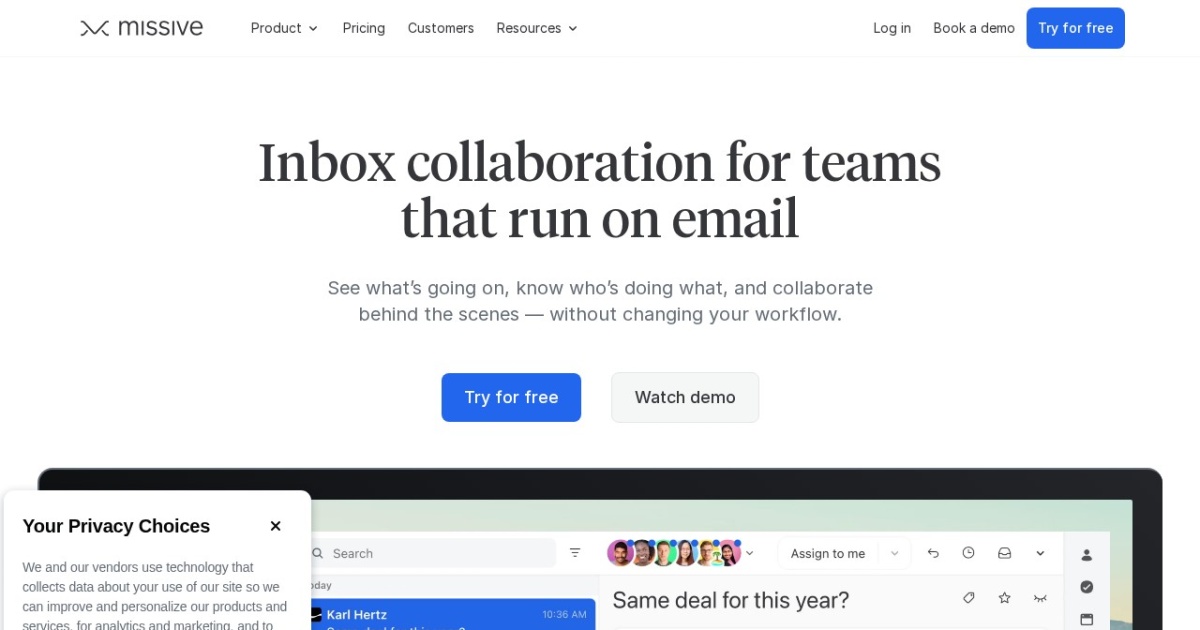
The landing page is a weekend Webflow job; the actual product it's selling is a decade-long, three-engineer bootstrap to $6M ARR that no prompt will ever reproduce.
You can clone the marketing pages in a day, but not ten years of bootstrapped product refinement, 2,000+ paying teams, and the email-client switching cost that keeps them there.
Not worth cloning as a whole — the landing page is trivial but worthless without the product, and the product is a multi-year, multi-person engineering effort competing in a crowded market against well-funded incumbents; only worth it if you already have (or plan to build over months) real email-sync/collaboration infrastructure and are targeting a specific underserved niche.
Shared-inbox/collaborative email is a proven, growing SaaS category with many funded and bootstrapped players; Missive itself grew from $3K to $6.1M ARR over ten years bootstrapped with under 10 employees, showing durable but slow-growing demand rather than explosive market.
$20-50 for the landing page alone (hosting/CDN); $2k-10k+/mo to run even a minimal real product clone (email sync infra, WebSocket realtime servers, SMS/WhatsApp API costs, storage, support tooling)
The landing page alone generates no revenue without the underlying product; a real competitor would need the full collaborative email backend to charge the $14-36/user/month Missive-style pricing, and the market already has entrenched, well-reviewed incumbents (Front, Help Scout, Hiver) making differentiation hard.
Front, Help Scout, Hiver, Gmelius, Zoho TeamInbox, Drag, Superhuman, Zendesk
Next.js (marketing site) + Webflow-style CMS content; for the real product: Node/Go backend + Postgres + Redis (presence/realtime) + WebSocket server (Y.js/CRDT for collaborative drafts) + IMAP/SMTP sync workers + Twilio (SMS) + WhatsApp Business API + Stripe billing + Auth0/Clerk
Vercel Next.js SaaS starter for the marketing site; for the app, fork an open-source CRDT collaborative editor (e.g. Yjs + Tiptap) plus an open-source IMAP sync library as a base
- 1.Clone the Webflow marketing pages 1:1 with Next.js + Tailwind, reusing the copy/route structure (/collaborate, /coordinate, /connect, /features, /pricing)
- 2.Wire up Segment + a cookie-consent tool (Ketch-equivalent, e.g. Osano) and Wistia embeds for parity on the facade
- 3.Stand up auth + Postgres schema for users/teams/shared-inboxes/labels/rules
- 4.Build IMAP/SMTP + OAuth sync workers per provider (Gmail, Outlook, generic IMAP) with per-message state (assigned/read/done)
- 5.Add a CRDT-based realtime layer (Yjs) for simultaneous draft editing with presence cursors
- 6.Integrate SMS (Twilio) and WhatsApp Business API as additional channels feeding the same unified inbox model
- 7.Layer a rules engine, integrations (Zapier/Salesforce/Shopify), and Stripe billing with seat-based tiers
▸Technical evidencefacade · hidden · 7 signalsShowHide
A prompt can nail the Webflow marketing site: hero copy, feature pages (/collaborate, /coordinate, /connect), comparison pages, pricing table, and Wistia video modals — all standard static components with a signup CTA linking out to the real app.
Behind the marketing site sits a full cross-platform collaborative email client (mail.missiveapp.com): multi-provider email/IMAP sync, real-time simultaneous draft editing with live cursors, a rules/automation engine, SMS/WhatsApp/social channel integrations, team/shared-inbox permissions, an integrations marketplace (Salesforce, Shopify, Zapier), billing/subscription logic, and a built-in affiliate system — none of which is visible in the crawled HTML.
Clonable and beatable — the fun kind.
Get the full build plan →