How is Miro built — and could you clone it?
Last analyzed 7/12/2026 · full report
https://miro.com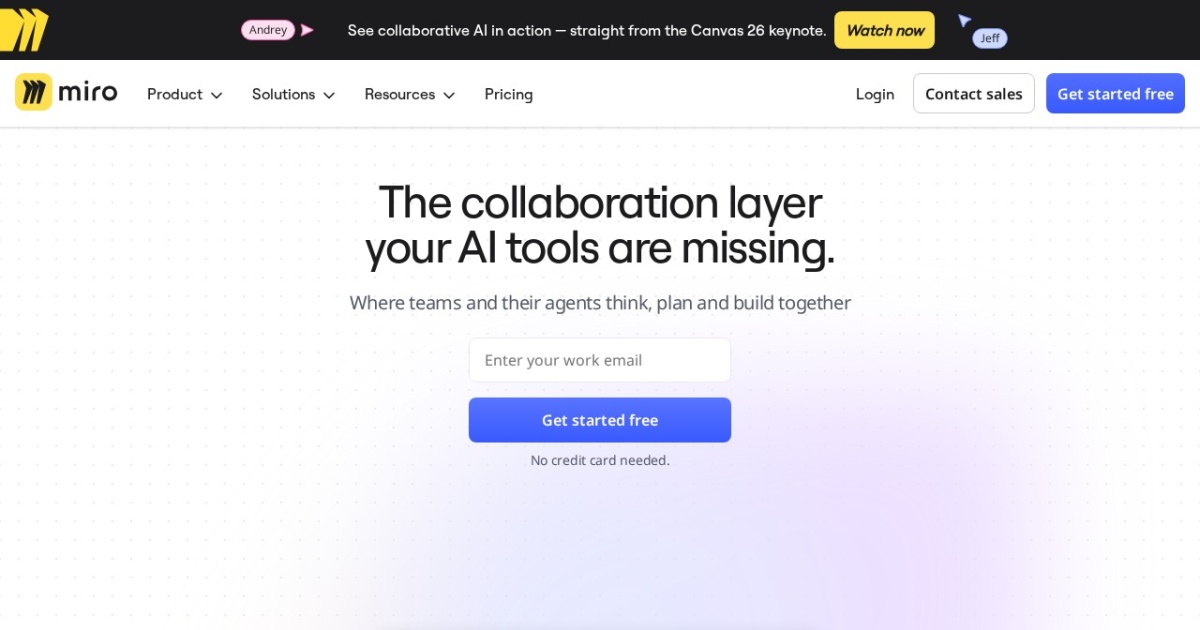
You can clone the brochure in a weekend; you cannot clone the real-time collaborative canvas engine that took a 1,600-person company over a decade and $476M to build.
The landing page is a Framer template away; the 35M-user network, 130,000 paying customers, and decade-deep real-time canvas engine are not.
Not worth it as a business — the landing page is trivial to clone but valueless alone, and the real product (real-time multiplayer canvas, enterprise auth/compliance, AI workflows) represents years of engineering that no amount of prompting reproduces; only worth it as a UI/portfolio exercise, not a competitive product.
Massive and still growing — Miro is estimated near $665M+ ARR at a $17.5B valuation, competing in a $45B+ enterprise collaboration market, though the whiteboarding niche is getting commoditized by Microsoft, Google, and Figma bundling similar features for free.
$0–20 for a landing-page-only clone; $50k+/mo at any real scale once you add realtime sync infra, storage, and AI compute for a functioning whiteboard backend
A landing-page clone alone earns nothing; a functioning whiteboard SaaS could monetize via the same per-seat freemium model, but competing against Miro's 35M-user network and enterprise integrations with a prompted clone is commercially hopeless.
Mural (acquired by Salesforce), Figma/FigJam, Microsoft Whiteboard, Lucidchart/Lucidspark, Zoom Whiteboards, Canva Whiteboards, Creately, ClickUp Whiteboards
Freemium per-seat SaaS subscription: Free (unlimited members, 3 editable boards) → Starter $8-10/user/mo → Business $20-25/user/mo (SSO, guests, AI Workflows) → custom Enterprise (30+ seats, SCIM, data residency), plus paid add-ons like Prototypes and extra AI credits.
Large and steady — 35M+ users, 130,000+ paying customers, 99% of Fortune 100 use it; growth has moderated post-pandemic but remains a market leader.
- Trademark/brand infringement if cloning 'Miro' name/look
- Enterprise data compliance claims (GDPR/CCPA/SCIM) can't be truthfully replicated without real infrastructure
- Deep integration partnerships (Slack, Jira, Zoom, Teams) are contractual and not clonable
Next.js + Framer-style page builder for marketing site; if attempting the real app: Next.js + Supabase/Postgres + Yjs or Liveblocks for CRDT realtime canvas sync + Clerk/Auth0 for SSO/passwordless + Stripe for per-seat billing + S3/Cloudflare R2 for board assets + Vercel/Fly.io hosting
Vercel's Next.js SaaS starter for the marketing/auth shell; tldraw or Liveblocks' whiteboard starter kit for the canvas engine
- 1.Clone the marketing site sections (hero, feature grids, pricing table, testimonials) as static Next.js pages with Tailwind
- 2.Wire up auth screens (login/signup/sso/recover/passwordless) using Auth0 or Clerk to match the observed routes
- 3.Integrate a canvas library like tldraw or Fabric.js and layer Liveblocks/Yjs for real-time multiplayer cursors and object sync
- 4.Build a Postgres schema for boards, teams, members/guests/visitors roles, and workspaces with per-seat billing via Stripe
- 5.Add a template library and basic integrations (Slack/Zoom webhook stubs) to mimic the ecosystem hooks
- 6.Layer in an AI panel (OpenAI API) to fake 'Miro AI' summarization/diagram generation features
- 7.Deploy on Vercel + managed Postgres, and stress-test realtime sync before positioning as a serious alternative
▸Technical evidencefacade · hidden · 5 signals · DR 90ShowHide
A prompt can rebuild the Framer-built marketing site (hero copy, feature sections, pricing page, login/signup forms) in an afternoon — it's static content with fonts and animations, no real logic.
Behind the login wall sits a real-time multiplayer infinite-canvas engine (CRDT/OT sync, cursors, presence), a full auth system with SSO/passwordless/SCIM, a permissions & billing engine for seats/guests/visitors, an AI layer (Sidekicks, Flows, MCP server), 5,000+ templates, an integrations marketplace (Slack, Jira, Zoom, Teams, Asana), and enterprise compliance infrastructure (audit logs, data residency, GDPR/CCPA) — none of which is visible in the crawled marketing pages.
You could build it — but that moat means you can't win. Find a better bet.
Analyze a different idea →