How is Memberstack built — and could you clone it?
Last analyzed 10/14/2026 · full report
https://memberstack.com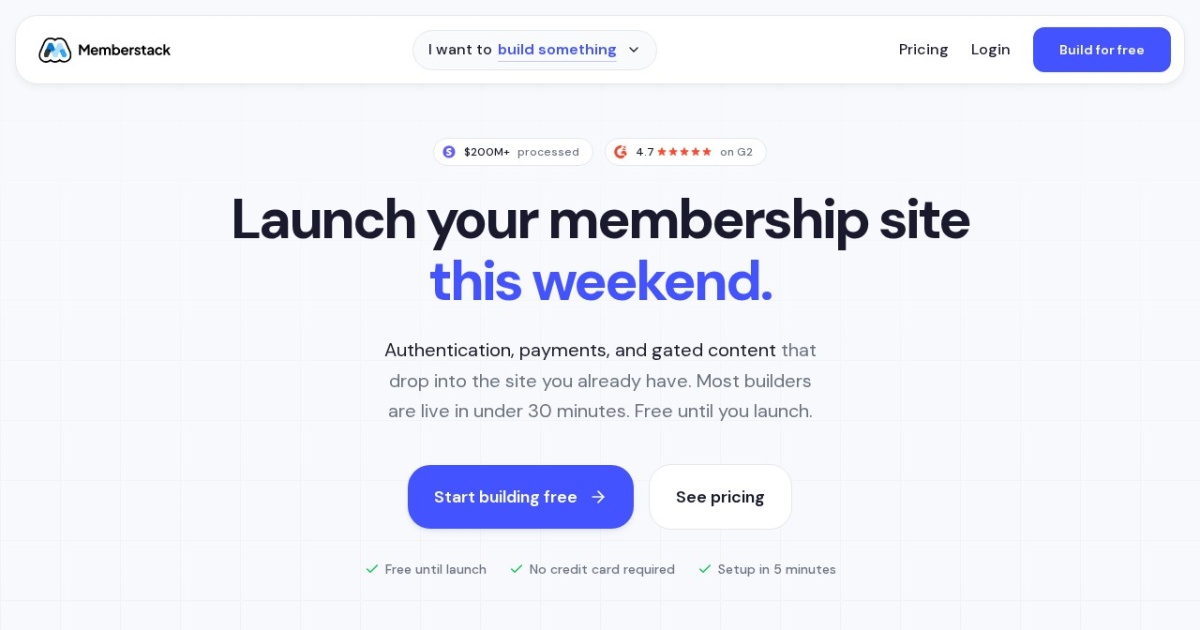
The landing page is a weekend's work; the actual product is a SOC2-compliant auth-and-billing engine processing $200M+ that took a funded team years to harden.
You can clone the pricing page in an afternoon, but not the 50,000-site Webflow ecosystem, $200M in processed payments, or SOC2 compliance.
Not worth it as a clone: the landing page is trivial, but the real value is a battle-tested auth+billing+compliance backend serving tens of thousands of paying Webflow/WordPress sites — rebuilding that to compete credibly requires months of engineering plus years to earn the trust/integrations moat Memberstack already has.
Large and proven: Memberstack is a category leader for Webflow/no-code membership sites, reportedly reaching $5M in revenue without raising any venture capital or outside funding and helps Webflow developers add secure user accounts and payments in a fraction of the time, with competitors like Outseta, Memberful, MemberPress, Mighty Networks, and Join It actively fighting for the same no-code membership niche.
$500–3k (auth infra, Stripe Connect fees, DB, email, support tooling, compliance overhead)
A clone could monetize via per-site subscription tiers plus Stripe transaction cuts, mirroring Memberstack's $25–$499/mo plans, but margins are eaten by support, compliance (SOC2/GDPR), and churn risk against an entrenched incumbent with a 50,000-site install base.
Outseta, Memberful, MemberPress, Mighty Networks, Join It, Memberspace, Memberply
Tiered SaaS subscription per website: plans from $25 to $499/mo scaling with member count/features, plus payment processing via Stripe (no extra transaction fee beyond Stripe's own) — Over 50,000 Webflow sites use Memberstack, processing $200M+ through Stripe.
Large and established in its niche — 50,000+ active Webflow sites and 100,000+ builders cited, category-leading status for Webflow membership tooling, trajectory growing per company milestones.
- Handles live payments/PII — any clone entering production needs PCI/GDPR/SOC2 diligence
- Competing directly with an entrenched, well-funded incumbent with deep Webflow/WordPress integrations
- Trademark/brand similarity risk if cloning name/look closely
Next.js (App Router) + Supabase or Postgres/Prisma for auth & member DB + Stripe Billing/Connect for payments + Clerk/Auth.js for auth primitives + Sanity/Contentful for CMS + Vercel hosting
Vercel SaaS Starter or Clerk + Stripe SaaS boilerplate
- 1.Scaffold Next.js marketing site matching the nav/animations and pricing/feature pages
- 2.Stand up auth service (Clerk or custom JWT) supporting social logins and embeddable login/signup widgets for Webflow/WordPress
- 3.Integrate Stripe for subscription billing, webhooks, and member-level entitlement checks
- 4.Build content-gating SDK/JS snippet + REST/GraphQL API for third-party site embedding
- 5.Add member data tables/CRM view and webhook/Zapier integration layer
- 6.Implement compliance basics (data encryption, audit logging) toward SOC2/GDPR readiness
- 7.Build Webflow/WordPress specific integration docs, components library, and templates marketplace
▸Technical evidencefacade · hidden · 7 signalsShowHide
A prompt can reproduce the Next.js marketing site itself — the animated nav, pricing tables, showcase pages, and content layout — since it's SSR'd React with Tailwind-style styling and no exotic WebGL.
Behind the marketing shell is a full multi-tenant auth/membership platform: user signup/login, social logins, Stripe subscription billing with webhooks, gated content enforcement, member databases/data tables, email campaigns, a JS/REST API + Webflow/WordPress embeds, and SOC2/GDPR-compliant infrastructure processing $200M+ for 50,000+ sites.
You could build it — but that moat means you can't win. Find a better bet.
Analyze a different idea →