How is Mailchimp built — and could you clone it?
Last analyzed 7/14/2026 · full report
https://mailchimp.com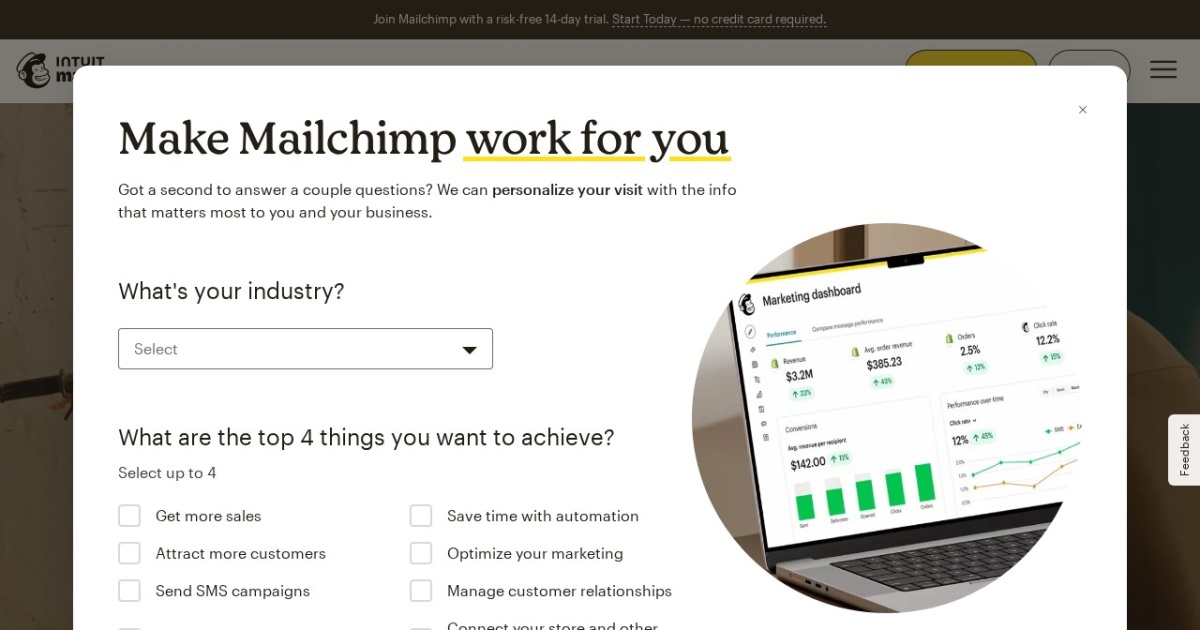
You can clone the Mailchimp homepage in a weekend; you cannot clone 20+ years of deliverability infrastructure, an Intuit-backed identity/fraud stack, and a 600,000+ company customer base.
A weekend clone gets you a pretty signup page; it does not get you Mailchimp's inbox deliverability reputation, its Intuit-backed capital and fraud infrastructure, or its ~600,000-company installed base.
Not worth cloning as a business — the visible site is trivial to fake but the real product is a mature, capital-intensive, deliverability-dependent platform now owned by Intuit with a dominant, entrenched customer base; the only sane reason to clone it is as a landing-page/portfolio exercise, not a competitive product.
Global email marketing software market is roughly valued at USD 1.7 billion in 2025 and is projected to grow from USD 1.91 billion in 2026 to USD 4.27 billion by 2034, exhibiting a CAGR of 10.6% — large and steadily growing, though Mailchimp itself has ceded some share as competitors like Klaviyo and Constant Contact grow faster in eCommerce-focused segments.
$5-20k+ (transactional email/SMS sending infra, CRM DB, CDN, support tooling, fraud/bot protection APIs at any real scale)
A cloned landing page could only monetize as a lead-gen or portfolio piece; actually competing in email marketing requires building sending infrastructure, deliverability reputation, and a sales/support org — a multi-year, capital-intensive undertaking, not a solo profit play.
Klaviyo, Constant Contact, HubSpot Marketing Hub, Sendinblue/Brevo, Zoho Campaigns, Mailjet, Intercom, ConvertKit
Freemium SaaS: free tier + paid tiers (Essentials/Standard/Premium) priced by contact count and feature set, plus transactional SMS/email add-ons and an API platform for developers; now bundled into Intuit's broader QuickBooks/small-business ecosystem.
Extremely large, tens of millions of visits/month historically; Mailchimp remains the most-adopted email marketing vendor by company count, though overall market share has declined somewhat since 2020-2022 peak as competitors like Klaviyo/Constant Contact grow.
- Mailchimp trademark/brand protected by Intuit
- Marketing API ToS restrict scraping/reuse
- Owned by regulated financial-software parent (Intuit) with strict data/privacy compliance obligations
- Any clone using real email sending must handle CAN-SPAM/GDPR compliance
Next.js + Tailwind for the marketing site; Postgres (Supabase) + Auth.js for a toy backend; Stripe for billing; SendGrid/Postmark for actual email sending if you want working campaigns
Vercel/Next.js SaaS marketing template (e.g. Tailwind UI marketing kit)
- 1.Scaffold Next.js site with reusable hero/marquee/logo-carousel/pricing components matching the CMS-driven modules seen (marquee_carousel, dual_plan_module, spotlight_card_grid)
- 2.Build a signup flow posting to a serverless /api/signup route, storing leads in Postgres, with reCAPTCHA and a mock email-verification step
- 3.Wire Stripe Checkout + Billing Portal for plan tiers (Free/Essentials/Standard/Premium) to fake the pricing page functionality
- 4.Add a minimal campaign builder (drag-drop email blocks) storing templates in Postgres, and integrate SendGrid/Postmark to actually send test campaigns
- 5.Stub an 'Audience/CRM' module with basic contact list CRUD and CSV import to mimic segmentation
- 6.Add industry landing-page templates (restaurants/hotels/nonprofits) as CMS-driven static routes via a headless CMS like Sanity or Contentful
- 7.Skip real deliverability infra, fraud/device intelligence, and Shopify-scale commerce sync — these are the non-buildable moat pieces
▸Technical evidencefacade · hidden · 1 signals · DR 93ShowHide
A prompt can quickly reproduce the marketing homepage, signup form UI, pricing tables, and industry solution pages (restaurants/hotels/nonprofits) using a CMS-style component library.
Behind the facade sits a global email/SMS sending infrastructure (deliverability, bounce/spam handling, IP reputation management), a marketing automation/CRM engine with audience segmentation and AI content tools, a full billing/subscription system, a public developer API platform, Shopify/BigCommerce commerce integrations, fraud/bot detection tied into Intuit's identity and device-intelligence stack, Eloqua-based lead capture, and enterprise-grade observability (Bugsnag, custom RUM) — none of which is visible or reconstructible from the crawled HTML/JS.
You could build it — but that moat means you can't win. Find a better bet.
Analyze a different idea →