How is Later.com (Social Media Management & Influencer Marketing Platform) built — and could you clone it?
Last analyzed 7/15/2026 · full report
https://later.com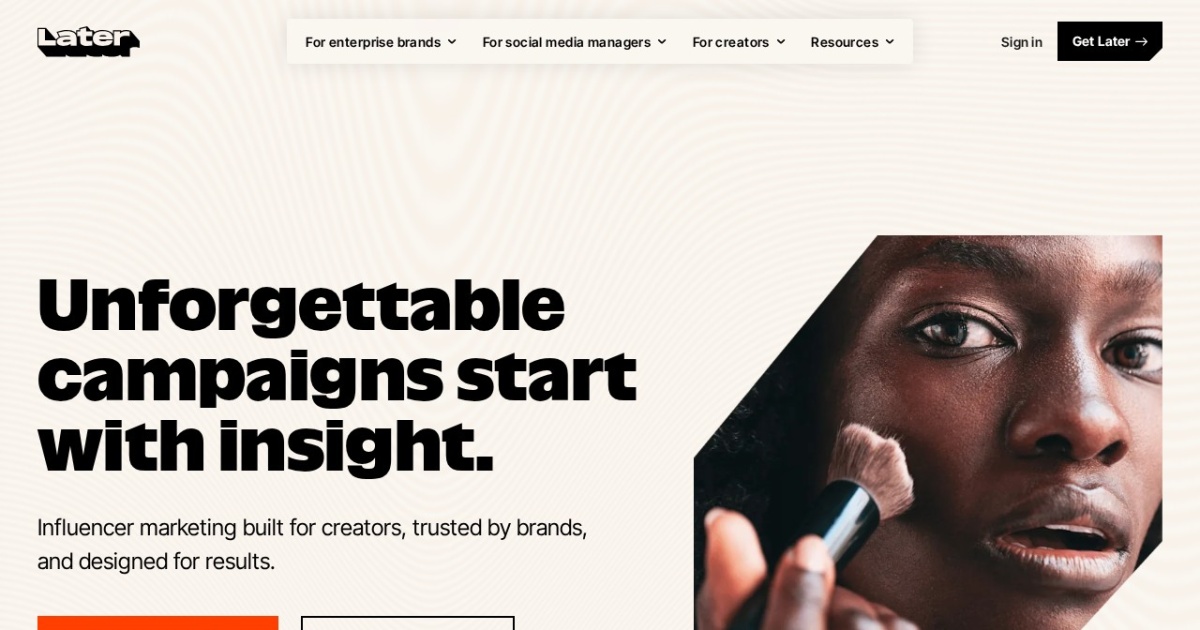
You can clone the brochure site in a weekend, but the actual product is a decade of social-API plumbing, creator marketplace data, and billing infrastructure a prompt will never touch.
The landing page is a weekend clone; the 8-platform API integration layer, years of platform trust/approval status with Meta/TikTok/etc., and an established creator+brand marketplace are not.
Not worth cloning as a full product — the market is real but saturated with entrenched, well-funded competitors (Buffer, Hootsuite, Sprout) and the core value is backend API integration work, not the marketing page. Worth it only if the goal is a portfolio landing-page clone, not a competing business.
Huge and mature market — social media management/scheduling tools are a well-established SaaS category with heavy competition and continuous growth as platforms multiply (Threads, TikTok, Reels, etc.).
$500-5,000+ (social API access/rate limits, CDN/media storage, analytics infra, CRM/billing SaaS fees) depending on scale — far more than a typical CRUD clone due to per-platform API costs and support overhead
A clone could theoretically monetize via subscription tiers like Later's own model, but competing requires replicating deep, approved integrations with each social platform's API (a lengthy partner-approval process), which is the real cost center, not the UI.
Buffer, Hootsuite, Sprout Social, Planoly, Planable, Sendible, Iconosquare, Agorapulse, Loomly, Vista Social
Freemium → tiered subscriptions (Starter $18.75/mo, Growth $37.50/mo, Scale $82.50/mo billed annually) priced per "social set" + per-seat + AI-credit add-ons, plus a separate influencer-marketing product line and enterprise custom pricing.
Large, established SaaS with millions of registered users historically (one of the original Instagram scheduling tools); traffic likely in the multi-million visits/month range, roughly flat-to-growing as it expands into influencer marketing and AI features.
- Trademark/brand infringement if cloning the Later name/logo
- Requires official developer-partner approval from Meta, TikTok, Pinterest, LinkedIn, Snapchat etc. to publish on their platforms — a real regulatory/partnership gate
- Data privacy compliance (GDPR/CCPA) needed given consent-management tooling (Transcend) already in use
- Scraping/ToS concerns if replicating proprietary analytics or creator marketplace data
Next.js + Contentful (headless CMS) + Tailwind for styling + Vercel hosting; for a real backend: Node/Postgres + Redis queue for scheduling + OAuth via each platform's official SDK + Stripe for billing
Next.js SaaS Starter or Vercel Commerce template, paired with Contentful's Next.js starter for the CMS-driven marketing pages
- 1.Fork a Next.js marketing starter and wire it to a headless CMS (Contentful) for page content, matching Later's route structure (/pricing, /case-studies, /influencer-marketing-platform)
- 2.Rebuild the visual components (animated marquee, hero graphics, pricing tables) with Framer Motion + Tailwind to match the bespoke CSS animations seen in the crawl
- 3.Add Segment (or a free alternative like PostHog) for analytics tracking and a cookie-consent tool (e.g., Osano) in place of Transcend
- 4.For the real product: implement OAuth flows individually for each social platform (Instagram Graph API, TikTok for Business API, Pinterest API, etc.) — each is its own multi-week integration with approval review
- 5.Build a scheduling engine (queue + worker jobs) that posts to each platform's API on schedule, handling rate limits and retries
- 6.Add Stripe billing with metered add-ons (social sets, seats, AI credits) mirroring Later's plan structure
- 7.Build an influencer marketplace module (creator profiles, campaign briefs, payments) if replicating the influencer-marketing side — this alone is a separate product
▸Technical evidencefacade · hidden · 7 signals · DR 86ShowHide
A prompt can clone the Gatsby marketing site itself — hero sections, pricing tables, animated marquees, case-study pages — since it's mostly static content pulled from a headless CMS (Contentful) with custom CSS animations.
Behind the marketing shell sits a mature, years-old SaaS product: OAuth integrations with 8+ social APIs (Instagram, TikTok, Facebook, Pinterest, LinkedIn, YouTube, Snapchat, Threads), a scheduling/auto-publishing engine, billing and subscription management, an influencer marketing marketplace/CRM connecting brands to creators, analytics pipelines, and a social inbox — none of which is visible in the crawled HTML/JS.
You could build it — but that moat means you can't win. Find a better bet.
Analyze a different idea →