How is Hugging Face built — and could you clone it?
Last analyzed 7/17/2026 · full report
https://huggingface.co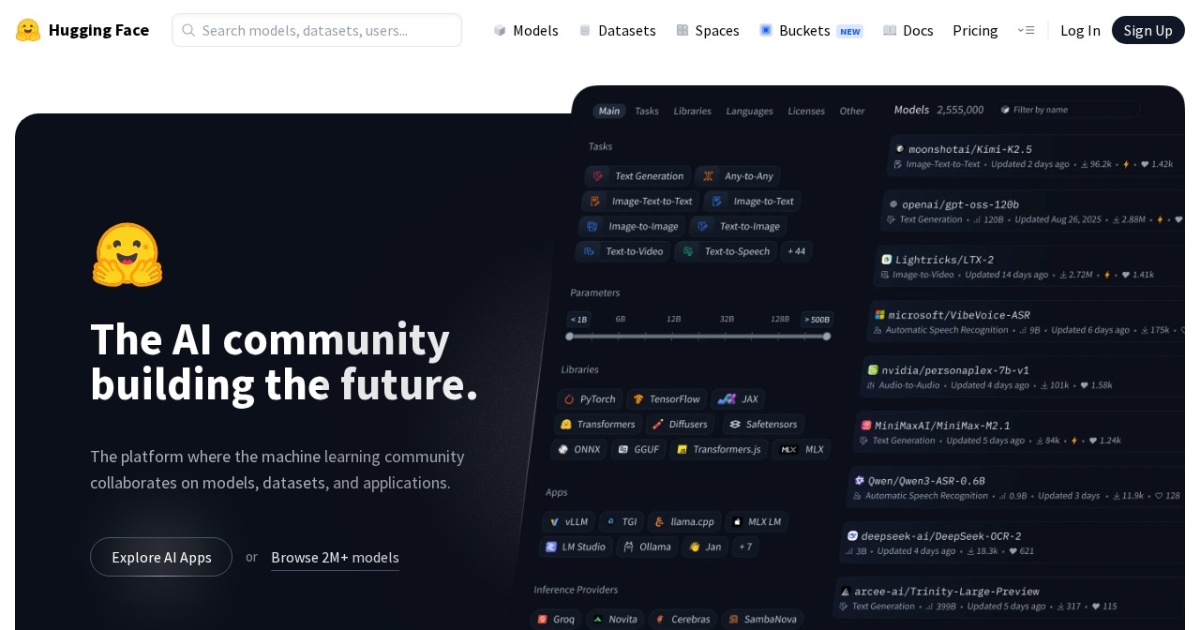
You can clone the homepage in an afternoon; you cannot clone a GitHub-for-ML with petabytes of model storage, live GPU container hosting, and a 13M-user network in a hundred lifetimes of prompting.
You can clone the UI in a weekend, but not the 2M+ community-uploaded models, 13M users, and Fortune-500 enterprise trust that make the Hub the default place AI ships from.
Not worth cloning as a competitor — the landing page is trivial but the actual product is a capital-intensive, network-effect-driven AI infrastructure platform; a clone would need millions in GPU/storage spend and years to attract the community that gives the real Hub its value. Only worth "cloning" as a learning exercise for the marketing page itself.
Massive and growing — Hugging Face is the de facto open-source AI hub with reported ARR in the $70-130M range and a valuation near $4.5B (some later reports suggest much higher), serving 13M+ users and 500K+ orgs.
$50k+ at even modest scale (GPU compute for Spaces/Inference, LFS storage, CDN, WAF) — far beyond typical "$0-20" static-site hosting
Real revenue comes from Pro/Enterprise subscriptions, per-hour Inference Endpoints, and enterprise consulting — none of which a clone could monetize without first replicating the model/dataset supply and community that make people pay.
Replicate, Modal, Together AI, ModelScope (Alibaba), Baseten, Kaggle, DagsHub, GitHub Models
Freemium: free public Hub access; Pro individual ~$9/mo; Enterprise Hub ~$20/user/mo with SSO/compliance; plus metered Inference Endpoints/API usage and large enterprise consulting/compute contracts.
Tens of millions of monthly visits, growing — 13M+ registered users and 500K+ orgs per recent estimates, with usage still accelerating alongside enterprise AI adoption.
- Massive compute/storage costs to operate at any real scale
- Trademark/brand recognition makes direct copy legally risky
- Community/network effect cannot be bootstrapped by cloning code alone
- Enterprise compliance (SSO, audit logs, data residency) requires real regulatory/security investment
Next.js frontend + Supabase/Postgres for user/org/repo metadata + S3-compatible object storage with LFS-like chunking for model files + Docker/Kubernetes (or Modal/Fly.io) for running Spaces + Stripe for billing + Auth0/Clerk for auth+SSO
Vercel/Next.js SaaS starter (for shell) + open-source 'Gradio' or 'Streamlit' runtime images for Spaces execution
- 1.Build static marketing shell + search UI in Next.js matching /models, /datasets, /spaces routes with mock data
- 2.Stand up Postgres schema for users, orgs, repos, model/dataset metadata, tags, likes/downloads
- 3.Integrate S3 + Git LFS-style versioned storage for model weight uploads/downloads
- 4.Add container orchestration (K8s or Modal) to spin up per-Space sandboxed containers with resource limits and iframe embedding
- 5.Wire Stripe for Pro/Enterprise subscription tiers and metered Inference Endpoint billing
- 6.Add auth (OAuth + SSO for enterprise), RBAC for org/team permissions
- 7.Add search/indexing (Elasticsearch or Postgres full-text) over models/datasets, plus analytics pipeline for event tracking
- 8.Bolt on WAF/bot protection and observability/error tracking before public launch
▸Technical evidencefacade · hidden · 8 signalsShowHide
A prompt can nail the Angular/Svelte-esque marketing shell — header, search bar, hero copy, model/dataset/spaces card grids with mocked data and static routes for /models, /datasets, /spaces, /docs, /pricing.
Behind the facade sits a git-based model/dataset storage system (LFS at petabyte scale), a container orchestration layer that runs millions of live Spaces (Gradio/Streamlit/Docker apps) on GPU/CPU fleets, an Inference API/Endpoints billing and metering system tied to Stripe, org/team RBAC and enterprise SSO, a search/discovery index over 2M+ models and 500K+ datasets, CDN-backed avatar/asset storage, WAF/bot protection (AWS WAF SDK visible), and an analytics pipeline (custom /api/event + observability SaaS).
You could build it — but that moat means you can't win. Find a better bet.
Analyze a different idea →