How is Grammarly built — and could you clone it?
Last analyzed 7/16/2026 · full report
https://grammarly.com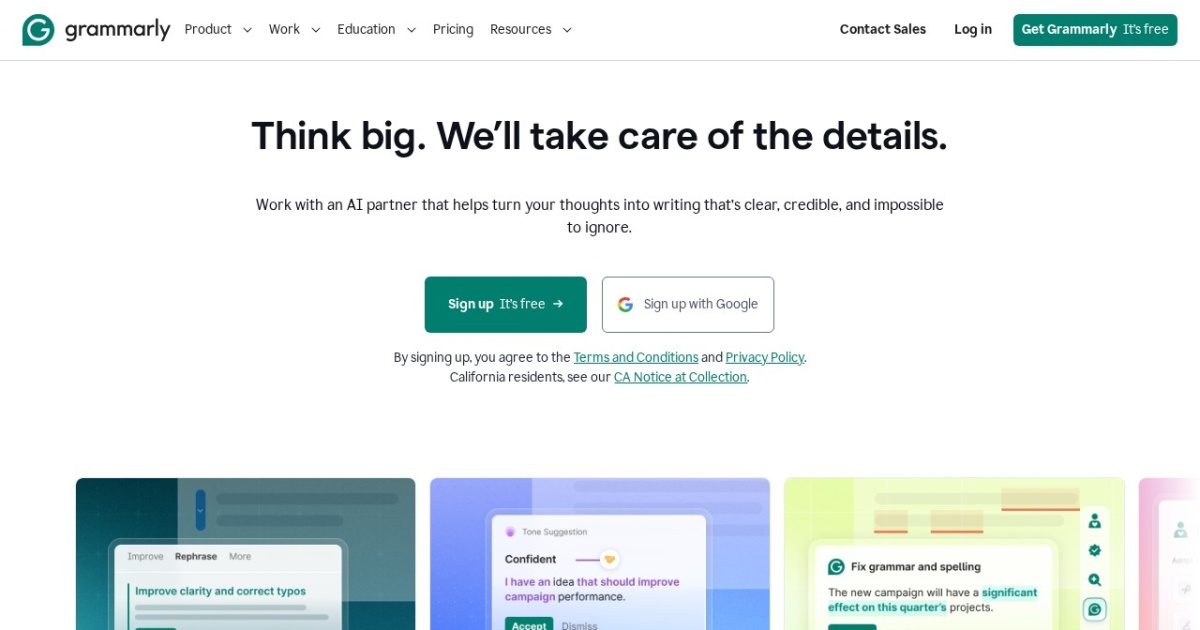
You can clone the homepage in an afternoon; you cannot clone the 15-year-old grammar engine and 30-million-user distribution network hiding behind it.
The landing page is a weekend build; the NLP engine, 500,000+ app integrations, and 30M-daily-user distribution flywheel took 15 years and $500M+ to build.
Not worth it as a real business — the landing page is trivial to clone but worthless without the underlying NLP engine and hundreds of thousands of integrations that took Grammarly 15 years and $500M+ to build, and the category is already being commoditized by free Microsoft/Apple/Google AI features; only worth it as a portfolio/demo piece, not a venture.
Massive and growing — Grammarly itself runs at roughly $700M+ annual revenue with 30M+ daily active users and a $13B valuation, and the broader AI-writing-assistant category is expanding fast as ChatGPT/Copilot bundle competing features for free.
$500–5,000+ (LLM/NLP API costs, hosting, CDN, and support tooling scale steeply with any real user base)
A cloned landing page alone earns nothing; monetization only works if you build the actual grammar-checking/AI-rewriting engine and browser extension, then run a freemium-to-subscription funnel — which requires competing against an incumbent with a 15-year data/integration head start and free bundled alternatives from Microsoft and Google.
ProWritingAid, LanguageTool, Wordtune, QuillBot, Writer.com, Microsoft Editor/Copilot, Ginger, Hemingway Editor, Jasper
Freemium SaaS: free tier drives adoption; Individual Premium ~$12/mo (annual); Grammarly Business ~$15-33/user/month; enterprise custom contracts; plus a 2025 pivot into a bundled "Superhuman" productivity suite after the Coda and Superhuman acquisitions.
~50-75M visits/month to grammarly.com, roughly flat to slightly declining recently, while overall product usage (30-40M+ daily active users) continues to grow.
- Trademark/brand infringement (Grammarly name/logo)
- Heavy reliance on proprietary/fine-tuned NLP models not reproducible via prompting
- Competing against free bundled alternatives (Microsoft Editor, Apple Intelligence, Google) erodes any new entrant's differentiation
- Data privacy/regulatory exposure if handling user writing content at scale (GDPR/CCPA)
Next.js + Tailwind for the marketing site; if attempting the product: Node/Python backend + Postgres + a fine-tuned LLM (via OpenAI/Anthropic API) for grammar/style suggestions + Auth0/Clerk for auth + Stripe for billing + a browser extension (Manifest V3) for in-page checking
Vercel's Next.js SaaS starter or Supabase Next.js template for the marketing/auth shell
- 1.Clone the homepage layout, hero, feature grid, and pricing cards with Next.js + Tailwind, matching fonts/colors from static assets
- 2.Wire up basic auth (Clerk/Auth0) and a signup wall to mimic the freemium gate
- 3.Stand up a simple grammar-check API endpoint using an LLM prompt (GPT-4/Claude) for MVP-level suggestions instead of building custom NLP models
- 4.Add Stripe subscription billing for a Premium tier gate
- 5.Build a minimal Chrome extension (Manifest V3) injecting a content script that calls your API for underline/suggestion overlays
- 6.Add an admin/analytics dashboard stub for a 'Business' tier to mimic enterprise features
- 7.Skip true plagiarism detection and authorship-detection — those require licensed corpora/models far beyond prompt-level effort
▸Technical evidencefacade · hidden · 7 signals · DR 90ShowHide
A prompt can trivially clone the marketing homepage: hero copy, feature tiles, testimonials, pricing cards, and CTA buttons built with Next.js and Tailwind in an afternoon.
Behind the landing page sits a proprietary NLP/LLM grammar-and-style engine processing 14 trillion words/year, a real-time browser extension injected into 500,000+ apps/sites, native integrations with Word/Outlook/Google Docs/Slack, an experimentation platform (dozens of live Statsig A/B tests visible in the page payload), account/auth system, plagiarism-detection database, enterprise admin/analytics console, and billing/subscription infrastructure serving 30M+ daily users.
You could build it — but that moat means you can't win. Find a better bet.
Analyze a different idea →