How is Grafana Labs built — and could you clone it?
Last analyzed 7/25/2026 · full report
https://grafana.com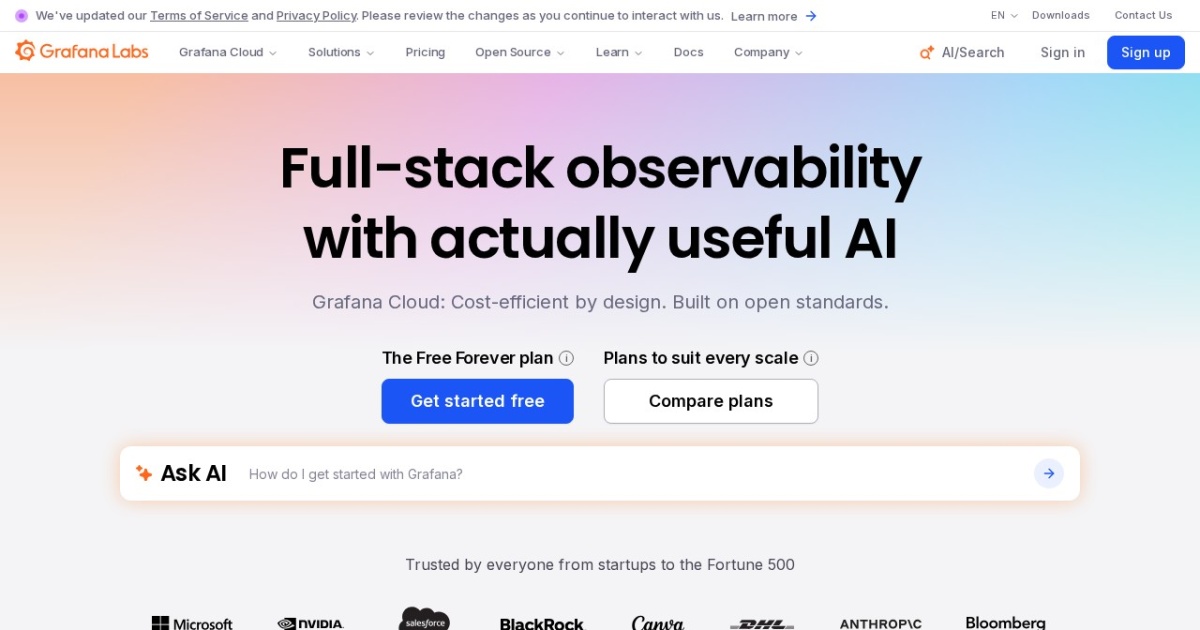
You could clone the brochure in a weekend; you'd need a decade and a few hundred engineers to clone what's actually behind the "Sign up" button.
You can clone the landing page over a weekend, but not the decade-old open-source project with 20M+ users, 5,000+ enterprise customers, and a $6-9B valuation built on it.
Not worth cloning as a business — the landing page is a trivial static-site exercise but the actual product (open-source observability stack + hosted SaaS) represents a decade of engineering and $800M+ in capital; a clone would have zero differentiation against Grafana's open-source moat, plugin ecosystem, and enterprise trust. Only worth it as a learning exercise in Next.js/CMS-driven marketing sites.
Observability is a $50B+ and growing market, with Grafana Labs reaching ~$400M ARR and a reported $9B valuation as of 2026, competing directly against Datadog, New Relic, Splunk, and Elastic.
$50-200 for a static/marketing clone hosted on Vercel; $10k+ if attempting any real metrics/log ingestion backend at even modest scale
A marketing-page clone alone generates no revenue since there's no product behind it; the only viable business model would be an actual competing observability SaaS, which requires enormous infra investment (Prometheus/Loki/Tempo-equivalent storage, ingestion pipelines) to even reach feature parity, in a market already dominated by well-funded incumbents.
Datadog, New Relic, Splunk, Elastic Observability, Dynatrace, Better Stack, SigNoz, Middleware.io
Open-core: free open-source Grafana + Grafana Cloud freemium (free tier, then usage-based Pro at ~$19-20/user/month plus metered ingestion) + custom-priced Grafana Enterprise for large orgs.
Very large and growing — Grafana is one of the most widely deployed open-source observability tools globally with 20M+ users and 5,000+ paying enterprise customers.
- Trademark ("Grafana" brand protected)","Cannot legally replicate open-source ecosystem/community trust","Enterprise customers require SOC2/compliance credentials a clone would lack","OAuth app registrations with Google/GitHub/Microsoft/Amazon require real developer accounts and review"]
Next.js (App Router) + Storyblok/Contentful headless CMS + NextAuth (Google/GitHub/Microsoft OAuth) + Postgres (Supabase) for any account data + Stripe for billing + Vercel hosting
Vercel's 'Next.js SaaS Starter' or 'Next.js + Storyblok' template
- 1.Fork a Next.js + Tailwind marketing starter and rebuild the navbar/hero/pricing/comparison pages from the crawled HTML structure
- 2.Wire up a headless CMS (Storyblok or Contentful) to drive blog/docs content and reuse the same content schema pattern observed (a-us.storyblok.com asset URLs)
- 3.Add NextAuth.js with Google/GitHub/Microsoft/Amazon OAuth providers to replicate the /api/login/* and /auth/sign-in flows
- 4.Stub a Postgres+Prisma backend for user/org accounts and a Stripe integration for the pricing tiers
- 5.Add Intercom or Crisp chat widget for support, and embed YouTube for video content sections
- 6.Deploy to Vercel with ISR for CMS-driven pages; skip attempting the actual Mimir/Loki/Tempo observability backend unless building a real product
▸Technical evidencefacade · hidden · 1 signals · DR 89ShowHide
A prompt tool can nail the polished Next.js marketing site — nav, hero, pricing tables, comparison pages, CMS-driven blog content, and OAuth-style login buttons that redirect to a real auth flow.
Behind the marketing shell sits Grafana Cloud: a hosted multi-tenant observability platform (Mimir metrics, Loki logs, Tempo traces, Pyroscope profiles), federated OAuth login (Google/GitHub/Microsoft/Amazon), billing/usage metering, plugin marketplace (rsi.grafana.com endpoints), a Storyblok headless CMS, support chat, and an entire open-source ecosystem with 100+ data source integrations — none of which is visible in the HTML.
You could build it — but that moat means you can't win. Find a better bet.
Analyze a different idea →