How is GitLab.com (marketing site + DevSecOps platform) built — and could you clone it?
Last analyzed 8/1/2026 · full report
https://gitlab.com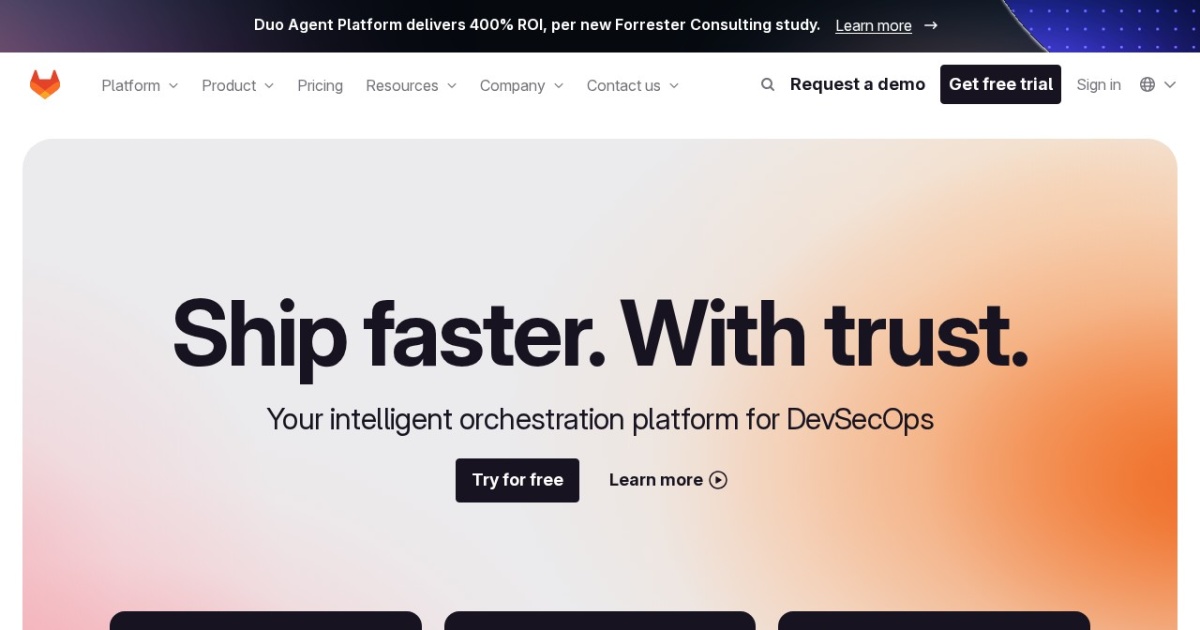
You can clone the brochure in a weekend; you cannot clone the decade-old, GraphQL-powered DevSecOps platform underneath it that powers millions of repos.
The landing page is a weekend clone; the 15-year open-source-rooted platform, millions of active repos, and Microsoft-scale competitive moat are not.
Not worth cloning as a business — the landing page is trivial to prompt but worthless without the product; competing with GitLab requires rebuilding a mature Git/CI/security platform against an entrenched, well-funded incumbent and Microsoft-owned GitHub, which no amount of prompting can shortcut.
Massive and growing: GitLab is a public company (NASDAQ: GTLB) with roughly $1B trailing-twelve-month revenue and double-digit YoY growth, competing in the large and expanding DevSecOps/DevOps-platform market.
$20-100 for a static marketing clone; $10k+ for even a minimal viable Git-hosting + CI backend at small scale
A marketing-page clone alone generates no revenue — GitLab's business model is SaaS/self-managed tiered subscriptions (Free/Premium/Ultimate) plus enterprise contracts, which require the full underlying platform, sales org, and compliance certifications to monetize.
GitHub (Microsoft), Atlassian Bitbucket/Jira, JFrog, CircleCI, Azure DevOps, Sonatype
Freemium tiered SaaS/self-managed subscriptions (Free/Premium/Ultimate) plus large enterprise contracts, driven by AI add-ons like GitLab Duo.
Very large, enterprise-grade traffic (tens of millions of monthly visits across gitlab.com and the hosted product); growing alongside ~25-30% YoY revenue growth.
- Trademark/brand protection on "GitLab" name and logo, competing against a public company with significant legal/IP resources, marketing stack relies on paid third-party SaaS (Marketo, Optimizely, Mutiny) with ongoing licensing costs
Next.js or Nuxt (matching their framework) + Tailwind for the marketing site; if attempting product features, Ruby on Rails/Go + PostgreSQL + Redis + Sidekiq for a real Git backend, GraphQL API layer, OAuth2/SAML auth, Stripe for billing
Nuxt Content or Next.js marketing template for the landing page; GitLab itself is open-source (gitlab-org/gitlab) so the actual product could be self-hosted rather than rebuilt
- 1.Fork a Nuxt/Next.js marketing starter and rebuild the nav, hero, pricing, and solution pages from the crawled HTML/CSS
- 2.Wire up OneTrust for cookie consent, Marketo/Bizible or a simpler CRM (HubSpot) for lead capture forms, and Cloudinary for optimized images
- 3.Add Optimizely or a lightweight A/B testing tool and basic analytics (GA4/Segment) for personalization parity
- 4.If pursuing the actual product (not just landing), skip building from scratch and self-host the open-source GitLab CE/EE codebase instead
- 5.Layer GraphQL API endpoints only if building real product features like issue tracking or CI status dashboards
- 6.Deploy landing page to Vercel/Netlify; reserve Kubernetes-based infra only if self-hosting the real GitLab backend
▸Technical evidencefacade · hidden · 1 signals · DR 92ShowHide
A prompt tool can replicate the Nuxt-based marketing pages — hero sections, pricing tables, feature pages, nav mega-menus, and CDN-served images/videos with reasonable visual fidelity.
Behind the marketing shell sits the actual GitLab product: a full Git hosting/version-control engine, CI/CD runner orchestration, GraphQL API, container registry, security scanning (SAST/DAST), issue tracking, and enterprise auth/billing — plus a marketing stack of Marketo, Bizible, OneTrust, Optimizely, and Mutiny for personalization/consent/analytics.
You could build it — but that moat means you can't win. Find a better bet.
Analyze a different idea →