How is GitHub built — and could you clone it?
Last analyzed 8/10/2026 · full report
https://github.com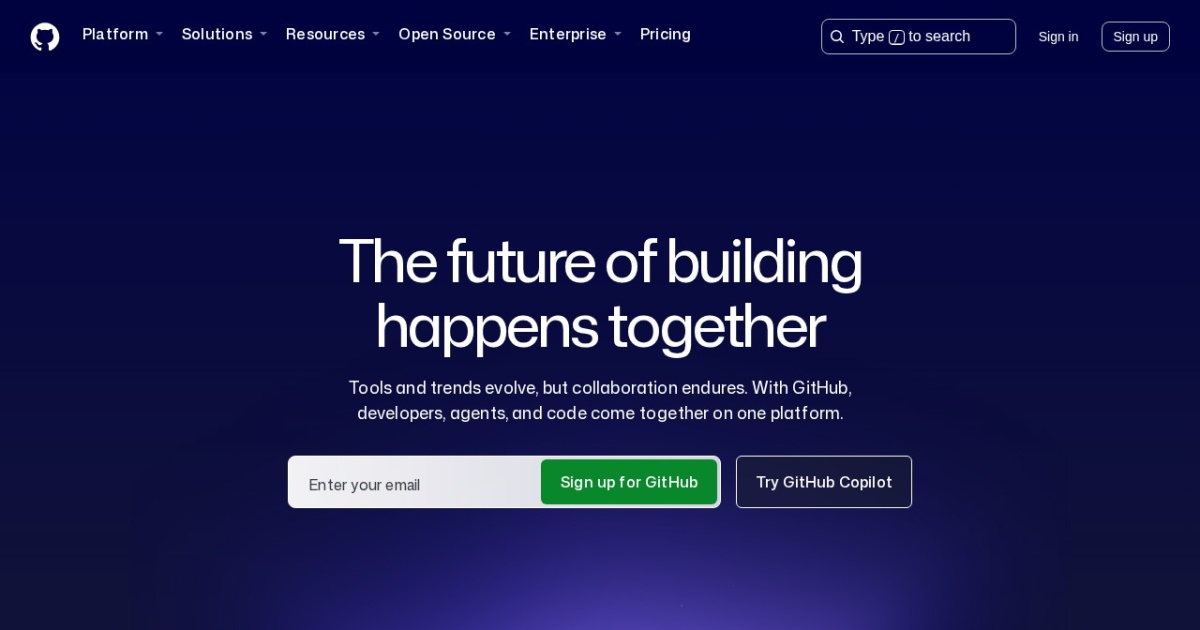
You can clone GitHub's homepage in an afternoon; you cannot clone git hosting for 420 million repos, Actions, Codespaces, or Copilot — that's a decade of infrastructure, not a prompt.
You can clone the pixels in a weekend, but not 150M+ developers, 420M repositories, Microsoft's balance sheet, or the git-hosting network effect that makes GitHub the default.
Not worth cloning as "GitHub" — the landing page is trivial but the actual product (Git hosting + Actions + Codespaces + Copilot) represents billions in infrastructure and a decade-plus network-effect moat; only worth it if your goal is a narrow self-hosted Git tool riding on existing open-source engines like Gitea rather than rebuilding GitHub itself.
Massive and still growing — Git hosting is used by essentially all professional developers, GitHub alone counts 180M+ developers and is projected toward ~$2.8B revenue in 2026, with Copilot alone reaching 4.7M paid subscribers.
$50,000+ at meaningful scale (compute for CI runners, storage for repos, GPU inference for Copilot, global CDN)
A real clone could only ever be a niche self-hosted Git alternative (like Gitea/Forgejo) monetized via enterprise self-hosting fees or hosted SaaS tiers — never competitive with GitHub's scale, but a viable micro-SaaS in narrow verticals (e.g. compliance-focused private Git hosting).
GitLab, Bitbucket, Azure DevOps, Gitea, Codeberg, SourceHut, Cursor (for AI coding)
Freemium developer platform: free public/private repos → paid tiers (Team $4/user/mo, Enterprise ~$21+/user/mo) + Copilot AI add-on ($10-39/user/mo, now usage-based AI Credits) + Marketplace transaction revenue.
Enormous and still growing — 180M+ registered developers, 420M+ repositories, revenue trending toward ~$2.8B in 2026.
- Trademark/brand infringement if cloned as 'GitHub'
- Massive scraping/ToS restrictions on github.com content
- Regulated enterprise compliance features (SSO/SCIM, audit logs) hard to replicate legally without real security certs
- Copilot AI relies on licensed/partnered LLMs (OpenAI/Anthropic) — not freely reproducible
Next.js + Tailwind for the marketing site; if attempting real functionality, fork Gitea/Forgejo (Go) for git hosting + Postgres + Docker-based CI runners + Keycloak/OAuth for auth
Gitea or Forgejo self-hosted Git server as the functional core; Vercel/Next.js template for the marketing pages
- 1.Clone the visual homepage: hero, nav, feature grids, dark/light theme toggle via Tailwind + Next.js
- 2.Stand up Gitea/Forgejo as the actual git storage + web UI backend if real repo hosting is needed
- 3.Add Postgres-backed auth (sessions, OAuth) mimicking /login and /session flows
- 4.Wire a minimal CI runner (e.g. Drone CI or GitHub Actions-compatible runner) for pipeline features
- 5.Integrate a third-party LLM API (OpenAI/Anthropic) behind a chat UI to mimic a 'Copilot'-style assistant
- 6.Build a simple marketplace/plugin directory as a Postgres-backed CRUD app
- 7.Deploy via Docker Compose or Kubernetes; skip trying to replicate Codespaces (use Coder or Gitpod OSS instead)
▸Technical evidencefacade · hidden · 6 signalsShowHide
A prompt can nail the marketing homepage, login page, and Copilot/pricing pages — dark-themed layout, hero copy, feature grids, and static illustrations are all easily reproducible with Tailwind/Next.js.
Behind the facade sits Git's actual object storage and version-control engine at planet scale, a distributed CI/CD system (GitHub Actions running billions of workflow runs), Codespaces cloud dev environments, a Copilot AI stack wired into multiple LLMs with token-based billing, a marketplace/payments platform, enterprise SSO/SCIM auth, and a REST+GraphQL API serving 150M+ developers.
You could build it — but that moat means you can't win. Find a better bet.
Analyze a different idea →