How is Fullstory built — and could you clone it?
Last analyzed 7/24/2026 · full report
https://fullstory.com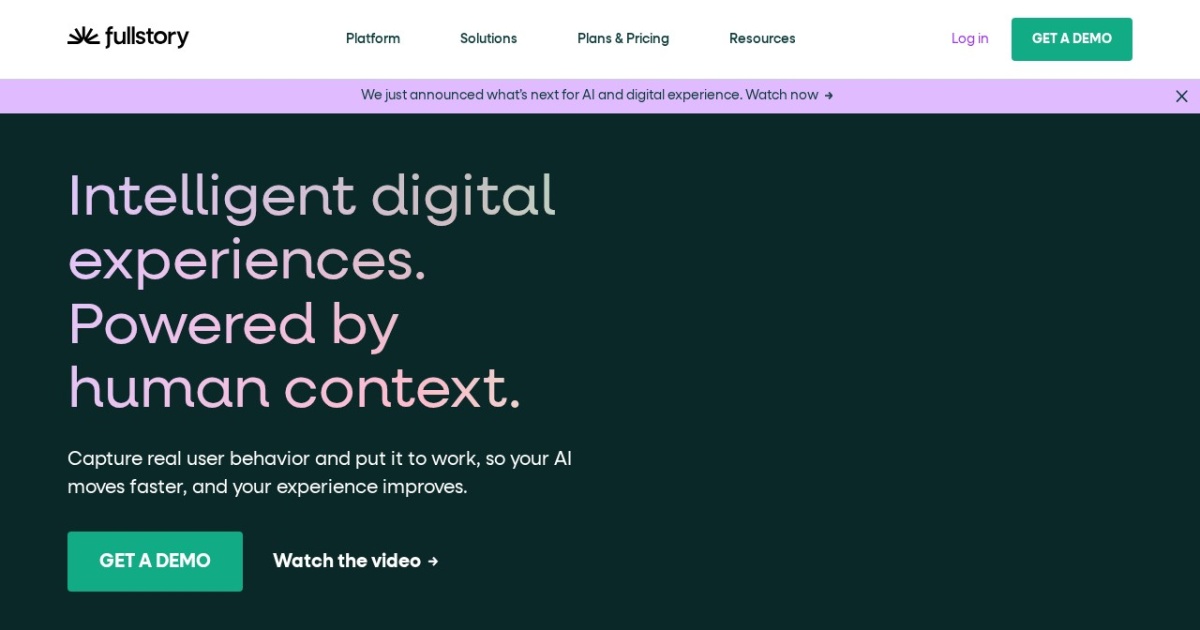
You can clone the pretty brochure in an afternoon, but the actual product is a decade-old, venture-funded data-capture engine processing billions of user sessions — that's not a prompt, that's a company.
You cannot clone $196M in funding, 3,500 enterprise customers, an 11-year-old session-capture engine, or a sales team of 98 quota-carrying reps.
Not worth it as a full clone — the landing page is trivial but valueless without the product, and the product is a multi-year, capital-intensive engineering effort competing against an entrenched $1.8B-valuation incumbent and several well-funded rivals; only worth it if the goal is purely a portfolio/landing-page design exercise.
Large and growing digital experience/session-replay analytics market with dozens of players (LogRocket, Hotjar, Microsoft Clarity, PostHog, Smartlook, Quantum Metric, Contentsquare/Heap), driven by demand for behavioral analytics and AI-assisted UX debugging.
$5k–50k+ at even modest scale (video-grade DOM capture storage, CDN, real-time processing, ML infra) — far beyond typical "$0-20" clone hosting
A cloned landing page generates no revenue by itself; monetizing would require rebuilding the entire capture/replay/analytics engine and underselling on price (as free/cheap competitors like Clarity and PostHog already do), making differentiation and profitability very hard.
LogRocket, Hotjar, Microsoft Clarity, PostHog, Smartlook, Quantum Metric, Contentsquare/Heap, Mouseflow, UXCam, LiveSession
Freemium (free tier up to 1,000 sessions/mo) → custom-quoted Business/Advanced/Enterprise plans requiring sales contact, plus an add-on "Data Direct" warehouse-export product; average contract value reported around $26.6K/year.
Enterprise SaaS with ~3,500 customers and ~$93M estimated 2024 revenue — large, established, still growing via enterprise/mid-market expansion.
- Trademark/brand infringement if cloning name/design closely
- Session-recording of end users raises GDPR/CCPA/HIPAA compliance obligations
- Competing against a well-capitalized incumbent with patents/proprietary capture tech
- Data privacy liability from capturing PII in DOM recordings
Next.js + Contentful (CMS) + Vercel for the marketing site only; if attempting real replay: rrweb (open-source DOM recording) + ClickHouse/S3 for event storage + Node/Go ingestion service + Postgres for metadata + Auth0/Clerk for auth
Vercel's Next.js + Contentful starter for the marketing site; rrweb-io/rrweb-io monorepo as a base for any real session-replay attempt
- 1.Scaffold Next.js site and port hero/feature sections, side-scroll galleries, and CTAs from the crawled HTML/CSS modules
- 2.Wire a headless CMS (Contentful) for blog/feature copy so marketing can edit without redeploys
- 3.If pursuing the product, integrate rrweb on the client to capture DOM mutations and ship events to an ingestion API
- 4.Stand up an ingestion + storage pipeline (Kafka/Kinesis → S3/ClickHouse) to handle high-volume session events
- 5.Build a session player UI that replays captured rrweb events, plus basic search/filtering
- 6.Add auth (Clerk/Auth0) and a billing layer (Stripe) gated by usage/session volume
- 7.Layer in basic 'frustration signal' heuristics (rage clicks, dead clicks) before even considering AI summarization
▸Technical evidencefacade · hidden · 7 signals · DR 84ShowHide
A prompt tool can nail the Gatsby-based marketing site — hero sections, feature pages, side-scroll galleries, CTAs, and CMS-driven content blocks pulling from a headless CMS like Contentful.
Behind the marketing shell sits a mature session-recording SDK that captures full DOM/mouse/click streams from millions of end-user browsers, a massive ingestion + storage pipeline for petabytes of replay data, real-time indexing/search across sessions, AI models for rage-click/frustration detection and session summarization, mobile SDKs (iOS/Android), a GraphQL API layer, enterprise auth/SSO, data warehouse export ("Data Direct"), and compliance-grade PII masking — none of which is visible in the crawled HTML/JS.
You could build it — but that moat means you can't win. Find a better bet.
Analyze a different idea →