How is Fireflies.ai built — and could you clone it?
Last analyzed 7/19/2026 · full report
https://fireflies.ai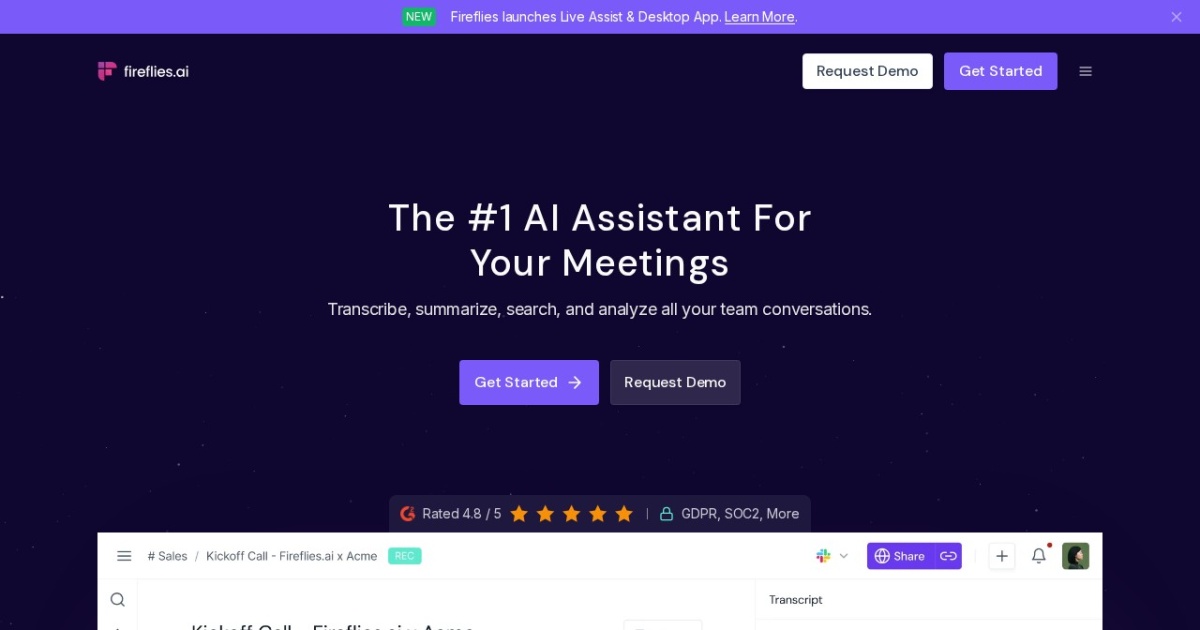
You can clone the marketing shell in an afternoon, but the actual product — a real-time meeting-bot + speech-AI pipeline serving 35K customers — is years of infra you cannot prompt into existence.
The landing page is a weekend clone; the $1B-valued speech-AI platform with 35K customers and a decade of integrations is not.
The landing page alone isn't a business — it's just a shell. The real product requires building and maintaining a meeting-bot fleet, ASR pipeline, and LLM summarization at scale, competing against 30+ funded rivals and a $1B incumbent; not worth it unless you have deep ML/infra resources and a differentiated angle.
Huge and growing — AI meeting assistants are a hot category with dozens of funded competitors (Otter, tl;dv, Fathom, Gong, Read AI, MeetGeek, Avoma); Fireflies alone hit a reported $1B valuation with ~35K customers and ~$10.9M ARR.
$500-5,000+ (speech-to-text API costs, bot infra to join calls, LLM API calls, hosting) scaling with usage — real transcription/LLM costs dominate, not just hosting
A clone could monetize via the same per-seat SaaS model (free/pro/business/enterprise tiers) but margins depend heavily on managing speech-to-text and LLM inference costs at scale; without the integrations/brand it would only compete on price in an already crowded, commoditizing market.
Otter.ai, tl;dv, Fathom, Gong, Read AI, MeetGeek, Avoma, Recall.ai, Chorus, Clari Copilot
Freemium SaaS: Free tier, then per-seat annual pricing (~$10/$19/$39 per user/month for Pro/Business/Enterprise) plus a consumable AI-credits add-on system for advanced summarization features.
Large and growing — reported ~35K customers, $1B valuation as of late 2025, and heavy category growth as AI meeting assistants proliferate.
- Recording/transcribing calls raises consent/wiretapping law considerations in some jurisdictions
- Heavy reliance on third-party ASR/LLM APIs for core function (cost + dependency risk)
- HIPAA/compliance claims require real certification, not just a landing-page promise
- Crowded, well-funded competitive space (30+ funded rivals)
Next.js (App Router) + Tailwind for the marketing site; for a real product: Node/Python backend, PostgreSQL, Recall.ai or custom bot SDK to join Zoom/Meet/Teams, Deepgram/Whisper for ASR, OpenAI/Anthropic for summarization, Stripe for billing, Auth0/Clerk for auth
Vercel Next.js SaaS starter (for landing+pricing) plus Recall.ai's meeting-bot API as the fastest path to the core join/record/transcribe loop
- 1.Fork a Next.js marketing template and rebuild hero/pricing/enterprise pages with Tailwind matching the visual style
- 2.Wire Stripe Checkout + a pricing table matching Free/Pro/Business/Enterprise tiers
- 3.Integrate Recall.ai (or build custom bots via Zoom/Meet/Teams SDKs) to join calls and capture audio
- 4.Pipe audio to Deepgram/Whisper for transcription, then to an LLM for summaries, action items, and topic tracking
- 5.Add a GraphQL API layer (Apollo/Hasura) exposing transcripts/notes for the dev-platform story
- 6.Build CRM integrations (Salesforce/HubSpot webhooks) and Slack app for parity with 'slack-assistant' feature
- 7.Add SSO/HIPAA controls and audit-log endpoints for an enterprise tier
▸Technical evidencefacade · hidden · 7 signalsShowHide
A prompt can nail the Next.js marketing site — hero, pricing table, feature pages, cookie banner, nav — in an afternoon since it's standard React/Tailwind components with static content.
Behind the page sits a full meeting-bot fleet that joins Zoom/Meet/Teams calls in real time, a speech-to-text pipeline, an LLM summarization/analytics layer (AskFred, topic tracking, live assist), a GraphQL API/dev platform, CRM integrations (Salesforce/HubSpot), voice agents, SSO/HIPAA-grade enterprise security, and billing/affiliate infra (FirstPromoter) — none of which is visible in the HTML.
You could build it — but that moat means you can't win. Find a better bet.
Analyze a different idea →