How is Feedly / Feedly Threat Intelligence built — and could you clone it?
Last analyzed 10/8/2026 · full report
https://feedly.com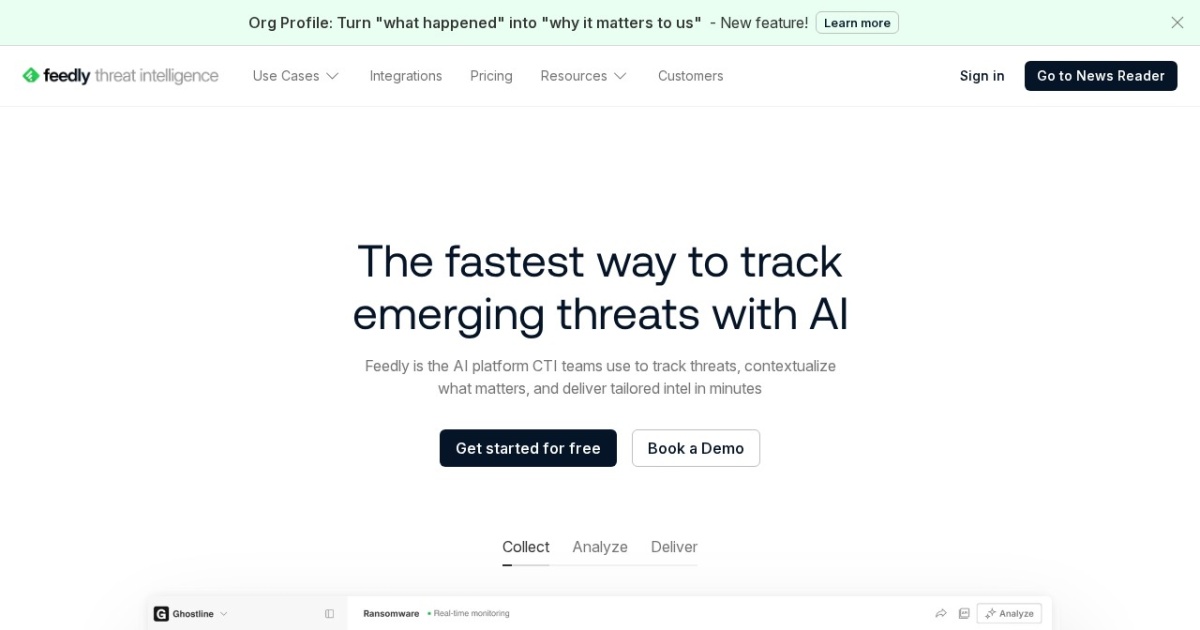
You can clone the glossy landing page in an afternoon, but Feedly's actual product is a decade of crawling infrastructure and AI pipelines a prompt will never touch.
The landing page is a weekend clone; the 18-year content index, AI enrichment pipeline, and enterprise security-team trust are not.
Not worth it as a full clone — the landing page is trivial but the real product (content crawling at scale + AI threat enrichment + enterprise integrations) represents years of engineering and data-pipeline investment that no prompt sequence reproduces; only worth it if the goal is a portfolio-piece landing page, not a competing business.
Threat intelligence platforms (TIP) are a growing cybersecurity subsegment as enterprises need faster vulnerability/CVE and threat-actor monitoring; Feedly bootstrapped to an estimated $7.3M in annual revenue in 2025 with 66 employees and broader Feedly.com draws 14.9M total visits per month, showing durable demand for both the consumer RSS reader and enterprise TI product.
$500-$3,000 for a minimal clone (hosting, a vector DB, LLM API calls for 'Ask AI'-style features, a basic crawler) — but scales fast with real crawling/data volume
A cloned landing page alone generates no revenue; monetizing would require rebuilding genuine content ingestion + AI enrichment, which is exactly the multi-year moat competitors like Recorded Future and CrowdStrike already own, making profitable competition very hard without a differentiated data source.
Recorded Future, CrowdStrike Falcon Intelligence, Cloudflare, Intezer, Cyble, CloudSEK, Inoreader, NewsBlur, Flipboard
B2B SaaS, annual contracts: Feedly Threat Intelligence starts at $19,200 per year for the Standard plan, which includes up to 10 users, with an Advanced plan at $38,400 per year supporting up to 25 users; the consumer Feedly reader runs a freemium model with paid Pro tiers.
~15M visits/mo across feedly.com, flat-to-growing per recent estimates
- Trademark/brand overlap with 'Feedly' name if cloned directly
- Enterprise TI data sourcing often involves licensed/aggregated threat feeds with usage restrictions
- Customer logos/testimonials on /customers page are proprietary brand assets, not reusable
Next.js (App Router) + Tailwind for the marketing site; Supabase/Postgres for any lead-gen form data; Stripe for self-serve pricing page checkout if desired; Vercel for hosting
Vercel's official Next.js SaaS marketing template or Taxonomy starter
- 1.Scaffold Next.js project and port the header/nav, hero, and footer structure seen in the crawled HTML
- 2.Rebuild pricing, integrations, and customers pages as static SSG routes pulling from a local JSON/CMS (Sanity or Contentful) for easy content edits
- 3.Add a Calendly or HubSpot embed for the /book-demo route instead of building custom scheduling
- 4.Wire a simple contact/demo-request form to a serverless function + email (Resend/SendGrid) or CRM webhook (HubSpot/Salesforce)
- 5.Add Mux or Cloudinary for hero product-demo video embeds mirroring the observed stream.mux.com usage
- 6.Stop there for the facade — do NOT attempt to rebuild the actual crawler/AI backend; that is a multi-year systems project outside prompt-based scope
▸Technical evidencefacade · hidden · 6 signalsShowHide
A prompt can easily recreate the marketing site: Next.js landing page, pricing table, integrations grid, customer logos, and a book-demo CTA.
Behind the marketing shell sits a 15+ year RSS/content aggregation engine crawling and indexing millions of sources in real time, plus an AI-driven threat-intel pipeline (entity extraction, CVE/threat-actor enrichment, Ask AI, Intel Agents, Report Builder, Real-Time Threat Graph) and dozens of SIEM/SOAR/ticketing integrations — none of which is visible in the crawled HTML/JS.
You could build it — but that moat means you can't win. Find a better bet.
Analyze a different idea →