How is Dropbox built — and could you clone it?
Last analyzed 7/14/2026 · full report
https://dropbox.com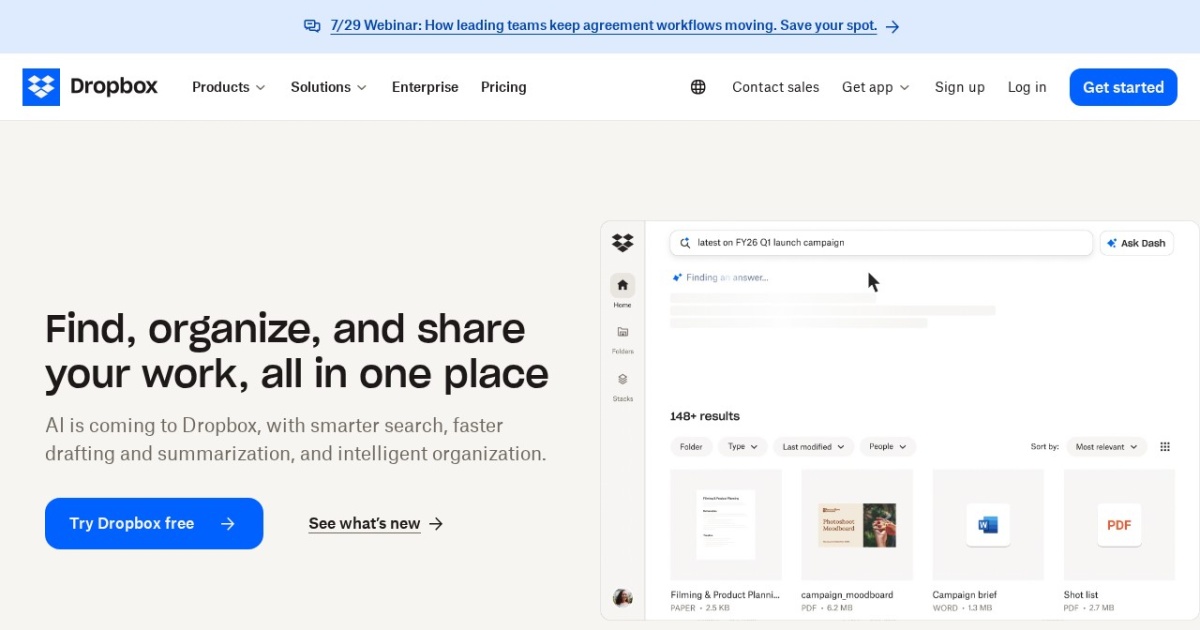
You can clone the Dropbox homepage in an afternoon; you cannot clone 18 years and billions of dollars of distributed storage engineering.
You can clone the homepage in a weekend, but not 1.1 billion accounts, exabytes of stored data, and a 18-year trust relationship with enterprises.
Not worth cloning as a business — the market is dominated by Google/Microsoft bundling free storage, and Dropbox itself is barely growing; only worth it as a portfolio/demo project to practice building file-upload UI and marketing pages, not as a real venture.
Cloud storage/file-sync is a mature, massive market; Dropbox generates roughly $2.5B/year in revenue but is a distant second to Google Drive and slow-growing (~-1% YoY in 2025), facing intense competition from bundled offerings.
$50-500 (basic S3/object-storage clone at small scale) — real Dropbox-scale infra costs hundreds of millions/year
A landing-page clone alone earns nothing; a real competitor would need to monetize storage subscriptions, but object storage (S3/Backblaze) + a sync client is commodity-priced and margins are thin unless you reach massive scale like Dropbox's ~80% gross margin.
Google Drive","Microsoft OneDrive","Box","iCloud","pCloud","Sync.com
Freemium cloud storage: free tier + paid Plus/Professional/Business tiers (~$10-25/mo), plus enterprise seats and add-on products (Sign, Replay, Dash) sold via sales-led and self-serve channels.
Tens of millions of monthly visits to dropbox.com; 700M+ registered users, ~1.1B total accounts, flat-to-declining core revenue trend.
- Trademark/brand protection (Dropbox name/logo)
- Enterprise data compliance (SOC2/GDPR) required for any real competitor
- Massive capital requirements to compete on storage economics
- Network effects from existing enterprise integrations hard to replicate
Next.js + Tailwind for the marketing site; if attempting real file storage, Supabase Storage or AWS S3 + Postgres for metadata + Auth0/Clerk for auth + Stripe for billing
Vercel's Next.js SaaS starter or Tailwind UI marketing template
- 1.Scaffold Next.js site with Tailwind, clone hero/nav/footer sections from the landing page
- 2.Build static pricing and product sub-pages (Dropbox, Replay, Sign, DocSend) as separate routes
- 3.Add a basic file-upload demo using S3-compatible storage (Supabase Storage) to fake 'sync'
- 4.Integrate Stripe Checkout for fake subscription tiers
- 5.Add Clerk/Auth0 for login/signup flows to mimic account gating
- 6.Skip real-time sync engine and enterprise admin — out of scope for a prompt-built clone
- 7.Deploy to Vercel with a custom domain
▸Technical evidencefacade · hidden · 1 signals · DR 94ShowHide
A prompt tool can replicate the marketing homepage: hero sections, product tiles (Dropbox, Replay, Sign, DocSend), pricing tables, and responsive nav/footer using a modern CSS framework.
Behind the facade sits a global distributed file-storage and sync engine (exabytes of data across 700M+ accounts), real-time sync protocols, e-signature and video-review products (Sign, Replay), enterprise SSO/admin consoles, billing/subscription infra, and an entire CRM/marketing personalization stack (Coframe A/B testing, JWT-based UX variant tokens) plus analytics/observability pipelines.
You could build it — but that moat means you can't win. Find a better bet.
Analyze a different idea →