How is Datadog built — and could you clone it?
Last analyzed 7/25/2026 · full report
https://datadoghq.com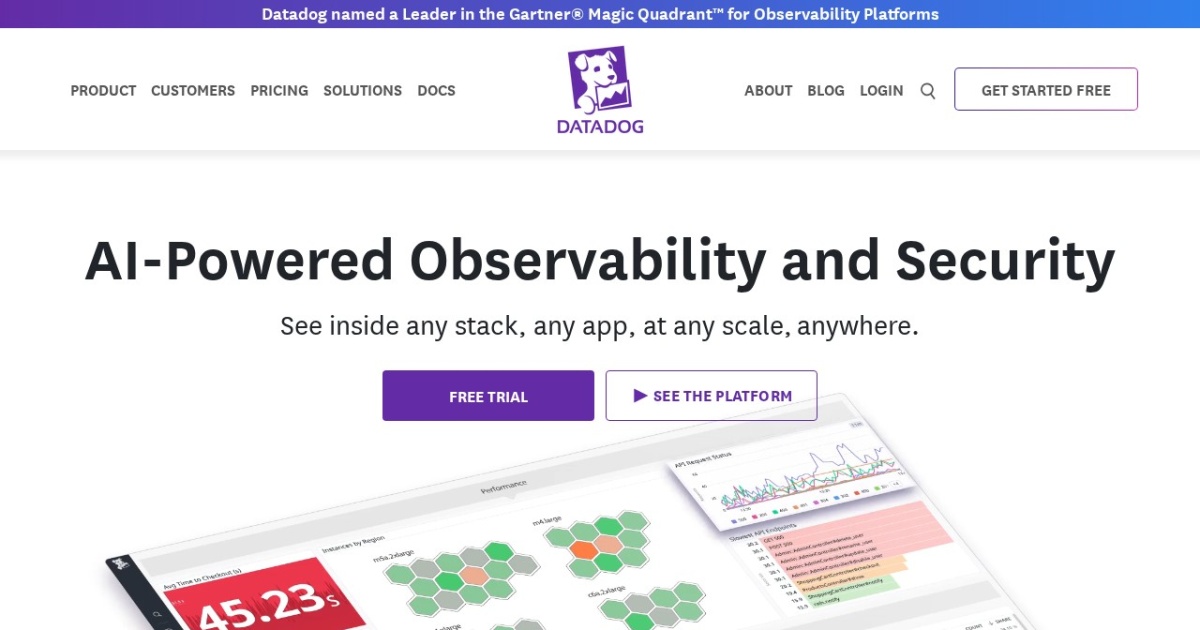
You can clone the homepage in an afternoon; you cannot clone a $3.4B/year observability platform with a decade of distributed-systems engineering behind it.
The landing page is a weekend clone; the 28,000+ enterprise customers, decade of agent/integration engineering, and $3.4B ARR moat are not.
Not worth cloning as a business — the landing page is trivial but valueless alone, and the real product is a decade-deep, capital-intensive distributed systems company competing against entrenched public players; only sensible use is as a design/copy reference, not a competitive clone.
Observability/cloud-monitoring is a large, fast-growing market; Datadog operates in a large, growing TAM with a clear, high-growth sub-segment (AI observability) where it already holds a leading position. Datadog recorded USD 3.3 billion revenue in 2025 and continues platform expansion via acquisitions of Eppo and Metaplane.
$0-20 for a static landing-page clone; the real product would cost tens of thousands/month minimum in infra (Kafka/Cassandra-scale storage, global compute) to operate at any real scale
A cloned landing page has no standalone monetization path — the value is entirely in the underlying monitoring product, which requires years of engineering; not a viable solo/indie business to compete on.
New Relic, Splunk (Cisco), Dynatrace, Grafana Labs, Elastic, AppDynamics (Cisco), Sentry, LogicMonitor
Usage-based SaaS subscriptions across dozens of modules (infra monitoring, APM, logs, security, RUM) plus enterprise contracts; Datadog's Q4/FY2025 results delivered $953M revenue (+29% YoY), FY2025 total $3.43B (+28%), with bookings at record $1.63B (+37%)—driven by 120% NRR, 603 $1M+ ARR customers.
Massive and growing enterprise adoption; from a single domain in December 2015, the platform reached 17,762 active domains by March 2025, a compound growth rate that dwarfs most monitoring tools.
- Datadog trademark/brand — cannot reuse name, logo, or copy verbatim
- Public company (DDOG) with legal resources to pursue copycats
- Any real clone competing on monitoring data would face massive infra costs and no data moat
Next.js (static export) + Tailwind + Algolia/Typesense Cloud for search + Segment/GTM for analytics + Vercel hosting
Next.js marketing template (e.g. Vercel's 'Nextra' or a Tailwind UI landing kit)
- 1.Scaffold a Next.js static site and port hero, feature-grid, and logo-wall sections from the crawled HTML
- 2.Wire up a Typesense Cloud (or Algolia) instance with public search-only API key for the /search page
- 3.Add GTM + a CDP script (Segment/MetaRouter) for marketing analytics parity
- 4.Recreate the animated product screenshots/illustrations as static images or Lottie animations
- 5.Stub a fake '/trial' signup form posting to a serverless function or Marketo-like webhook
- 6.Deploy static build to Vercel/Netlify with CDN caching for the marketing shell only
- 7.(Out of scope) Do NOT attempt to clone the actual monitoring product — that requires a real ingestion pipeline, time-series DB, and agents, which is a multi-year, multi-engineer effort
▸Technical evidencefacade · hidden · 5 signals · DR 88ShowHide
A prompt can rebuild this static Hugo-generated marketing homepage — hero copy, product tiles, logos, animations, and a hosted Typesense/Algolia search widget — in a single sitting.
Behind the marketing shell sits Datadog's actual product: agents collecting metrics/traces/logs from millions of hosts, a petabyte-scale ingestion and storage pipeline, real-time stream processing, APM distributed tracing, ML-based anomaly detection, a full SaaS billing/usage-metering system, SSO/RBAC auth, 800+ third-party integrations, and a global multi-region infrastructure footprint — none of which is visible in the crawled HTML/JS.
You could build it — but that moat means you can't win. Find a better bet.
Analyze a different idea →