How is Craft.do built — and could you clone it?
Last analyzed 10/4/2026 · full report
https://craft.do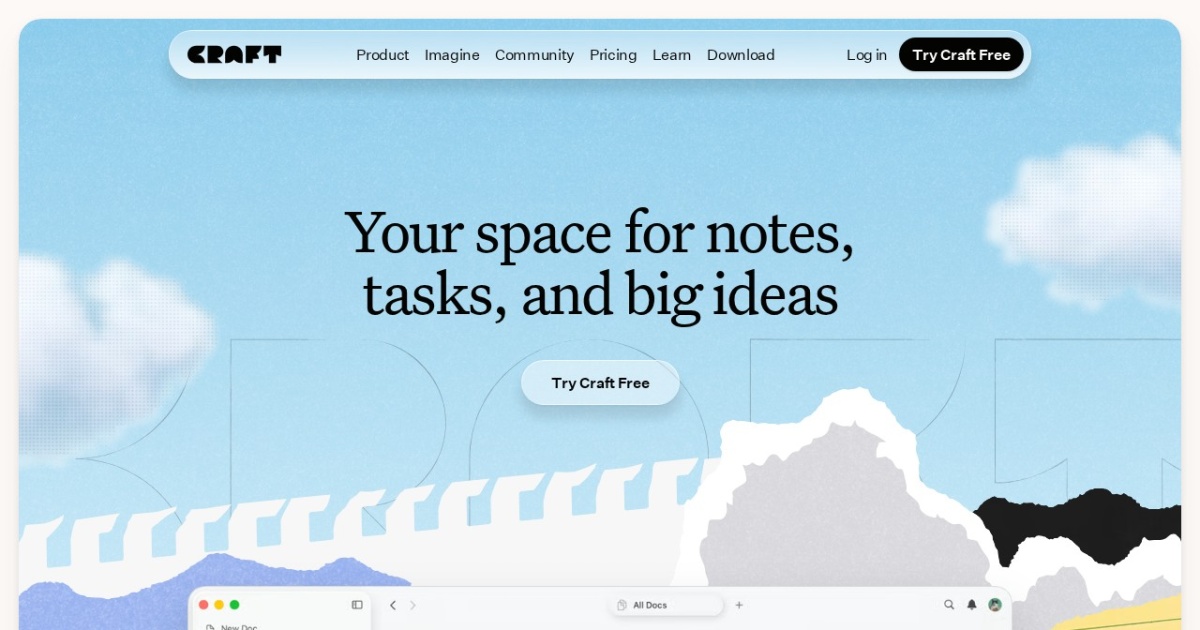
You can clone the pretty Next.js website in a weekend, but Craft the product is a $20M, six-year, multi-platform sync engine — not a prompt away.
The marketing page is a weekend clone; the 2M-install native sync engine, $20M in funding, and Apple-native polish that users pay a premium for are not.
Not worth it as a real business clone — the market is real but dominated by Notion and well-funded Craft itself ($20.2M raised, 450K+ MAU); the landing page is trivial to copy but has zero value without the native sync/offline/AI engine behind it, which is a multi-year, capital-intensive build. Only worth it as a portfolio/landing-page exercise, not a competing product.
Note-taking/productivity is a large, crowded market anchored by Notion (100M+ users); Craft has carved a smaller premium niche with "Monthly active users (MAUs) hit 450,000+ in Q2 2026, with 50% growth YoY" and "Estimated annual recurring revenue (ARR) stands at approximately $7.6 million in 2026".
$50-200 for a landing-page-only clone (hosting + domain); $5,000-20,000+/mo to run a real sync/AI backend at any scale (DB, object storage, CRDT infra, LLM API costs, mobile push, CDN)
A cloned landing page alone generates no revenue; monetizing would require rebuilding the actual freemium subscription product (~$5-9/mo Pro tiers per competitor research) which demands the full native-app/sync stack, making profitability contingent on the unclonable backend.
Notion, Obsidian, Bear, Apple Notes, Evernote, Coda, Roam Research
Freemium SaaS: free tier with limited blocks/documents, Pro/Plus plans around $5-9/user/month, Friends & Family and Team tiers, plus a custom Enterprise tier with SSO/compliance features.
Mid-size but growing — company reports 450K+ MAU in 2026 with 50% YoY growth and 2M+ cumulative installs, far smaller than Notion's 100M+ user base.
- Trademark/brand name collision if cloned under similar name
- Public API (connect.craft.do) likely has its own ToS restricting scraping/reuse
- AI features rely on third-party LLM provider terms (OpenAI/GPT-4o) which carry usage/licensing constraints
Next.js (App Router) + Tailwind + Vercel for the marketing site; if attempting the real product: Supabase/Postgres or custom CRDT backend (e.g. Automerge/Yjs) + S3-compatible object storage + Electron/Capacitor or native Swift/Kotlin clients + OpenAI API for AI features
Vercel's Next.js marketing starter or Taxonomy/shadcn-ui template for the landing page
- 1.Scaffold Next.js app with App Router, set up locale routing ([locale]) mirroring craft.do's i18n structure
- 2.Build the marketing pages (home, /pricing, /imagine, /learn) using Tailwind + shadcn components, replicate the glass-effect nav and SVG logo
- 3.Wire up Plausible analytics and a simple waitlist/signup form posting to a serverless function or Supabase table
- 4.If pursuing the real app: pick a CRDT library (Yjs/Automerge) for offline-first sync, stand up a Postgres + websocket relay backend for multi-device merge
- 5.Build a single web-based rich text editor (e.g. ProseMirror/Tiptap) before attempting native clients
- 6.Integrate OpenAI/GPT-4o for AI assist features behind a usage-metered API gateway
- 7.Add Stripe for freemium subscription billing once the editor and sync are stable
▸Technical evidencefacade · hidden · 6 signalsShowHide
A prompt can nail the Next.js marketing site — hero, pricing grid, nav mega-menus, localized pages, glassmorphism header, blog/learn hub — in an afternoon.
Behind the marketing shell sits a full cross-platform native document app (Mac/iOS/Windows/Android/web) with offline-first local storage, real-time multi-device sync/CRDT merge engine, sharing/collaboration permissions, an AI assistant pipeline (GPT-4o + on-device models), a public developer API (connect.craft.do/api-docs) and MCP integrations for ChatGPT/Claude — years of systems engineering invisible to the crawl.
Clonable and beatable — the fun kind.
Get the full build plan →