How is Close CRM built — and could you clone it?
Last analyzed 7/21/2026 · full report
https://close.com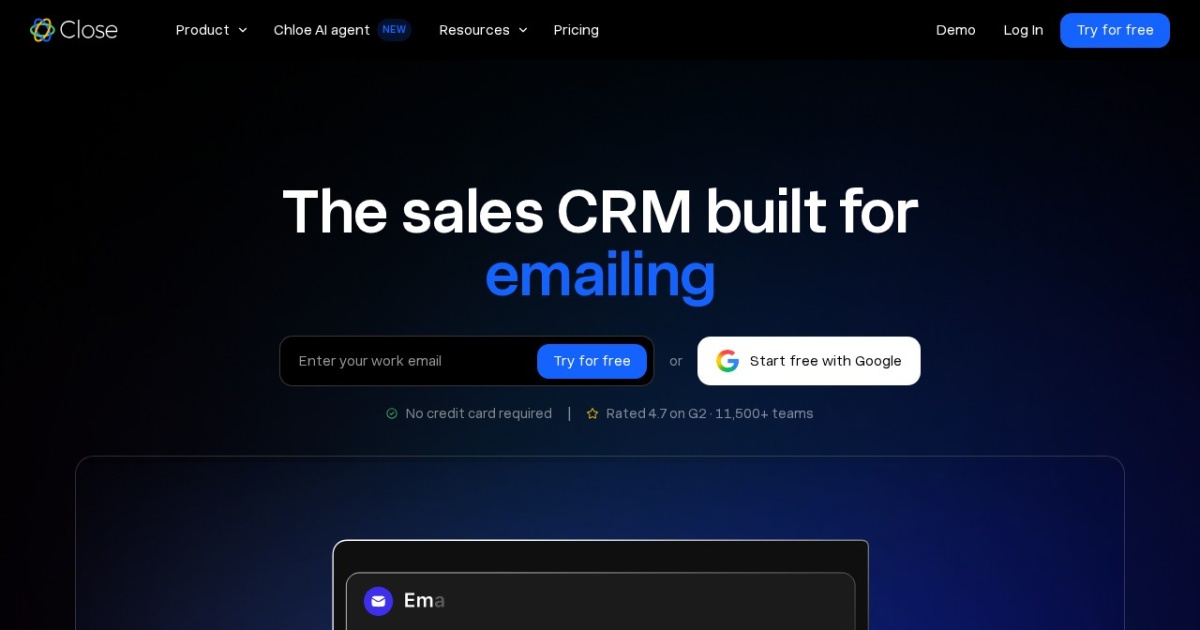
You can clone the marketing site in an afternoon, but "Close" is a decade-old telephony-and-AI sales engine wearing a Webflow t-shirt.
The landing page is a weekend Webflow clone; the 13-year-old telephony infrastructure, carrier relationships, AI calling agent, and installed base of thousands of sales teams are not.
Not worth cloning as a real business — the landing page is trivial but valueless alone, and the actual product (telephony, SMS, automation, AI calling agent, reporting) is a multi-year, capital-intensive build competing in an oversaturated market against entrenched players; only worth it as a portfolio/demo exercise in Webflow-style design cloning.
CRM software is a massive, crowded market (projected to surpass $112B in 2025); Close occupies a mid-market outbound/calling-focused niche with reported ~$27M estimated annual revenue and ~180 employees.
$500-5k+ for a minimal clone (hosting, Twilio/telephony, SendGrid-style email, DB, AI API calls) — scales fast with call/SMS volume
A cloned landing page alone earns nothing; monetizing would require actually building and running the CRM + telephony stack, which carries real per-minute/per-message variable costs and competes against 4,000+ funded CRM competitors, most already at feature parity or ahead.
HubSpot, Salesforce, Pipedrive, Freshsales/Freshworks, Attio, Copper, Zoho CRM
Per-seat SaaS subscription: Solo $9/user/mo, Essentials $35/user/mo, Growth $99/user/mo, Scale $139/user/mo (annual billing), plus usage-based add-ons for calling minutes/SMS and enterprise custom pricing.
Small-to-mid B2B SaaS scale (~150 reported customer companies in one tracking dataset, ~180 employees, ~$27M estimated ARR) — steady/growing niche player, not a mass-market consumer site.
- Telephony/SMS carrier compliance (TCPA, A2P 10DLC registration) if cloning calling/SMS features
- Trademark/brand similarity risk if visually copying Close's site closely
- Segment/Amplitude/PartnerStack third-party ToS for embedding their scripts
- AI auto-dialing agent raises regulatory scrutiny (robocall/consent laws)
Next.js + Tailwind for the marketing site; Supabase (Postgres/auth) + Twilio (calling/SMS) + Postmark/SendGrid (email) + a workflow engine (Temporal or simple cron/queue) + OpenAI API for an AI calling/qualification agent, deployed on Vercel
Vercel/Next.js SaaS starter or a Webflow-cloned template for the marketing pages, paired with the Supabase Next.js auth starter for the app shell
- 1.Clone the Webflow marketing pages (hero, feature pages like /crm, /automation, /communication) 1:1 using a scraped HTML/CSS starter
- 2.Stand up auth + multi-tenant Postgres schema (leads, contacts, pipelines, deals) via Supabase
- 3.Integrate Twilio Voice + Programmable SMS for the power dialer / calling feature, and SendGrid/Postmark for bulk email sequences
- 4.Build a workflow/automation engine (trigger-action rules) using a queue (BullMQ/Temporal) for the /automation feature set
- 5.Wire an LLM agent (OpenAI/Anthropic function-calling) to autonomously place calls, log outcomes, and update CRM records for a 'Chloe'-style AI teammate
- 6.Add Stripe billing for seat-based subscription tiers and a reporting dashboard querying the Postgres data
- 7.Layer Segment + Amplitude for product analytics and a PartnerStack-style affiliate program if going to market
▸Technical evidencefacade · hidden · 9 signals · DR 80ShowHide
A prompt can quickly reproduce the Webflow-built marketing pages (hero, feature grids, pricing comparisons, nav, animations) since it's static content with third-party analytics scripts bolted on.
Behind the signup form (app.close.com) sits a full multi-tenant CRM: built-in VoIP calling/power dialer, SMS, email sending infrastructure, an automation/workflow engine, an AI "Chloe" sales agent that autonomously calls and qualifies leads, reporting/analytics pipelines, and a public developer API/MCP server — none of which is visible in the crawled HTML.
You could build it — but that moat means you can't win. Find a better bet.
Analyze a different idea →