How is Alfred App built — and could you clone it?
Last analyzed 10/1/2026 · full report
https://alfredapp.com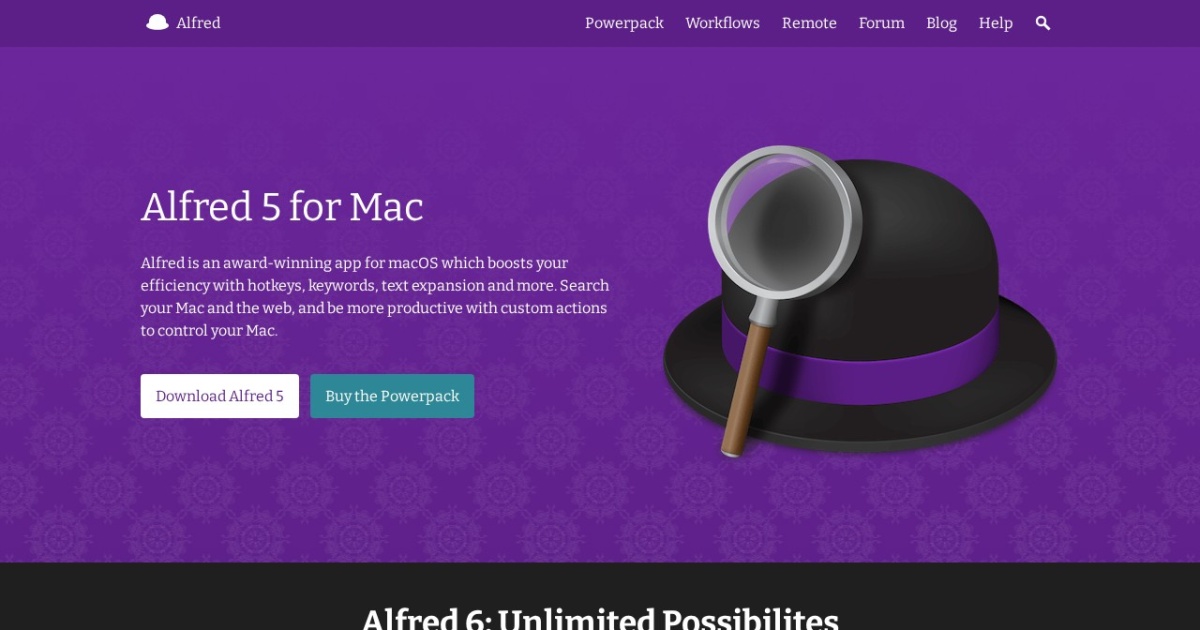
You can clone the brochure in an afternoon, but Alfred's actual product is a 15-year-old native macOS automation engine that no web prompt will ever touch.
The landing page is a free afternoon's work, but Alfred's real moat is 15+ years of native macOS engineering, a loyal power-user community, and thousands of community-built workflows you can't fork.
The landing page itself is worthless to clone standalone — the business value lives entirely in the native macOS app, workflow ecosystem, and license infrastructure, none of which a prompt can produce; not worth it unless you're committed to building a real macOS automation product over months.
Mac productivity launchers are a durable niche market with strong power-user demand; Alfred's main rival Raycast has gained significant momentum with a modern UI and AI features, intensifying competition in 2026.
$20–100 (static site hosting + CDN for DMG downloads + license server)
Alfred monetizes via a one-time Powerpack purchase (roughly £34/$43 single license, £59/$74 Mega Supporter lifetime), not a subscription; a clone would need the same perpetual-license e-commerce plus the actual native app to have any value, since the website alone generates no revenue.
Raycast, Spotlight, Quicksilver, LaunchBar, Keyboard Maestro
Freemium macOS app: free core launcher, with a one-time perpetual Powerpack license (~£34/$43 single, ~£59/$74 Mega Supporter lifetime upgrades) unlocking workflows, clipboard history, snippets, and automation — no subscription.
Established long-tail traffic within the Mac power-user niche; likely flat-to-modest growth as Raycast captures newer/younger developer mindshare.
- Trademark/brand recognition (15+ year established name)
- Native macOS app functionality cannot be replicated by web prompting
- Community workflow ecosystem (Packal, forums) is a non-transferable network asset
Marketing site: Next.js (static) + Vercel. Actual product (if attempting the real app): Swift/AppKit native macOS app + SQLite for local data + Sparkle for auto-updates + Paddle/FastSpring for perpetual license billing + a lightweight license-validation API (Node/Postgres) + SwiftUI iOS app for Remote.
Next.js marketing template (e.g. Vercel's 'Nextjs-landing-page' starter) for the site; for the real app there is no viable AI-prompt starter — would require forking an open-source launcher like 'Raycast'-style Electron shell or building native Swift from scratch.
- 1.Clone the static HTML structure (nav, hero, feature sections, pricing) into Next.js components
- 2.Recreate the CSS styling (fonts, awards strip, feature grid icons) from the crawled stylesheet
- 3.Wire up /blog and /help as MDX-powered static content routes
- 4.Stand up a simple Paddle/Stripe checkout for a one-time 'license' SKU to mimic /shop
- 5.If pursuing the real product: start a native Swift/AppKit shell with a global hotkey + Spotlight metadata query integration
- 6.Build a minimal workflow engine (JSON-defined trigger→action chains executing shell/AppleScript) as the MVP automation core
- 7.Add a license-key generation + validation microservice and gate Powerpack features behind it
▸Technical evidencefacade · hidden · 7 signalsShowHide
A prompt can trivially clone the static marketing site — nav, hero, feature grid, pricing section, and blog/help links — it's plain HTML/CSS with no interactivity.
The real product is a native macOS application (deep OS-level hooks into Spotlight indexing, AppleScript/JS/Python/Bash workflow execution engine, clipboard manager, file system actions, music app control) plus a license-key generation/activation and e-commerce system, a companion iOS Remote app, and a community workflow-sharing ecosystem — none of which is visible in the crawled HTML/JS.
You could build it — but that moat means you can't win. Find a better bet.
Analyze a different idea →